
Choosing between a custom bathroom vanity vs premade comes down to what matters most to you, budget, design control, or long-term durability. Both options have real advantages, and neither is universally "better." The right pick depends on your bathroom’s layout, your timeline, and how much flexibility you need in materials, sizing, and style.
A premade vanity gets you a functional piece fast and at a lower upfront cost. A custom vanity lets you build around your exact space, especially useful in older Cape Cod homes where standard dimensions rarely cooperate with existing plumbing or tight floor plans. That’s a tradeoff worth understanding before you commit either way.
At Suman Custom Carpentry, we design and hand-build custom vanities at our shop in Hyannis, so we’ve seen firsthand where each option makes sense, and where it doesn’t. This article breaks down the real cost differences, quality considerations, and practical pros and cons of both routes so you can make a confident decision for your bathroom remodel.
What counts as custom vs premade vanities
When you’re comparing a custom bathroom vanity vs premade, the core difference is in how the piece is made and where it comes from. A premade vanity is manufactured in bulk at a factory, finished before it ships, and sold in fixed sizes and standard configurations. You pick from whatever the manufacturer offers, typically widths in 24", 30", 36", 48", or 60" increments, and you adapt your bathroom to fit it.
How premade vanities are built and sold
Premade vanities arrive ready to install. You’ll find them at big-box retailers, online, or through plumbing supply houses. Most use particleboard or MDF carcasses with a wood veneer or thermofoil finish. Some higher-end premade options use solid wood doors, but the box construction is almost always engineered wood. The advantage is speed and price. The limitation is that you work around the product, not the other way around.
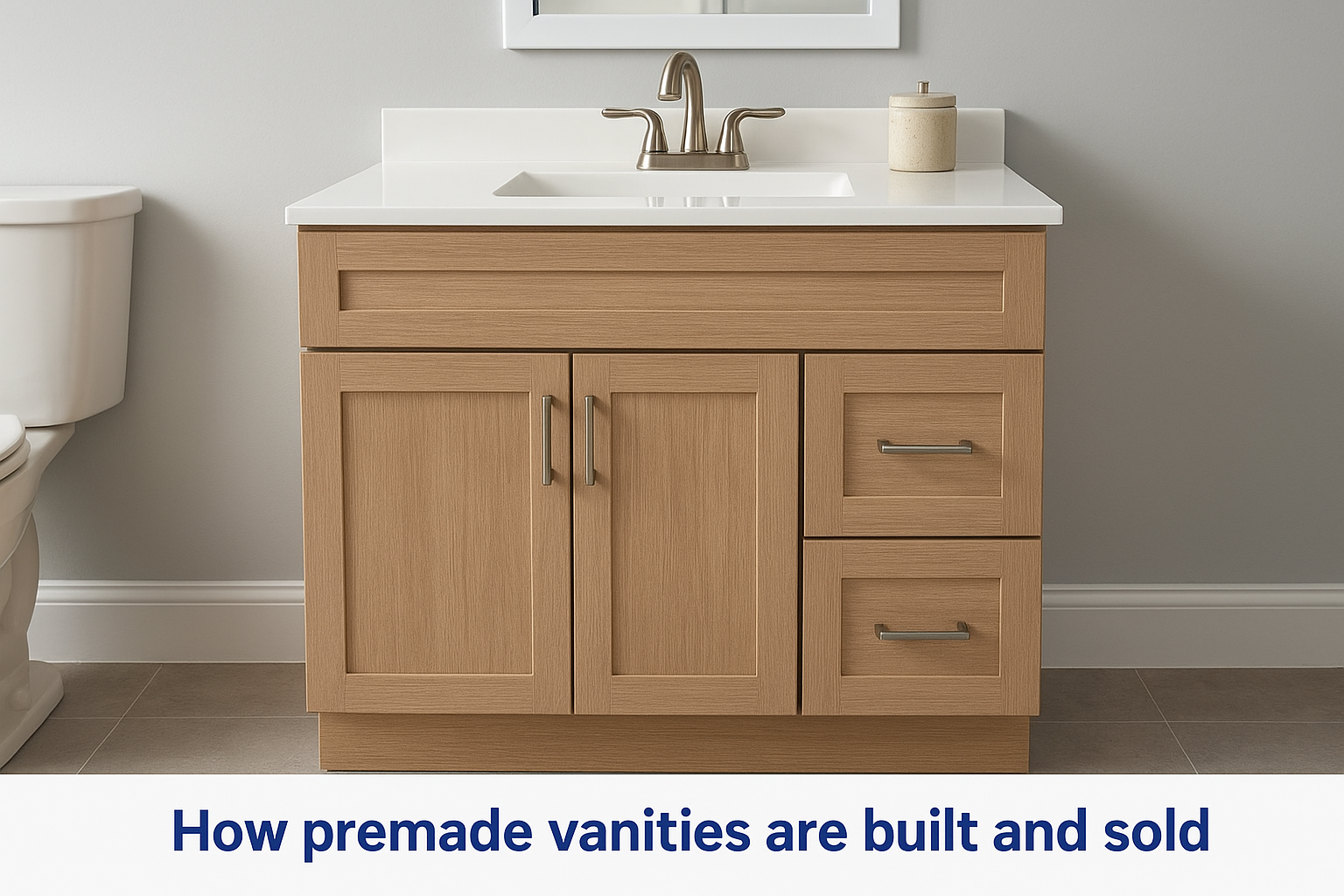
A standard premade vanity also comes with preset hardware placement and fixed drawer sizes, along with limited interior storage options. If your bathroom is an odd size or has plumbing in an unconventional spot, fitting a premade unit can mean cutting corners or losing usable space.
How custom vanities are built and sold
A custom vanity is built specifically for your space and your preferences. A carpenter takes your exact measurements, discusses your storage needs, material choices, and finish options, then builds the piece from scratch. There’s no standard catalog to flip through because the design starts with your bathroom, not a factory floor template.
Custom vanities are built around your space, while premade vanities require your space to adapt to them.
With a custom build, you control the wood species, box depth, door style, and interior layout. That level of control matters most in older homes with uneven walls, unusual plumbing runs, or bathrooms that simply don’t conform to what a standard product line accommodates.
Cost breakdown and what drives the price
When comparing custom bathroom vanity vs premade on price, the gap is real but not always as wide as people assume. A basic premade vanity runs $200 to $800 at a big-box retailer, while mid-range premade units with solid wood doors and soft-close hardware typically land between $800 and $2,000. Custom vanities generally start around $2,500 to $4,000 for a single-sink design and go up from there depending on size, materials, and complexity.
What makes a custom vanity cost more
A custom build costs more because you’re paying for skilled labor, premium materials, and a design built specifically for your space rather than a factory-produced unit. The carpenter measures your bathroom, sources materials, and builds the piece by hand. That process takes time, and time is the biggest cost driver in any custom woodworking project.
The upfront price difference is real, but a well-built custom vanity rarely needs replacing within the life of the home.
What makes premade vanities cheaper
Premade vanities keep costs low through mass production and standardized components. Factories build thousands of the same unit, which spreads tooling and material costs across a large volume. You pay less, but you get less control over dimensions, finish options, and interior storage layout. Common cost-cutting factors in premade units include:
- MDF or particleboard box construction
- Fixed size increments only
- No design consultation or custom labor included
Quality, materials, and durability in bathrooms
Bathrooms deal with moisture, humidity, and temperature changes every day, which makes material choice the most critical factor in any custom bathroom vanity vs premade decision. A piece that looks good in the store can warp or delaminate within a few years if the underlying construction isn’t built for a wet environment.
What premade vanities use inside
Most premade vanities rely on particleboard or MDF cores for the box, wrapped in veneer or thermofoil. Both materials are vulnerable to water infiltration, especially around plumbing connections and sink cutouts. Common durability issues you’ll run into with premade units include:
- Swelling and delamination near sink edges
- Thermofoil peeling in high-humidity bathrooms
- Cabinet floors softening from under-sink leaks
Once particleboard absorbs water, the damage is permanent, and replacement is usually the only fix.
Where custom construction holds up better
Custom vanities use solid wood or high-grade plywood for the box, both of which resist moisture far better than engineered board. These materials don’t swell and separate when exposed to bathroom humidity over time.
At Suman Custom Carpentry, we finish all interior surfaces to seal the wood against moisture, which matters especially on Cape Cod where salt air and coastal humidity add another layer of daily wear to everything in your home.
Which one fits your bathroom and your timeline
The right choice in the custom bathroom vanity vs premade debate often comes down to two practical factors: how your bathroom is shaped and how much time you have before you need it done. Both matter, and ignoring either one leads to frustration later.
When a premade vanity makes sense
Premade units work well when your bathroom has standard dimensions and your plumbing lines up with a stock configuration. If you’re replacing an existing vanity without moving any pipes, a premade unit can be ordered and installed within days. That speed is genuinely useful if you’re on a tight renovation schedule.
A premade vanity is likely a good fit if:
- Your bathroom width matches a standard 24", 30", 36", 48", or 60" increment
- You’re not relocating any plumbing
- You need the bathroom functional again quickly
When a custom vanity is the better fit
Your bathroom likely needs a custom build if it has an odd width, angled walls, or plumbing outside standard positions. These situations are common in older Cape Cod homes where layouts were never designed around modern stock sizes.
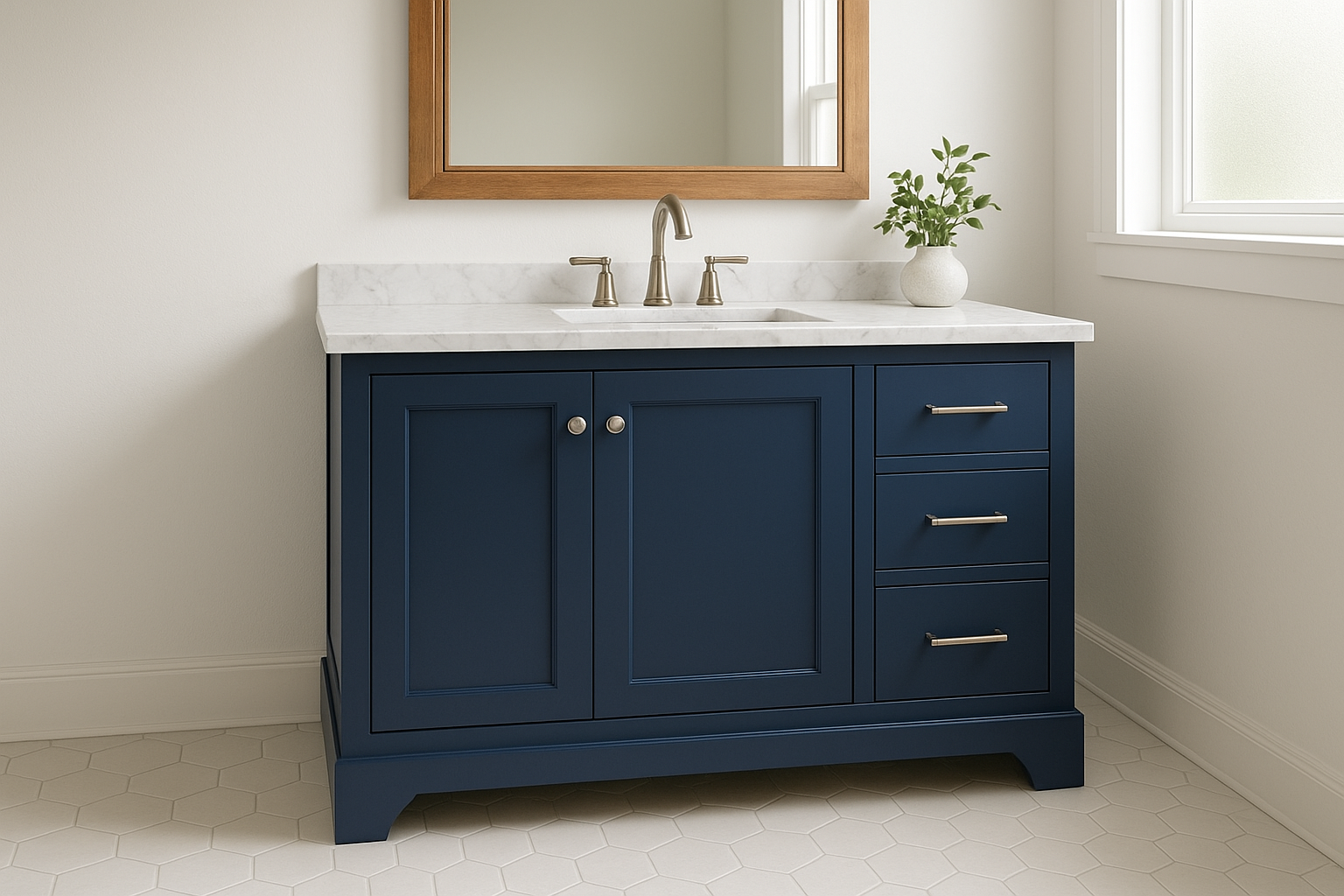
If your bathroom has even one non-standard dimension, a premade unit will either leave gaps or force compromises you’ll notice every day.
Custom builds also suit you when storage and finish details matter enough to justify the longer timeline. Plan for 6 to 10 weeks from design sign-off to installation.
How to choose and plan a vanity you will not regret
Making the right call in the custom bathroom vanity vs premade decision starts with measuring your bathroom accurately and being honest about your priorities. Before you look at products or call a carpenter, write down your non-negotiables: storage requirements, finish preferences, and whether your plumbing can stay where it is.
Start with your space, not a catalog
Pull out a tape measure and record the exact width, depth, and height available for your vanity, including any obstacles like door swings, trim, or tile edges. If those numbers don’t match a standard increment, a premade unit will leave gaps or force awkward filler pieces you’ll notice every day.
Accurate measurements before any purchase decision will save you more time and money than any other single step in this process.
Know your timeline before you commit
A premade vanity can arrive within a week; a custom build typically takes 6 to 10 weeks from design approval to installation. That gap matters if your bathroom is out of commission during the renovation. Factor your actual project schedule into the decision early so the timeline doesn’t become a problem after you’ve already committed to a direction.
- Premade: available within days to two weeks
- Custom: 6 to 10 weeks from design sign-off to installation
- Budget time for delivery, any plumbing adjustments, and final trim work
Key takeaways
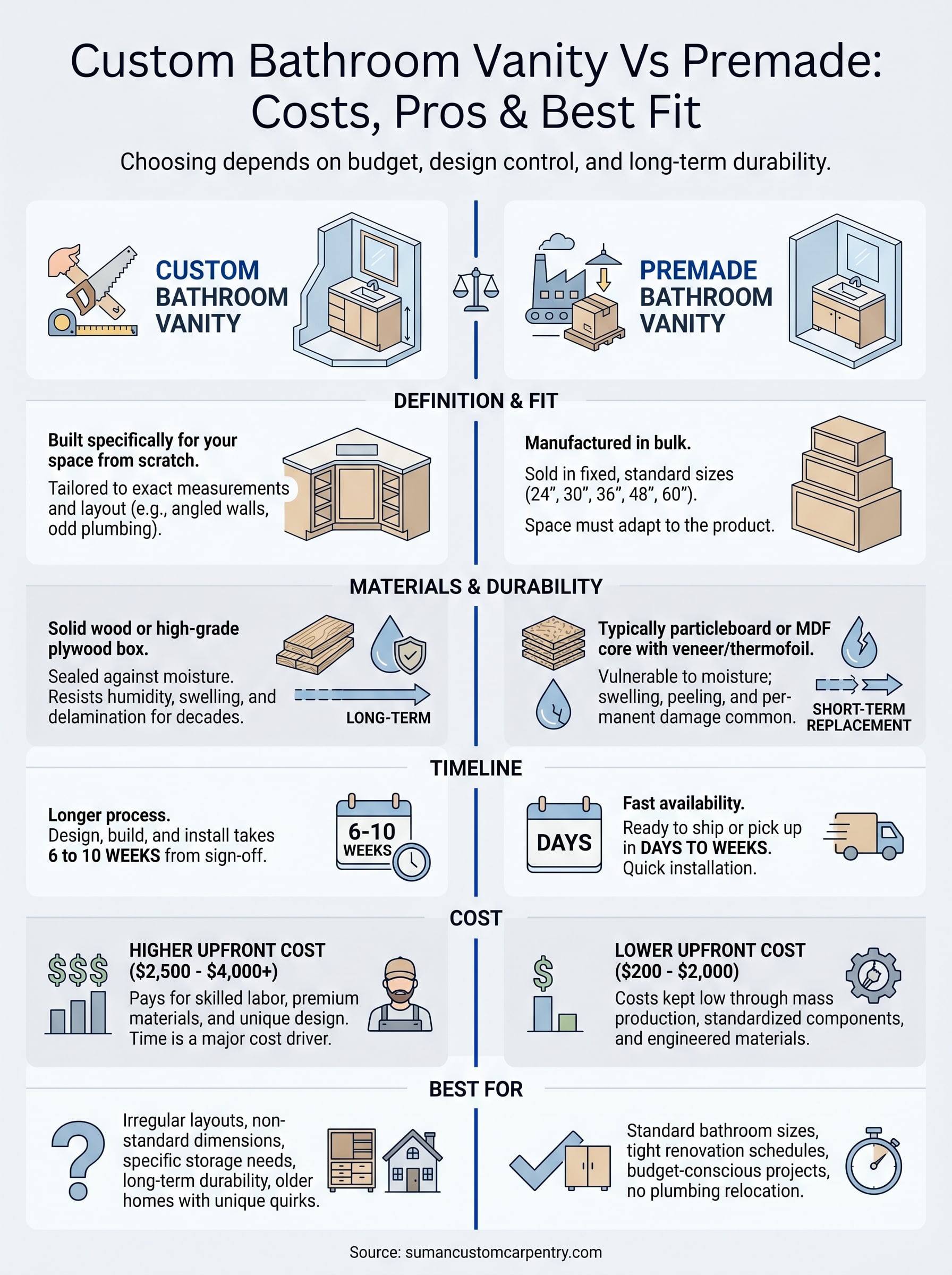
The custom bathroom vanity vs premade decision comes down to three things: your bathroom’s dimensions, your timeline, and how long you want the piece to last. Premade units work well when your space fits standard sizes and you need a fast, lower-cost solution. Custom builds make sense when your layout is non-standard, your storage needs are specific, or you want solid construction that holds up to decades of bathroom humidity without warping or delaminating.
If your bathroom doesn’t cooperate with stock dimensions, forcing a premade unit will cost you in gaps, filler pieces, and compromises you’ll see every day. A custom vanity built to your exact measurements eliminates all of that. On Cape Cod especially, where older homes rarely follow modern standard sizing, a custom build is often the more practical choice, not just the premium one.
Ready to talk through what your bathroom actually needs? Contact Suman Custom Carpentry to start your project.