
You’re trying to figure out custom kitchen cabinets price before you commit to a remodel, and the ranges you’re finding online swing wildly from a few thousand dollars to well over $50,000. That gap isn’t a pricing gimmick, it comes down to materials, box construction, finish work, and who’s actually building your cabinets.
So here’s the direct answer: most custom kitchens run $500 to $1,200 per linear foot, with a full kitchen typically landing between $15,000 and $45,000 depending on size and finish level. Painted maple boxes with soft-close hardware sit at the lower end, while rift-cut white oak or full custom inset doors push you toward the top.
In this guide, we’ll break down exactly what drives that per-foot number, from wood species and door style to hardware and finish, so you can build a realistic budget for your own kitchen. We’ll also cover where custom cabinetry cost differs from stock and semi-custom options, and what Cape Cod homeowners specifically should expect when working with a local shop that builds everything in-house rather than outsourcing to a factory.
Why custom kitchen cabinet prices vary so much
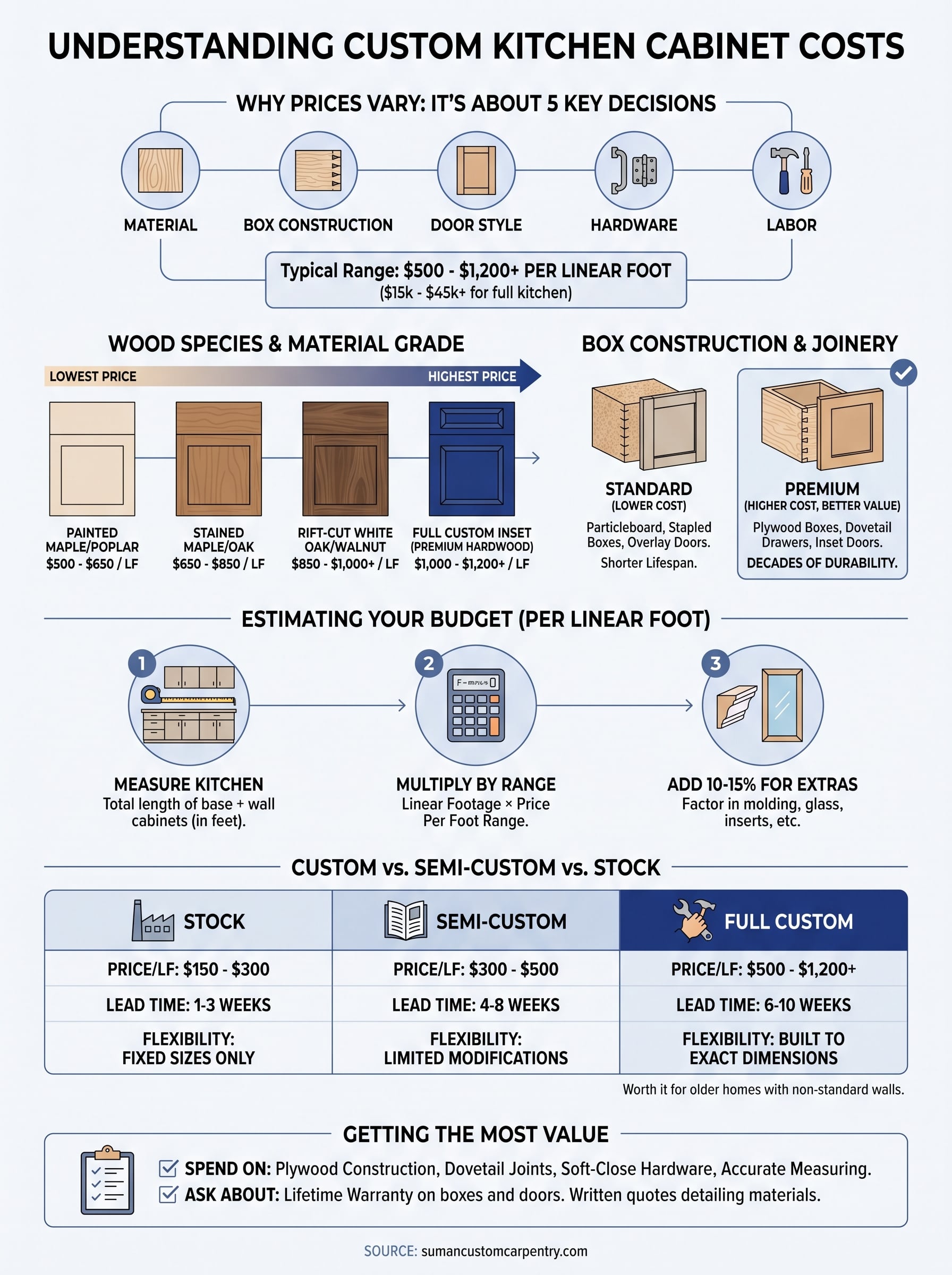
Every custom kitchen quote looks different because you’re really pricing five separate decisions stacked on top of each other: material, box construction, door style, hardware, and labor. Change any one variable and the average cost of custom kitchen cabinets shifts by hundreds of dollars per linear foot. That’s why two homeowners on the same street can get quotes of $18,000 and $40,000 for kitchens that are nearly the same size.
Wood species and material grade
Wood species alone can swing your price by 40% or more. Paint-grade poplar or maple runs cheapest because the wood grain doesn’t need to be perfect since it’s covered in finish. Stain-grade woods like white oak, walnut, and cherry cost more because the shop has to select boards with matching grain and color. Here’s how that typically breaks down per linear foot for a full custom kitchen:
| Material | Typical price per linear foot |
|---|---|
| Painted maple or poplar | $500 – $650 |
| Stained maple or oak | $650 – $850 |
| Rift-cut white oak or walnut | $850 – $1,000+ |
| Full custom inset with premium hardwood | $1,000 – $1,200+ |
Box construction and joinery
How the cabinet box itself is built matters just as much as the wood you pick. Plywood boxes with dovetailed drawers and solid wood face frames cost more to build than particleboard boxes with stapled drawer boxes, but they last decades longer and hold up better to Cape Cod’s humidity swings. Overlay doors, where the door sits on top of the frame, are the most affordable custom option. Full inset doors, which sit flush inside the frame with tight, even reveals on all sides, require much tighter tolerances and more shop time, which is why they sit at the top of the pricing scale.
The biggest price gap in custom cabinetry isn’t the wood, it’s whether the box is built to last one kitchen or three.
Door style and finish work
Once you’ve settled on wood and box style, the door profile and finish add another layer of cost. A simple slab or shaker door with a clear coat finish is far cheaper to produce than a raised panel door with a hand-applied glaze or a high-gloss lacquer finish, so it pays to compare cabinet door profiles for Cape Cod homes before you commit. Painted finishes also require more prep and drying time than a straight stain, since primer, sanding, and multiple coats all add labor hours, which is why the best finish option for kitchen cabinets is worth settling early. If you’re comparing quotes and one seems unusually low, ask specifically what finish process is included, since a
How to estimate your budget per linear foot
Measuring your own kitchen before you call anyone gives you a real number to compare against quotes, instead of guessing based on someone else’s kitchen. Linear footage is simply the total length of your base and wall cabinets measured along the wall, not the square footage of your floor. A typical U-shaped kitchen runs 20 to 25 linear feet, while a galley kitchen might only need 12 to 15 feet. This is the single most useful step for anyone trying to figure out how much do custom kitchen cabinets cost before a designer even walks through the door.
Measuring your kitchen accurately
Grab a tape measure and walk your kitchen wall by wall, adding both base cabinet runs and upper cabinet runs together. Skip open spaces like doorways, windows below counter height, and the refrigerator gap, since those don’t get cabinet boxes. Islands count separately and usually add $2,000 to $6,000 depending on size and whether they include seating or storage on multiple sides.
- Measure base cabinets along every wall, in feet
- Measure wall cabinets the same way
- Add island length separately if you’re including one
- Note any tall pantry cabinets, since these often price higher per foot than standard runs
Building a realistic total
Once you have your linear footage, multiply it by the per-foot range from the material table above to get a rough floor and ceiling. A 22-foot kitchen in stained maple, for example, lands between $14,300 and $18,700 before you add an island, hardware upgrades, or a hood surround. Factor in another 10% to 15% for extras like crown molding, glass-front doors, or interior organizers, since these rarely show up in a base per-foot number.
A rough per-foot estimate is only useful once you’ve measured your own kitchen, not someone else’s.
Homeowners often ask about the cost of custom kitchen cabinets per linear foot without realizing that hardware alone can add $15 to $40 per foot once you factor in soft-close hinges, undermount slides, and pulls versus knobs, on top of what installing cabinets costs per linear foot. Get a written breakdown from your carpenter that separates material, box construction, and hardware, so you know exactly where your money is going and can adjust one variable without blowing up the whole budget.
Custom vs. semi-custom vs. stock cabinet costs
Stock, semi-custom, and custom cabinets aren’t just different price points, they’re different manufacturing processes, and that’s what actually drives the gap in custom kitchen cabinets prices versus the boxes you’d find at a big-box store. Stock cabinets come in fixed sizes, usually 3-inch increments, built on an assembly line and shipped from a warehouse. Semi-custom cabinets give you more size and finish options within a set line of styles, but you’re still choosing from a catalog. Custom means the shop builds every box to your exact dimensions, wood choice, and door style, with no size limitations and no substituting a filler panel because your wall is two inches off.
Comparing the three tiers
Here’s how the three options typically compare on price, lead time, and flexibility for a full kitchen:
| Cabinet type | Price per linear foot | Typical lead time | Sizing flexibility |
|---|---|---|---|
| Stock | $150 – $300 | 1-3 weeks | Fixed sizes only |
| Semi-custom | $300 – $500 | 4-8 weeks | Limited modifications |
| Full custom | $500 – $1,200+ | 6-10 weeks | Built to exact dimensions |
Quality shows up in details a spec sheet won’t list. Full custom boxes use solid wood face frames and dovetailed drawers as a baseline, while stock lines often reserve those features for their most expensive tier, if they offer them at all.
Why the cost difference is worth it for older homes
Rounding out the picture, Cape Cod’s older housing stock rarely has square walls or standard-depth openings, and that’s where stock and semi-custom cabinets start costing you in ways the sticker price doesn’t show. Filler strips, scribe pieces, and mismatched panels end up covering gaps that a custom-built box would never create in the first place. Working with a shop that hand-builds every box in-house, the way we do at Suman Custom Carpentry, means your kitchen gets measured and built for the actual walls you have, not the walls a factory assumed you’d have.
Stock cabinets fit a standard kitchen. Custom cabinets fit yours.
So when you’re comparing a stock quote against a custom one, factor in the fillers, the shims, and the years you’ll spend living with drawers that don’t quite align, because that’s the real cost difference the per-foot number doesn’t capture.
How to get the most value for your investment
Getting real value out of a custom kitchen isn’t about finding the cheapest cost for custom kitchen cabinets you can, it’s about knowing which upgrades pay off for decades and which ones just look good on a spec sheet. Plywood boxes, dovetailed drawers, and soft-close hardware belong in every budget, because they’re the parts you touch every day and the parts a factory line skips first to hit a lower price. Save your splurging for door style, finish, and hardware pulls, since those are the easiest things to change later without tearing into the box itself.
Where to spend and where to hold back
Before you sign anything, walk through your own priority list and match it against what actually affects daily use versus what’s purely cosmetic:
- Spend on plywood construction, dovetail joints, and full-extension soft-close slides, since these determine how the cabinet holds up over 15 to 20 years
- Spend on accurate measuring and in-house building, which eliminates the filler strips and shims that stock cabinets require
- Hold back on exotic wood species if a stained maple or oak will look nearly identical once finished
- Hold back on decorative glass inserts or heavy crown molding until you’ve locked in the core box and hardware budget
Value in a custom kitchen comes from what’s inside the box, not what’s painted on the door.
Ask about the warranty before you compare prices
Questions about how much are custom kitchen cabinets should always include a follow-up about what’s covered after installation, because a lower quote often means a shorter warranty or none at all. A shop offering a lifetime guarantee on the cabinet boxes and doors, with a separate multi-year warranty on painted finishes, is telling you they expect the work to hold up without callbacks. That’s the kind of guarantee we stand behind on every project at Suman Custom Carpentry, and it’s worth asking any carpenter you’re considering to put in writing.
Requesting three itemized quotes, broken down by material, box construction, and hardware, lets you compare apples to apples instead of guessing why one number is $8,000 higher than another. Transparency at the quote stage tells you a lot about how a shop will communicate once your kitchen is torn apart and decisions need to happen fast.
Turning your estimate into a finished kitchen
Numbers on a page only get you so far. Once you’ve measured your kitchen and matched a material and box style to your budget, the real custom kitchen cabinets price becomes a lot less mysterious, and you’re left with a range you can actually plan around instead of guessing. Getting from that estimate to a finished kitchen means finding a shop that builds everything in-house, stands behind the work with a real lifetime warranty, and communicates clearly from the first measurement to the final install. Cape Cod’s older homes and coastal humidity reward that kind of hands-on craftsmanship over anything mass-produced. If you’re ready to turn your budget into drawings, wood samples, and a firm quote, request a free estimate from our Hyannis shop and let’s talk through what your kitchen actually needs.