
A kitchen remodel forces you to make dozens of decisions, but few carry as much weight as choosing between custom kitchen cabinets vs stock cabinets. Cabinets account for roughly 30–40% of most kitchen renovation budgets, so the direction you pick shapes everything, from how your kitchen looks and functions to how long those cabinets actually last.
At Suman Custom Carpentry, we hand-build custom cabinetry in our Hyannis shop for homeowners across Cape Cod. We’ve seen kitchens transformed by well-built custom work, and we’ve also ripped out stock cabinets that fell apart in under a decade. That experience gives us a clear picture of where each option succeeds and where it falls short. We’re obviously biased toward custom work, it’s what we do, but we also believe you deserve a straight comparison so you can spend your money where it counts.
This article breaks down the real differences between custom and stock kitchen cabinets: materials, construction quality, design flexibility, cost ranges, and long-term value. Whether you’re planning a full kitchen renovation or just replacing worn-out cabinetry, the information here will help you make a confident decision based on your budget, your timeline, and how you actually use your kitchen every day.
Why this cabinet choice matters in a remodel
Cabinets are the backbone of your kitchen. They determine how the space looks, how it functions every day, and how it holds up through years of cooking, cleaning, and general wear. Getting this decision right early in the planning process protects your budget and prevents expensive corrections once work has already started.
Cabinets claim the largest share of your remodel budget
Kitchen renovations vary widely in scope, but cabinets consistently take the largest single line item in most budgets. Depending on your kitchen size and the option you choose, cabinets typically represent 30 to 40 percent of your total remodel cost. That means a choice made early in the process directly shapes how much money remains for countertops, appliances, flooring, and labor.
Getting your cabinet direction locked in before other decisions are made keeps your budget intact and your timeline realistic, since reversing course mid-project rarely comes cheap.
When you’re weighing custom kitchen cabinets vs stock cabinets, you’re not just picking a door style. You’re choosing a construction method, a material grade, a lead time, and a long-term maintenance path. Each of those factors ripples outward and affects other parts of your remodel in ways that aren’t always visible when you’re still in the planning phase.
Layout and fit affect function more than aesthetics do
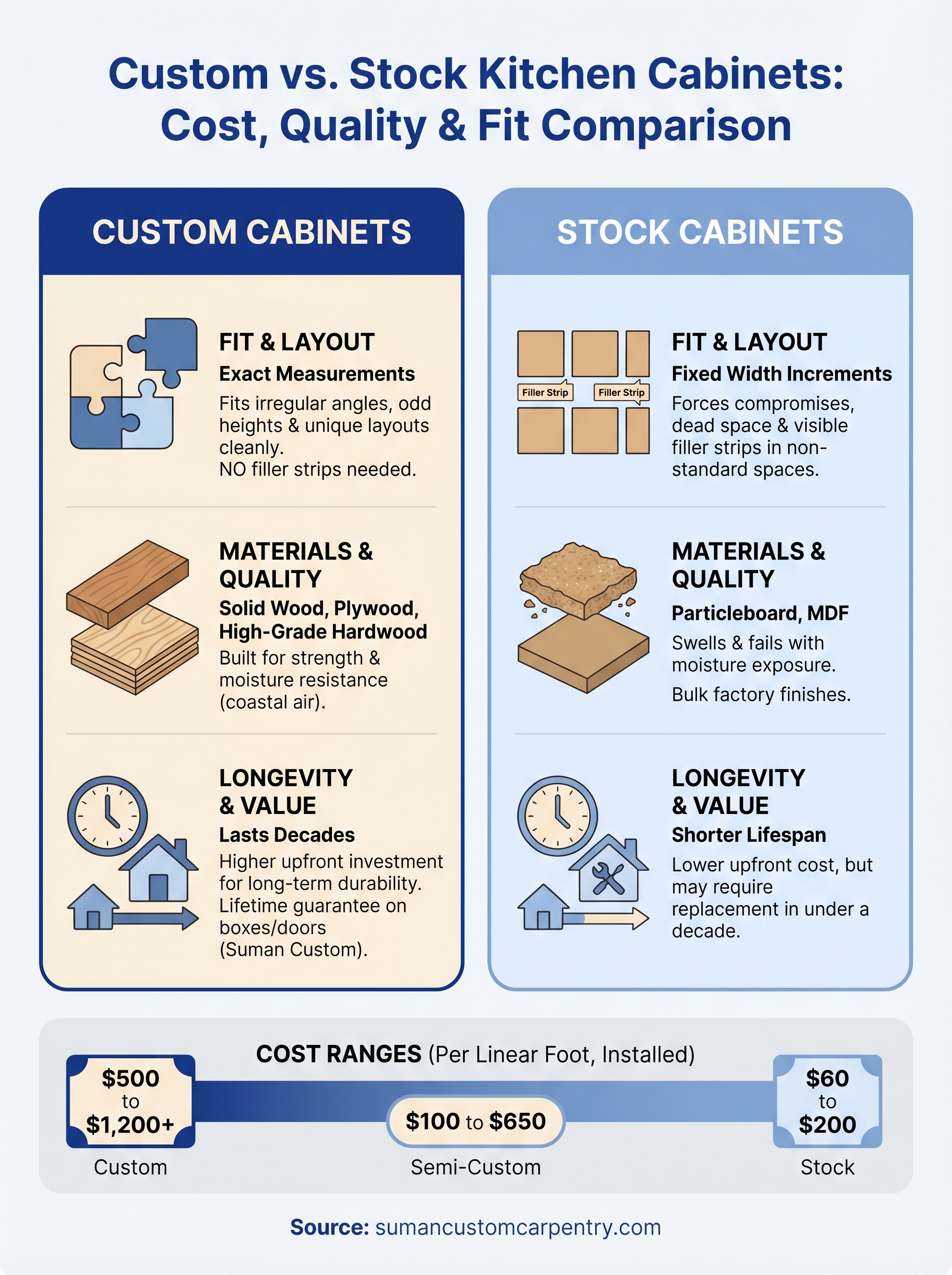
Stock cabinets come in fixed width increments, typically jumping in two-inch steps. If your kitchen walls don’t align with those increments, you end up with filler strips, dead corner space, or gaps that look unfinished regardless of how well everything else is executed. Custom cabinets are built to your exact measurements, so every inch of your kitchen layout works intentionally rather than by accommodation.
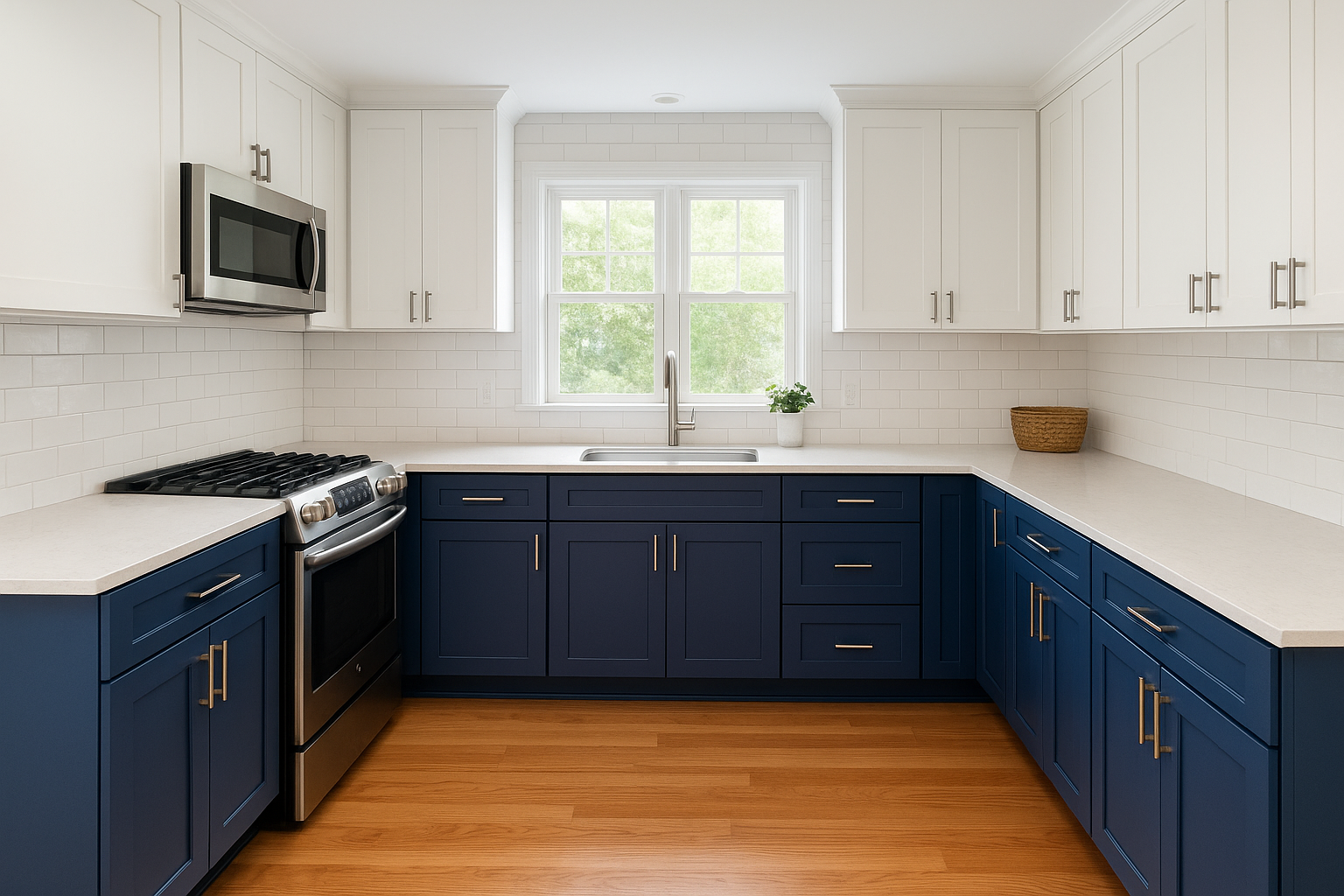
This matters especially in older Cape Cod homes, where irregular wall angles, non-standard ceiling heights, and off-center window placements are common. Standard cabinet sizes often fight those conditions instead of working with them. A kitchen that fits the actual space functions better and photographs better, which also matters when it comes to resale value and long-term property appeal in a competitive coastal market.
How to choose between custom and stock cabinets
Deciding between custom kitchen cabinets vs stock cabinets comes down to three core factors: your kitchen’s physical conditions, your budget range, and how long you plan to stay in the home. None of those factors alone gives you the full answer, but together they point clearly in one direction or the other.
Getting clear on these three factors before you talk to any contractor or visit any showroom will save you time and prevent costly changes later.
Consider your kitchen’s layout and constraints
If your kitchen has standard dimensions and square walls, stock cabinets can fit with minimal filler work. Measure your actual wall runs and note where gaps or awkward transitions would appear with fixed-size units before committing to anything.
Kitchens with irregular angles or non-standard ceiling heights are where stock sizes force compromises that add up fast. Custom work solves those conditions at the design stage rather than patching them during installation.
Match your timeline and budget realistically
Custom cabinets typically carry a 40-to-60-day build and installation timeline, so they require planning ahead. Stock cabinets can ship within days, making them practical when a tight schedule drives the decision rather than design precision.
Your budget is the other key filter. If your renovation ceiling limits total spend, stock cabinets may free up money for countertops or appliances. If long-term durability and a precise fit matter more than upfront cost, custom cabinets deliver a return that outlasts the initial price difference.
Cost breakdown: price ranges and what drives them
Cost is usually the first filter people apply when comparing custom kitchen cabinets vs stock cabinets, but the raw numbers rarely tell the full story. What you pay depends on kitchen size, material grade, hardware choices, and the complexity of your layout, so two kitchens at similar square footage can land at very different price points.
Stock cabinet price ranges
Stock cabinets typically run between $60 and $200 per linear foot, installed. For an average 10-by-10 kitchen, that puts total cost somewhere in the $2,000 to $5,000 range for the cabinets alone. Semi-custom options sit in the middle ground at roughly $100 to $650 per linear foot, giving you limited size adjustments and more finish choices without the full custom commitment.
| Cabinet type | Approximate cost per linear foot |
|---|---|
| Stock | $60 to $200 |
| Semi-custom | $100 to $650 |
| Custom | $500 to $1,200+ |
The lower upfront cost of stock cabinets can look attractive, but factor in filler strips, trim pieces, and modification costs before locking in a budget.
Custom cabinet price ranges
Custom cabinets typically start at $500 per linear foot and can climb well past $1,200 depending on wood species, door profiles, and finish work. For a full kitchen, total custom cabinet costs commonly range from $15,000 to $50,000 or more. At Suman Custom Carpentry, every cabinet is hand-built in our Hyannis shop, so the price reflects real craftsmanship and materials rather than mass-production markups.
The primary cost driver in custom work is labor and precision, not just raw materials. Each cabinet is sized and built for your specific space, which eliminates workarounds and produces a finished result that stock units simply cannot match.
Quality and longevity: materials, build, and finishes
When comparing custom kitchen cabinets vs stock cabinets, material quality and construction method separate the two options more sharply than price alone does. Cabinets that look similar on a showroom floor can behave very differently after five years of daily cooking, humidity exposure, and general wear, especially in a coastal environment like Cape Cod where moisture is a constant factor.
What stock cabinets are typically made from
Stock cabinets rely heavily on particleboard and medium-density fiberboard for their boxes and shelving. Both materials hold up reasonably well in dry, stable environments but respond poorly to moisture. Once water reaches the edges of a particleboard box, the material swells, weakens, and eventually fails. Finishes on stock cabinets are applied in bulk at the factory, which limits how well they adhere and how long they hold their appearance under regular cleaning.
The surface finish on a stock cabinet is often its weakest point, not the door style or the hardware.
How custom cabinets are built differently
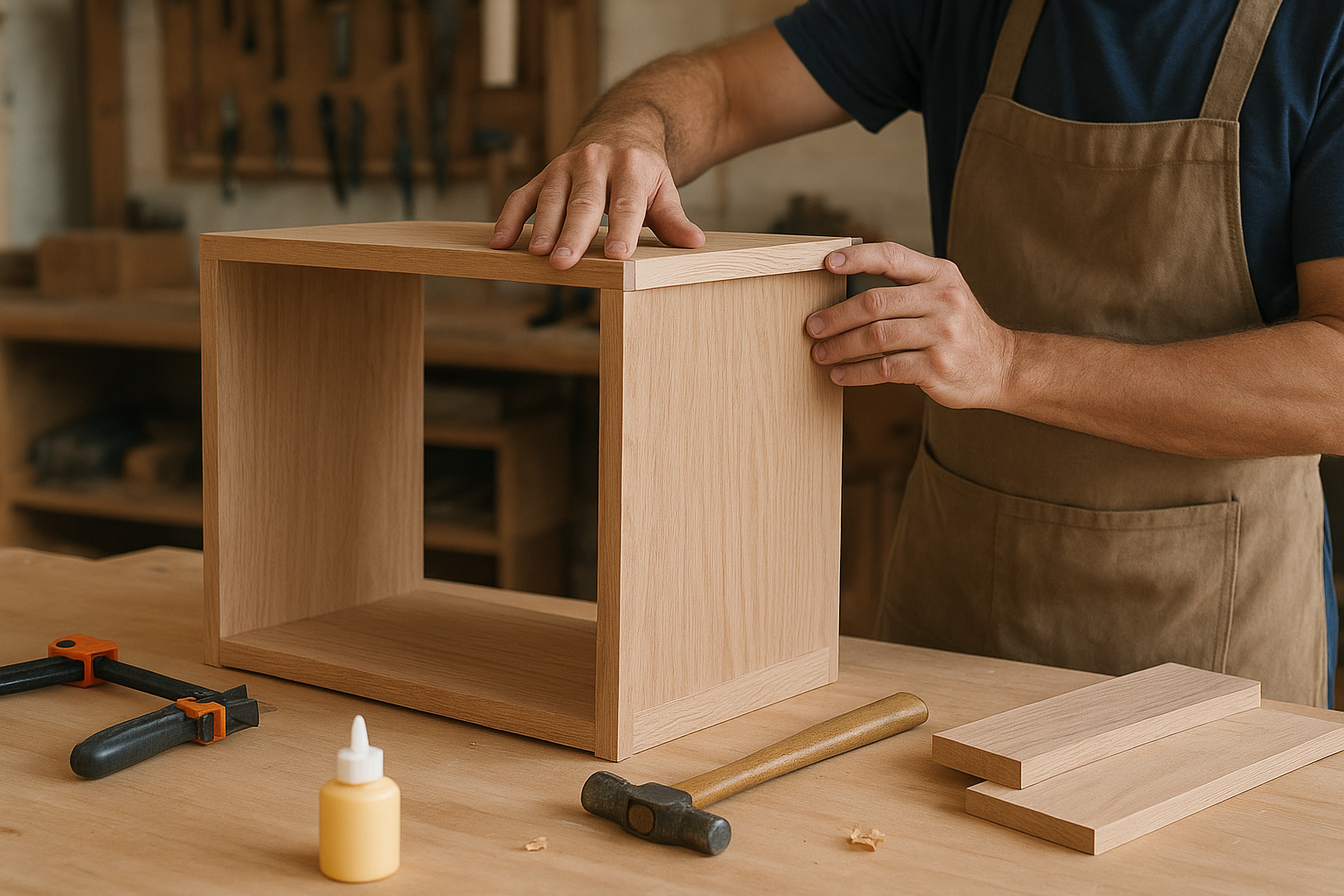
Custom cabinets use solid wood, plywood, or high-grade hardwood depending on your specification, giving the box structure real strength and resistance to moisture movement. At Suman Custom Carpentry, every cabinet box is hand-built in our Hyannis shop, which means construction quality is controlled at every stage rather than delegated to a production line. Joints are fitted properly, finishes are applied with attention to adhesion and coverage, and the final product is built to last decades rather than years. That build standard is what backs our lifetime guarantee on cabinet boxes and doors.
Common scenarios: which option fits best
Knowing where each option performs well helps you move past the general debate around custom kitchen cabinets vs stock cabinets and into a decision that fits your actual situation. The right choice depends on your kitchen’s physical conditions, your timeline, and what you expect from the finished result five or ten years from now.
When stock cabinets make sense
Stock cabinets work best when your kitchen has standard dimensions and square walls, your remodel timeline is short, and your primary goal is updating the look without a major structural investment. Rental properties, starter homes, and budget-constrained renovations where speed matters more than precision are the clearest fits. If you plan to sell within a few years and just need the kitchen to present well, stock cabinets can accomplish that at a reasonable cost.
Stock cabinets also make sense when your layout is simple enough that fixed width increments won’t force awkward gaps or filler strips.
When custom cabinets are the right call
Custom cabinets fit best when your kitchen has irregular wall angles, non-standard ceiling heights, or a layout that stock sizes cannot accommodate cleanly. They’re also the right choice when you’re investing in a long-term home and want cabinetry that holds up through decades of use rather than requiring replacement in under ten years. On Cape Cod specifically, moisture exposure from coastal air makes construction quality a serious factor, and solid-wood custom builds handle that environment far better than particleboard-based stock units do.
Next steps for your cabinet plan
The comparison between custom kitchen cabinets vs stock cabinets ultimately comes down to what your kitchen demands and what you want from the finished result. If your space has irregular dimensions or coastal exposure, custom work gives you a fit and durability that stock units cannot match. If your timeline is short and your layout is straightforward, stock cabinets can get the job done at a lower upfront cost.
Your next move is to get your kitchen measured accurately and walk through the design options with someone who builds cabinets for a living. At Suman Custom Carpentry, we hand-build every cabinet in our Hyannis shop and carry a lifetime guarantee on cabinet boxes and doors. If you’re ready to talk through your kitchen project, reach out to the Suman Custom Carpentry team and we’ll start with a consultation built around your space, your budget, and your timeline.