
A dedicated workspace at home works best when it’s designed around the room you actually have, not the other way around. That’s where home office built-ins with desk setups come in. They combine your work surface, storage, and shelving into one seamless unit that makes every square foot count, whether you’re working with a full spare bedroom or an awkward nook under the stairs.
At Suman Custom Carpentry, we design and hand-build these kinds of pieces every day in our Hyannis, Cape Cod shop. From floor-to-ceiling bookshelves with an integrated desk to compact wall units tucked into a corner, we’ve seen firsthand how the right built-in transforms a cluttered room into a focused workspace.
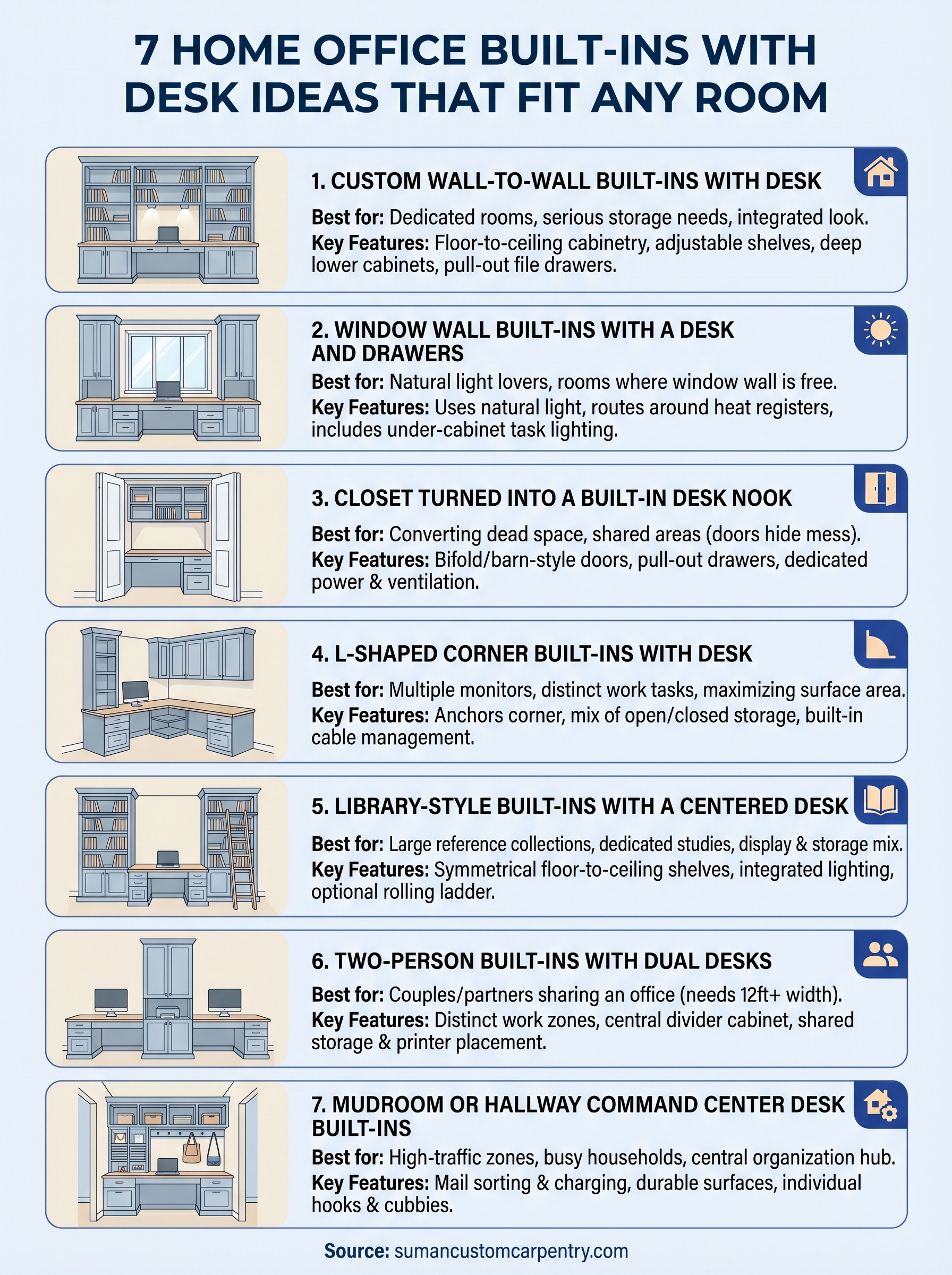
Below, you’ll find seven built-in desk ideas worth stealing for your own home office. Each one solves a different layout challenge, so no matter your room’s shape or size, there’s something here that fits. We’ll cover what makes each design work, who it’s best suited for, and what to keep in mind if you decide to build one.
1. Custom wall-to-wall built-ins with desk
A wall-to-wall built-in is the fullest version of a home office built-ins with desk setup you can build. It spans the entire wall, tying your work surface into floor-to-ceiling cabinetry on both sides and overhead into one seamless unit that looks like part of the house rather than furniture sitting in front of it.
Best for
This layout works best if you have a dedicated room for your office and need serious storage alongside your work surface. It suits anyone who wants the workspace to look built into the architecture of the room rather than assembled from separate pieces.
Layout and proportions that work
Standard desk height runs 28 to 30 inches, with a depth of 24 inches giving you enough clearance for a monitor, keyboard, and paperwork side by side. Upper cabinets above the desk add overhead storage without cutting into your floor space or making the room feel smaller.
Getting the desk height right from the start matters more than almost any other decision in this build.
Storage features to consider
Plan your storage based on what you actually reach for every day. Good options to build in include:
- Adjustable shelves for books, binders, and equipment that changes over time
- Deep lower cabinets with doors to keep supplies and hardware out of sight
- Pull-out file drawers for anyone who still handles physical paperwork
Materials and finish choices that hold up
Plywood box construction with solid wood face frames outperforms particleboard in durability, especially in a coastal climate where humidity fluctuates. Particleboard absorbs moisture, swells, and breaks down at joints over time.
A satin-finish paint cleans up easily and holds up to daily contact far better than flat paint on a surface you touch constantly.
Cost drivers and budget range
Size and hardware choices drive cost more than anything else. A full wall-to-wall unit in the Cape Cod area typically runs between $8,000 and $20,000. Soft-close hardware, glass-front doors, and pull-out inserts move the number toward the higher end of that range.
When to hire a Cape Cod millwork shop
If your wall has existing trim, outlets, or windows that need to be worked around, a local shop that measures and builds to your specific conditions handles those details directly. Prefabricated units rarely account for the quirks of an older or custom-built home.
Working with a shop that hand-builds every piece in-house gives you tighter tolerances and better quality control than anything assembled from stock components shipped to a job site.
2. Window wall built-ins with a desk and drawers
A window wall setup positions your desk directly in front of or alongside a window, wrapping the surrounding wall with built-in cabinetry, drawers, and shelving. The result is a home office built-ins with desk design that uses natural light as a feature rather than an afterthought.
Best for
This layout suits anyone who works better with natural light and wants to look out rather than stare at a blank wall all day. It’s a strong choice for rooms where the window wall is the only real wall free of doors.
Desk height, depth, and knee space
Standard desk height of 28 to 30 inches works for most people, but depth matters too. Aim for at least 24 inches of usable surface, and confirm your knee space clears 24 to 27 inches so you’re not cramped after a few hours of sitting.
Daylight, glare, and lighting plan
Natural light helps, but a window directly behind your monitor creates glare that strains your eyes quickly. Position your screen perpendicular to the window when possible, and add under-cabinet task lighting to fill shadows during early mornings or overcast days.
A well-placed task light often matters more than the window itself for daily comfort.
Heat registers, baseboards, and trim details
Many window walls have floor registers or baseboard heaters running beneath them. A skilled millwork shop routes around these details with toe-kick venting or raised cabinet bases so airflow stays unblocked and the build looks intentional.
Cost drivers and budget range
Window wall units typically run $5,000 to $14,000 in the Cape Cod area, depending on drawer count, cabinet doors, and how much custom trim work the installation requires.
3. Closet turned into a built-in desk nook
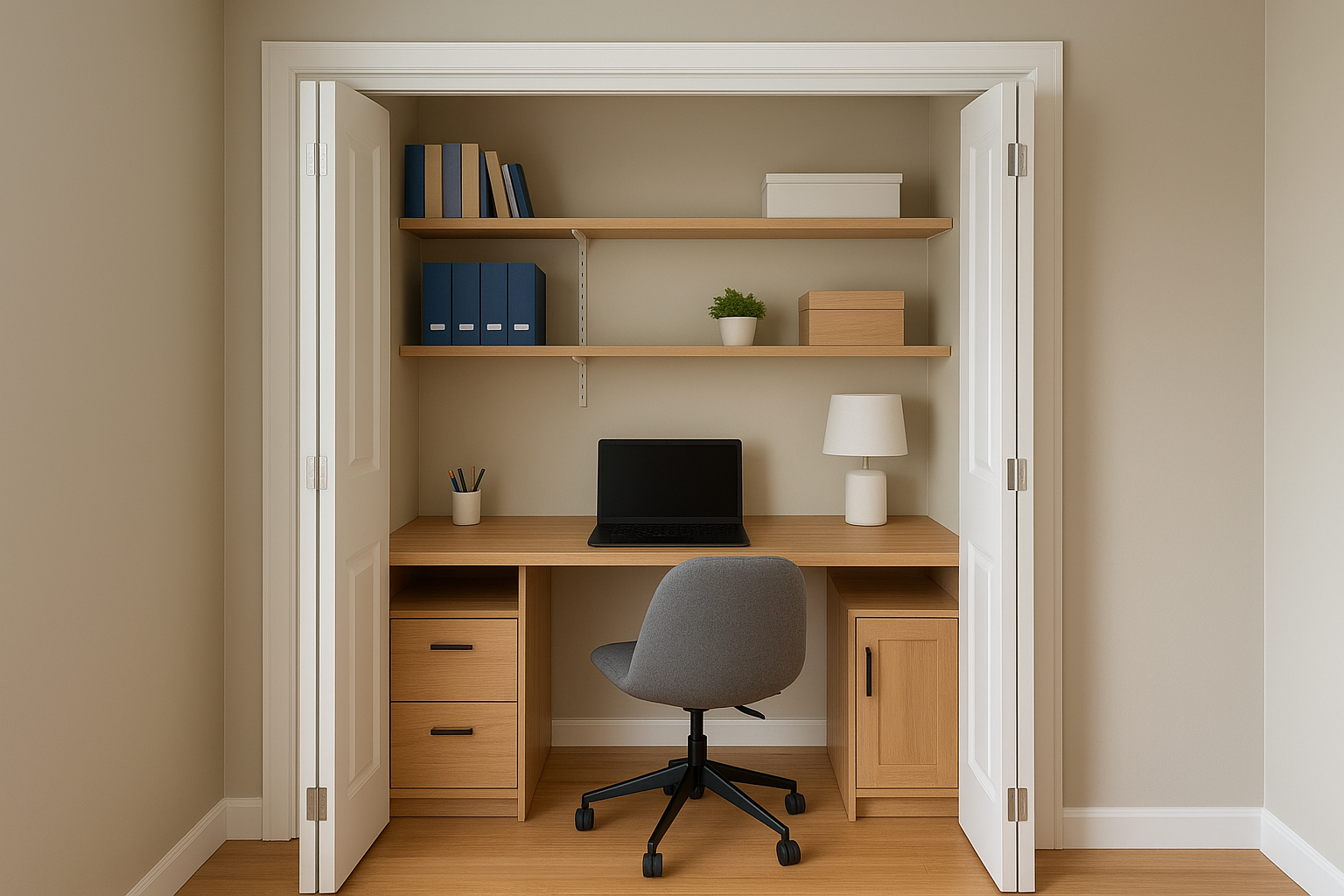
A spare closet is one of the most practical spaces you can convert into a home office built-ins with desk setup. Removing the doors and building in a desk surface, shelving, and storage turns dead square footage into a fully functional workspace that closes off from the rest of the room when you need it to.
Door options that hide the mess
Bifold or barn-style doors let you shut the entire nook away at the end of the day, which matters if your office shares space with a guest room or living area. Pocket doors work well too, since they disappear into the wall and keep the surrounding area clear when the desk is in use.
Shelves, uppers, and file storage
Build adjustable upper shelves above the desk surface to handle books, binders, and equipment without eating into your legroom. Good additions for the lower section include:
- Pull-out file drawers for physical paperwork
- A small cabinet with a door to hide a printer or supplies
- Open cubbies for items you grab throughout the day
Power, internet, and ventilation needs
Run dedicated outlets and a data port through the back wall before the cabinets go in. Closets trap heat from computers and monitors, so confirm your HVAC plan accounts for airflow into the nook or add a small ventilation solution.
Getting electrical and data lines roughed in before cabinet installation saves a costly rework later.
Cost drivers and budget range
Closet conversions typically run $3,000 to $8,000 in the Cape Cod area. Door hardware, electrical rough-in, and custom adjustments to fit an existing closet opening are the main cost variables.
4. L-shaped corner built-ins with desk
An L-shaped corner built-in turns the most underused corner of a room into a highly productive workspace. By anchoring your desk into the corner, you connect two runs of work surface at a right angle, which gives you serious spread without consuming an entire wall. This is a strong home office built-ins with desk layout when surface area is your top priority.
Best for
This design suits anyone managing multiple monitors or two distinct work tasks at the same time. It also works well if you want one run for computer work and the other for writing, drawing, or reviewing documents.
Corner ergonomics and monitor placement
Place your primary monitor slightly off-center from the corner so your neck stays neutral throughout the day. Lock down desk depth on both runs before the design is finalized.
Confirming monitor placement before cabinet dimensions are set prevents an ergonomic issue that’s hard to correct after installation.
Upper cabinets vs open shelving
Open shelving above one run keeps the room from feeling enclosed, while closed upper cabinets on the other side keep equipment and supplies out of sight. Mixing both gives you display space alongside practical concealed storage in a single unit.
Cable management and outlet placement
Build dedicated outlets into the cabinet base or back wall on both runs before installation begins. Corner units trap cords quickly, so a built-in cable chase keeps the finished surface clean and organized.
Cost drivers and budget range
Corner joints require custom fitting and additional material compared to a straight run, which raises the overall price. Expect to pay $6,000 to $16,000 in the Cape Cod area depending on cabinet count, hardware, and finish choices.
5. Library-style built-ins with a centered desk
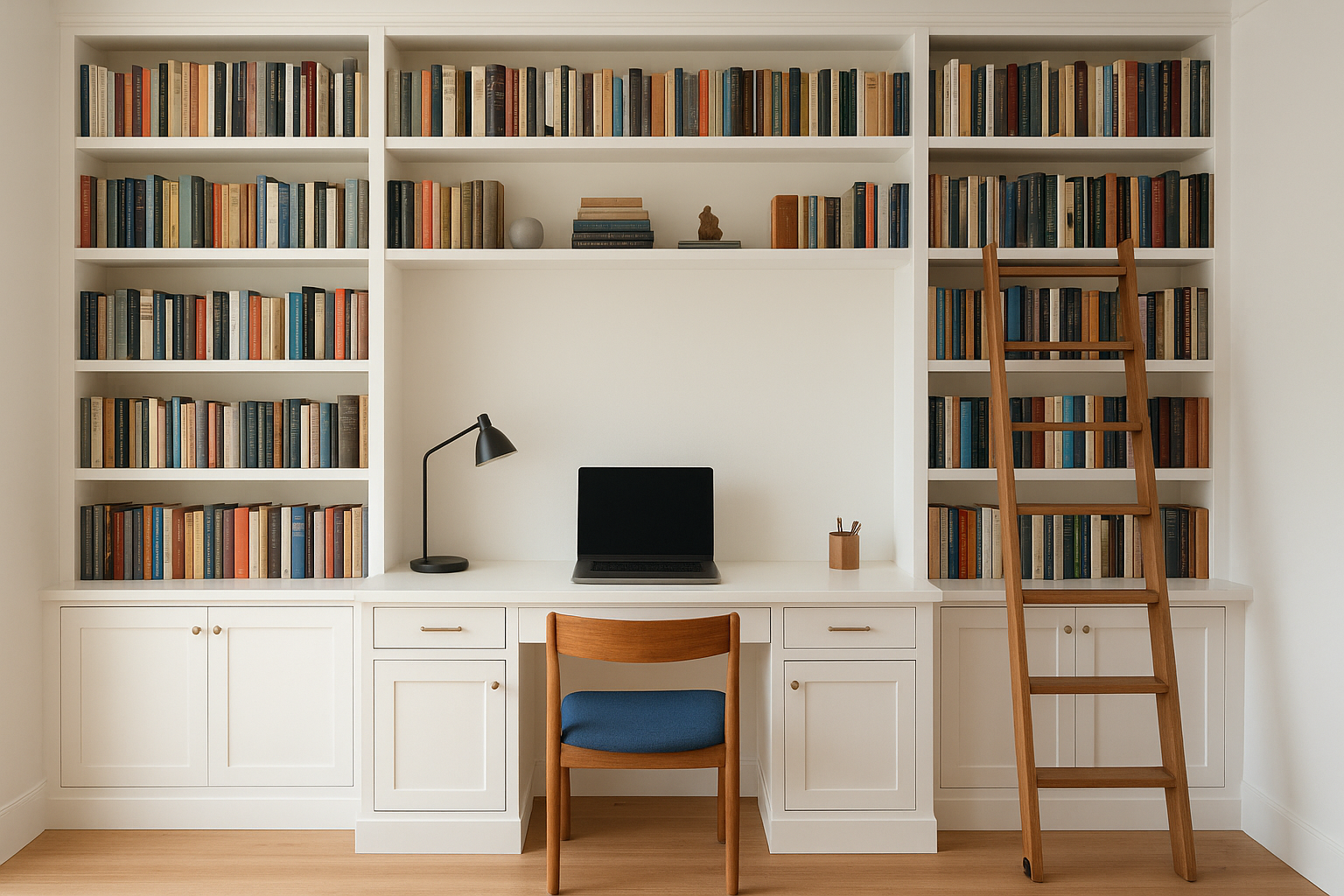
A library-style setup frames your desk between floor-to-ceiling bookshelves on both sides, creating a home office built-ins with desk layout that feels anchored and intentional. The desk sits centered on the wall, with shelving flanking it symmetrically from floor to ceiling on each side.
Best for
This design works best for anyone who handles large reference collections, needs display space alongside a work surface, or simply wants a room that reads as a proper study. It suits dedicated home offices with at least ten feet of wall width to keep the proportions from feeling cramped.
Shelf spacing and a balanced layout
Plan your shelf heights before ordering materials, since mixing taller lower shelves with tighter upper spacing gives you flexibility for both oversized books and standard volumes. A consistent reveal between shelf edges and the desk face frames keeps the unit looking cohesive rather than assembled in pieces.
Locking in shelf spacing during the design phase costs nothing; adjusting built shelves after installation costs significantly more.
Display vs closed storage mix
Open shelves on the upper runs put your books and objects on display, while closed lower cabinets beside the desk keep supplies, files, and equipment out of sight. Mixing both gives the unit visual depth and practical utility in one build.
Ladder, lighting, and reach considerations
If your shelves run above seven feet, a rolling library ladder gives you safe access to upper storage. Add integrated lighting strips under each shelf to eliminate shadows across the desk surface below.
Cost drivers and budget range
Library-style units involve significant linear footage and tall cabinet runs, which pushes costs higher than shorter builds. Expect to pay $9,000 to $22,000 in the Cape Cod area depending on shelf count, ladder hardware, and lighting.
6. Two-person built-ins with dual desks
A two-person home office built-ins with desk setup fits two full workstations into one room without two separate desks competing for floor space. Designing the unit so each person gets a distinct work surface and dedicated storage keeps the build cohesive while meeting two sets of needs at once.
Best for
This layout suits couples, roommates, or business partners who share a home office daily. It works best in rooms with at least 12 feet of usable wall width, giving each person enough space to work independently without feeling like they’re sharing a table.
Separating work zones and noise
A tall center divider cabinet between the two desks creates a physical buffer that cuts visual distraction without closing off the room entirely. You can reinforce the separation further by angling each desk slightly toward its own wall if your room layout allows.
Even a modest physical divider between two workstations measurably reduces distraction during calls and focused work.
Shared storage and printer placement
Place your shared storage in a center cabinet that both people can reach without crossing into the other’s zone. A built-in printer cabinet with a door keeps equipment out of sight at a neutral access point that works for both users.
Symmetry, seating, and legroom
Keep desk depth and height identical on both sides so neither workspace feels cramped compared to the other. Confirm each seat position has at least 24 inches of knee clearance below the surface before the design is finalized.
Cost drivers and budget range
Two full workstations with dedicated storage run $10,000 to $22,000 in the Cape Cod area. Divider cabinet height, drawer count, and finish choices are the main variables that move the number in either direction.
7. Mudroom or hallway command center desk built-ins
A mudroom or hallway command center turns a high-traffic transition zone into a home office built-ins with desk setup that handles daily logistics without needing a dedicated room. This design fits into wall space you already walk past every day, keeping your household organized from one central spot.
Best for
This layout suits busy households that need a hub for mail, charging, and scheduling without committing a full room to the task. It works especially well in homes where hallways or mudrooms connect the garage and kitchen, which is the natural landing zone for everything coming through the door.
Mail, charging, and calendar setup
Build in a shallow desk surface at counter height with a vertical slot organizer for incoming and outgoing mail. Add recessed outlets and USB ports along the back wall so devices charge in one dedicated spot rather than scattered across kitchen counters.
A single built-in charging station keeps cords out of shared living spaces for good.
Durable surfaces and easy-clean finishes
High-traffic areas need hard-wearing surfaces like maple or painted MDF with a satin topcoat that wipe down without scuffing. Skip open-grain wood stains in this zone since dirt and fingerprints embed quickly in porous finishes near an entry point.
Hooks, cubbies, and closed drop-zone storage
Add individual cubbies per family member above the desk surface for bags, gear, and loose items. Closed lower cabinets below the work surface keep bulky everyday items out of sight until they’re needed.
Cost drivers and budget range
Mudroom command centers typically run $3,500 to $9,000 in the Cape Cod area. Cubby count, hook hardware, and outlet installation are the main variables that shift the final number.
Next steps
Every home office built-ins with desk setup on this list solves a real layout problem, but the right one depends on your room’s specific dimensions, how you actually work, and what you need to store. Take stock of your wall space, your daily habits, and your storage priorities before settling on a direction. That groundwork makes the design conversation with a builder far more productive from the first meeting.
Custom millwork built specifically for your room will always outperform a prefabricated unit you adapt to fit. Hand-built pieces account for your existing trim, outlets, windows, and ceiling height in ways that stock cabinetry simply cannot. If you’re ready to move from ideas to a real plan, reach out to Suman Custom Carpentry to talk through your project. We design and build every piece in our Cape Cod shop, and we’ll work with you from the first sketch through final installation.