
Home Office Custom Cabinets: What They Are & What to Expect
Your home office probably looks like every other room in the house that lost the storage battle: cables tangled behind a desk, files stacked on the floor, a bookshelf that doesn’t quite fit the wall. Home office custom cabinets solve that problem by building storage around how you actually work, not around whatever dimensions a big-box retailer decided to stock.
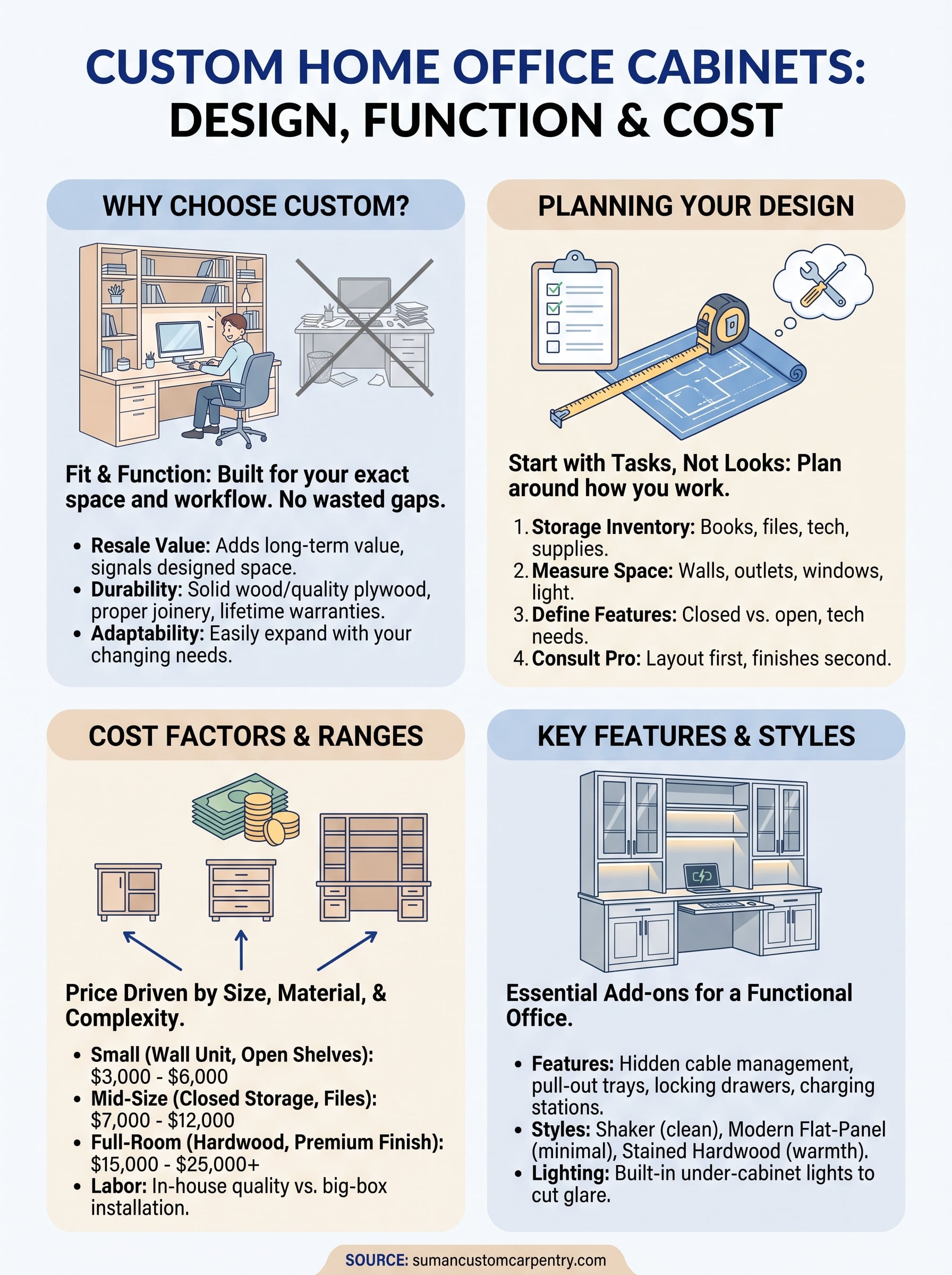
If you’re searching for this, you’re likely trying to figure out what these systems actually include and what they’ll cost you. Custom home office cabinets typically combine desks, file drawers, bookshelves, and closed storage into one built-in system designed for your exact space. Pricing depends heavily on materials, size, and finish work, and the cost of home office built-ins can range from a few thousand dollars for a simple wall unit to well over $20,000 for a full-room installation with premium hardwood and custom finishes.
This article walks through what home office built-ins are, the features worth considering, and realistic price ranges so you know what to expect before you contact a carpenter or design firm.
Why custom cabinets make sense for a home office
Stock cabinets get built for average rooms, not your room. When you buy a prefab unit from a furniture store, you’re stuck with whatever width, depth, and configuration the manufacturer decided worked for most people. Custom cabinets home office installations skip that compromise entirely. A carpenter measures your actual walls, accounts for that awkward jog where the closet sticks out, and builds storage that uses every inch instead of leaving gaps that collect dust and clutter.
Function matters more in a home office than almost anywhere else in the house. You’re not just storing books, you’re managing cables, chargers, printer paper, tax documents, and probably a second monitor you don’t want sitting on exposed shelving. Custom work lets you dictate exactly where the power outlets land, how deep the file drawers run, and whether you need a pull-out keyboard tray or a hidden charging station built into the desk surface. None of that comes standard on a retail bookshelf.
Custom cabinetry turns a home office from a room with furniture in it into a workspace built specifically for how you work.
Resale value is the other piece people underestimate. A well-built home office has become a real selling point since remote work became permanent for millions of households. According to the U.S. Bureau of Labor Statistics, a significant share of employed people still work from home at least part of the week, and buyers touring homes notice when a office looks like an afterthought versus a designed space. Home office custom cabinets signal to a future buyer that the room was planned, not just furnished, and that kind of built-in quality tends to hold value better than movable furniture that walks out the door with the seller.
Durability separates custom work from retail furniture too. Big-box cabinets often use thin particleboard and stapled joints that loosen within a few years, especially under the weight of loaded file drawers or a printer shelf. A carpenter building custom cabinetry uses solid wood or high-grade plywood with proper joinery, doweled or dovetailed drawers, and hardware rated for daily use. That’s why a shop like Suman Custom Carpentry backs its custom cabinetry with a lifetime warranty on the boxes and doors, something you’ll rarely see attached to a flat-pack unit.
Finally, custom cabinets adapt as your work changes. Maybe you start with a simple desk and shelving, then add a closed cabinet for a second monitor setup or a filing system for a growing business. Because the design gets planned around your space from the start, expanding or reconfiguring later is far easier than retrofitting furniture that was never meant to be modular.
How to plan your custom home office cabinet design
Start with how you actually work, not how a showroom photo looks. Walk through your daily routine: do you take video calls that need a clean background, print constantly, or store client files that require locked storage? Write down every task the room needs to support before you sketch a single shelf. Custom cabinets for home office projects go wrong most often when the homeowner designs for looks first and function second, then discovers six months in that there’s nowhere to put the label maker or the second monitor box.
Measure the room properly before you talk to anyone about design. You need wall height, width, ceiling height, window and door placement, and the location of every outlet, vent, and switch. Note where natural light falls during the hours you work, since a desk facing a bright window creates glare on screens.
A good custom cabinet plan starts with a list of tasks, not a list of finishes.
Here’s a simple checklist to bring to your first design consultation:
- Storage inventory: books, files, supplies, equipment you need to house
- Work style: sitting, standing, or a mix, and whether you need a return or L-shaped desk
- Tech needs: outlet placement, cable management, printer location
- Closed vs. open storage: what needs to stay hidden versus what you want on display
- Future growth: room to add filing or shelving as your work changes
Once you have that list, bring it to a carpenter or designer rather than starting with a Pinterest board. A good shop will translate your task list into a layout, then show you material and finish options that fit your budget. This order matters: function drives the layout, and the layout drives the finish choices, not the other way around.
What custom home office cabinets cost
Pricing for a home office built-in comes down to three variables: size, material, and complexity. A small wall unit with open shelving and a simple desk might run $3,000 to $6,000. A full-room installation with a wraparound desk, closed cabinets, file drawers, and premium hardwood finishes can climb past $20,000. The cost of home office built ins scales with linear footage more than anything else, so a 12-foot wall costs roughly double what a 6-foot wall costs, assuming similar materials.
Size and material drive most of the price, so decide what you actually need before you start comparing quotes.
Material choice moves the number the most. Painted MDF or plywood with a paint-grade finish sits at the lower end. Solid hardwood, stained finishes, and specialty features like glass-front cabinets or integrated lighting push the price up fast. Here’s a rough breakdown to set expectations:
| Project scope | Typical price range |
|---|---|
| Small wall unit, open shelving, simple desk | $3,000 – $6,000 |
| Mid-size built-in with closed storage and file drawers | $7,000 – $12,000 |
| Full-room system, hardwood, custom finishes | $15,000 – $25,000+ |
Labor is the other half of the equation, and it’s where quality actually shows up. A shop hand-building everything in-house, measuring your space precisely, and installing with proper joinery charges more than a big-box installer slapping together pre-cut panels, but the finished product lasts decades instead of years. When you’re comparing quotes, ask what’s included: design consultation, delivery, installation, and warranty coverage all vary between shops, and a lower number sometimes hides a shorter warranty or cheaper hardware. Get at least two or three quotes before committing, and ask each carpenter to break down material cost separately from labor so you can see where your money actually goes.
Styles and features to consider for your cabinets
Style should match the rest of your home, but a home office also needs features a living room built-in doesn’t. Shaker-style doors with a painted finish read as clean and versatile, working in colonial capes and newer coastal builds alike here on Cape Cod. Modern flat-panel doors with minimal hardware suit a more contemporary house. Stained hardwood, oak or maple especially, adds warmth and tends to photograph well for resale listings, which matters if you’re thinking about long-term value as much as daily use.
Beyond the door style, the features you choose determine whether the office actually functions day to day. Custom home office cabinets can include a lot more than a desk and a shelf, and it’s worth deciding upfront which of these you actually need versus which ones sound nice but won’t get used:
- Pull-out keyboard trays to free up desk surface
- Hidden cable management channels built into the desk and cabinet backs
- Locking drawers for client files or sensitive documents
- Adjustable shelving so book heights and equipment sizes aren’t fixed
- Built-in lighting under upper cabinets or shelves to cut glare on screens
- Charging stations integrated into a drawer or cabinet interior
Glass-front upper cabinets look good for displaying books or awards but add cost and show dust, so weigh that against a fully closed cabinet if low maintenance matters more to you. Countertop material also deserves a decision early, since a durable quartz or laminate surface holds up to daily typing and coffee cups far better than an unfinished wood top.
The best feature list is the one built around what you’ll actually use every day, not what looks good in a showroom photo.
Working through a shop’s custom cabinetry options before you finalize a design helps you see what’s realistic for your budget and space.
Choosing a carpenter for your custom cabinetry
Not every carpenter who builds a deck or hangs doors is equipped to design and build custom cabinets for home office installations, which is where knowing when to call a carpenter for specialized cabinet work comes in. Cabinet work requires a different skill set: precise joinery, an understanding of how wood moves with seasonal humidity, and the design sense to translate your task list into a working layout. Before you sign a contract, ask to see photos of finished home office projects specifically, not just kitchens or bathrooms, since the storage and desk requirements differ quite a bit from other rooms.
Insurance and warranty coverage tell you more about a shop than a glossy portfolio does. Ask whether the carpenter is fully insured, how long they’ve been in business, and what happens if a drawer slide fails or a door warps two years down the road. A shop confident in its own work backs it with a real warranty, not a vague promise. Suman Custom Carpentry, for example, covers cabinet boxes and doors with a lifetime warranty and offers a three-year warranty on painted finishes, which reflects the durability of hand-built work over mass-produced alternatives.
A strong warranty is the clearest sign a carpenter trusts their own craftsmanship.
Where the work happens matters too. A shop that builds everything in-house, rather than outsourcing cabinet boxes to a wholesale supplier, controls quality from the first cut to final installation. That matters most on Cape Cod, where humidity and salt air stress wood and finishes differently than they do inland, and a local carpenter who’s dealt with those conditions for years will make better material choices than a national chain unfamiliar with coastal homes.
Finally, pay attention to communication during the quote process. A carpenter who asks detailed questions about how you work, walks your space in person, and explains material tradeoffs clearly is more likely to deliver a design that actually fits your daily routine.
Making your home office work for you
A home office should earn its place in your house, not just occupy square footage. Home office custom cabinets give you storage that fits your actual work instead of forcing your work to fit generic furniture. You’ve seen the planning steps, the cost ranges, and the features worth prioritizing, so you’re in a good spot to start sketching what your space needs rather than guessing at what a showroom sells.
Getting there means starting with your daily tasks, measuring carefully, and picking a carpenter who builds in-house and stands behind the work with a real warranty. Skip that groundwork and you end up with the same mismatched shelving you started with, just more expensive.
If you’re ready to turn that task list into a workable design, reach out to Suman Custom Carpentry for a consultation built around your space, your budget, and how you actually work.