
If you’ve been pricing out a kitchen remodel, you’ve probably run into three tiers: stock, semi-custom, and full custom. Semi-custom kitchen cabinets sit in the middle, giving you standard box sizes with room to adjust finishes, door styles, and interior configurations without paying full custom rates. That flexibility is exactly why so many homeowners search for semi custom cabinets near me before committing to a design.
This guide breaks down what you’re actually paying for at each price point, how semi-custom stacks up against full custom cabinetry, and which brands and local retailers on Cape Cod are worth a look. You’ll also see where semi custom built-ins fit into closets, mudrooms, and bathroom vanities, since the same pricing logic applies there too.
We’ve spent years building hand-built cabinetry in our Hyannis shop, so we know exactly where semi-custom lines fall short and where they make sense for your budget and timeline. Read on for real numbers, real trade-offs, and honest advice before you sign a contract.
Why semi-custom cabinets appeal to homeowners
Most homeowners land on semi-custom cabinets because stock options feel too limiting and full custom feels too expensive for a kitchen that doesn’t need reinvented architecture. Semi-custom lines start from a manufacturer’s existing cabinet boxes, then let you dial in the finish, door profile, wood species, and a handful of interior configurations. You’re not designing from a blank sheet, but you’re also not stuck with whatever a big-box store happens to stock in a warehouse three states away.
A faster path than full custom shops
Because the box construction is already standardized, semi-custom lead times typically run 4 to 8 weeks from order to delivery, compared to the 40 to 60 days you’d budget for a fully custom kitchen built from scratch. That difference matters if you’re working around a closing date, a contractor’s schedule, or a family that can only live without a working kitchen for so long. Manufacturers keep base cabinet dimensions, hinge hardware, and drawer glide systems consistent across their catalog, which is what lets them turn around a modified order faster than a shop building every box by hand.
Semi-custom cabinets give you real design control without the full-custom wait or price tag.
Enough flexibility to solve real layout problems
Benjamin Moore paint colors and trendy door styles get all the attention, but the bigger value in semi-custom lines is functional. You can usually request:
- Modified cabinet widths and heights in 3-inch increments to fit an odd wall or ceiling height
- Deeper upper cabinets for tall stand mixers or bulky serveware
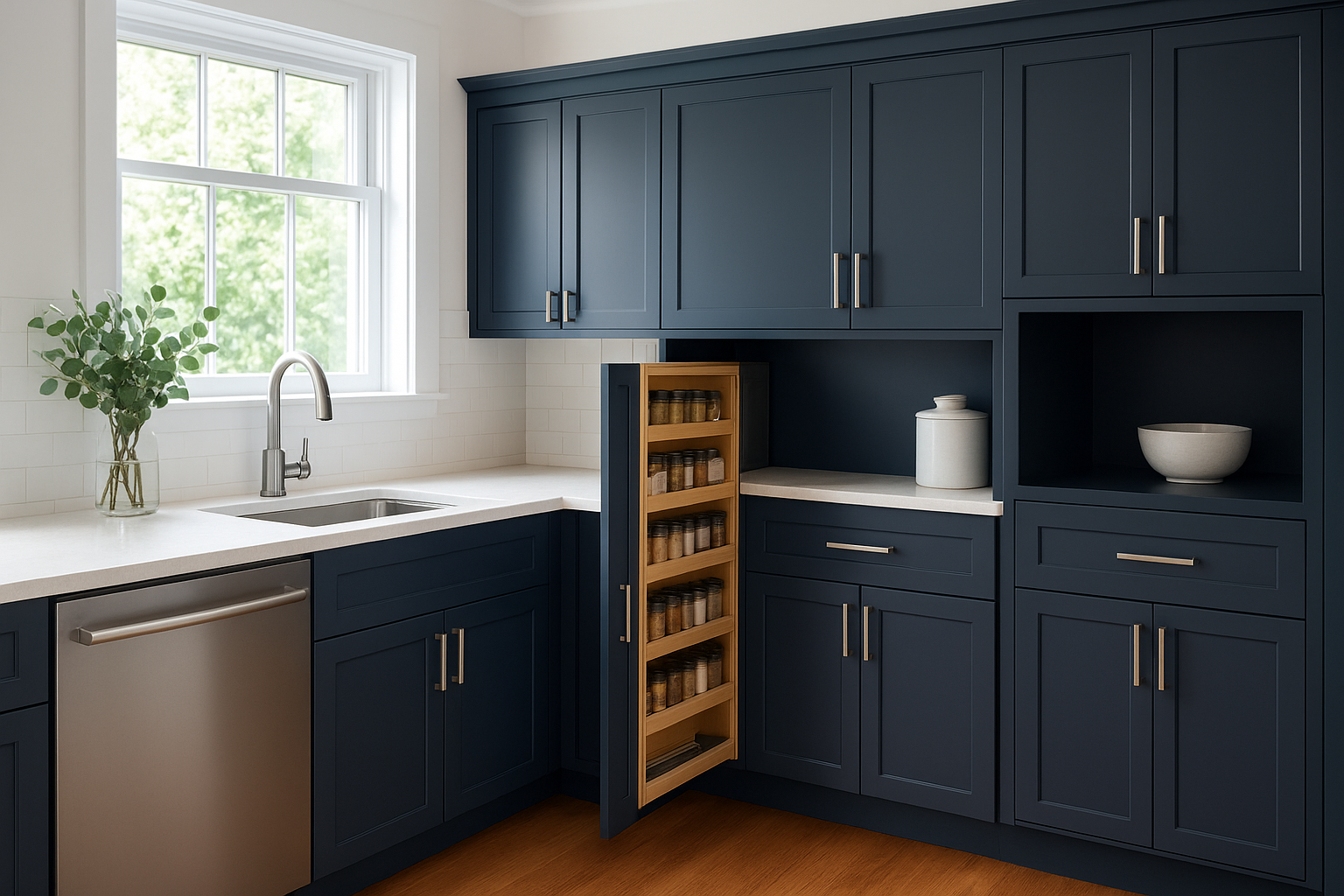
- Pull-out spice racks, trash pullouts, and blind-corner Susans built into standard boxes
- Furniture-grade panels and matching end caps for islands or exposed sides
- A choice of soft-close hinges, dovetail drawer boxes, and plywood versus particleboard construction
Combine two or three of these and you’ve solved the layout headaches that stock cabinets can’t touch, at a fraction of what a fully custom shop would charge for the same fixes.
Fitting closets, mudrooms, and bathrooms too
Once homeowners understand how semi-custom works in a kitchen, they often ask about applying the same approach elsewhere. Semi custom built ins for a mudroom bench, a home office wall unit, or a bathroom vanity built to your space follow identical logic: standard cabinet modules, adjustable finishes, and a narrower set of size options than a fully custom build-out. That makes semi-custom a reasonable middle step for secondary rooms where you want a tailored look without commissioning a one-off design for every closet in the house.
Where the appeal has limits
We’ll be straight with you here. Semi-custom cabinets still come from a factory, which means you’re choosing from a catalog of pre-engineered options rather than getting a design built around your exact space. If your kitchen has an angled wall, a non-standard ceiling height, or a layout that doesn’t fit neatly into 3-inch increments, you’ll hit the edges of what semi-custom can accommodate. That’s usually the point where clients call our Hyannis shop instead, because hand-built cabinetry doesn’t have to compromise around a manufacturer’s size chart. For a straightforward kitchen with typical dimensions, though, semi-custom genuinely delivers most of the personalization homeowners want, at a price point that doesn’t require a second mortgage.
How to choose the right style and finish
Picking a door style before you’ve thought about your kitchen’s traffic pattern is how a lot of homeowners end up with cabinets they regret in five years. Start with how you actually use the space, not with a photo you saved from a design site. A shaker door in a painted white finish photographs well, but if you’ve got young kids and a lot of grease splatter near the stove, a slab door with a smooth catalyzed finish wipes down faster and shows less wear at the edges.
Match the door profile to your kitchen’s age and layout
Semi-custom kitchen cabinets typically offer three or four cabinet door styles per line: shaker, raised panel, slab, and sometimes a beadboard option for coastal or farmhouse looks. Shaker remains the safest choice because it reads as both traditional and modern, which matters if you’re planning to sell the house within ten years. Raised panel doors suit older colonial-style homes on Cape Cod, but they trap dust in the grooves and take longer to clean. Slab doors work best in smaller galley kitchens where visual clutter needs to stay to a minimum.
Choose the door profile that matches how you clean and cook, not just how it looks in a showroom.
Finish choices that hold up on Cape Cod
Humidity and salt air change how finishes perform here in ways manufacturers rarely mention in their brochures. Painted finishes look sharp on day one, but a lower-grade catalyzed paint can show hairline cracking at the joints within two or three years of coastal humidity swings, so it helps to know how paint, stain, and glaze finishes differ before you choose. Ask any semi-custom manufacturer for their paint warranty terms in writing, and compare that against the 3-year warranty we offer on painted cabinetry, since it tells you how confident they actually are in their own coating process.
| Finish Type | Best For | Maintenance Level |
|---|---|---|
| Painted (white/gray) | Bright, resale-friendly kitchens | Moderate, watch for chipping |
| Stained wood | Traditional or farmhouse styles | Low, hides minor scratches |
| Thermofoil | Budget-conscious remodels | Low, but peels near heat sources |
| Glazed finishes | Ornate, traditional kitchens | High, grooves collect dust |
Finally, don’t finalize hardware until the door and finish are locked in. Kitchen cabinet hardware ideas like pulls and knobs in matte black or brushed brass can shift a kitchen from builder-grade to custom-looking for a few hundred dollars, and most semi-custom lines let you swap hardware without touching the base price of the boxes themselves.
What semi-custom kitchen cabinets cost
Budget somewhere between $150 and $400 per linear foot for semi-custom kitchen cabinets, with a typical 10-foot kitchen running $6,000 to $18,000 for cabinets alone before installation, countertops, or hardware upgrades. That range feels wide because it is, and the gap comes down to wood species, finish quality, and how many modifications you stack onto the base boxes. A painted maple shaker line with standard sizing lands near the bottom of that range, while a stained cherry line with deep drawers and furniture panels pushes toward the top.
What actually moves the price
Manufacturers price semi-custom cabinets by adding modifiers on top of a base box cost, and those modifiers add up fast if you’re not tracking them. Expect line-item charges for:
- Wood species upgrades (maple and oak cost less than cherry or walnut)
- Custom widths outside the standard 3-inch increments
- Soft-close hinges and dovetail drawer boxes as an upgrade over standard glides
- Specialty storage inserts like pull-out spice racks or blind-corner units
- Finish level, since a hand-glazed or distressed finish costs more than a flat painted door
A semi-custom kitchen’s final price depends far more on your modification list than on the base cabinet line you started from.
A realistic cost breakdown
Here’s roughly how a mid-range 10-foot kitchen breaks down once you move past the base cabinet price:
| Cost Component | Typical Range |
|---|---|
| Base cabinet boxes | $4,000-$9,000 |
| Finish and door style upgrade | $1,000-$3,000 |
| Interior storage modifications | $500-$2,000 |
| Hardware (pulls, knobs, hinges) | $300-$800 |
| Delivery and installation | $1,200-$3,000 |
Notice that installation alone can rival the cost of the modifications you picked, which is where a lot of homeowners get caught off guard mid-project.
Where hand-built cabinetry changes the math
Once your modification list gets long enough, a semi-custom quote can creep uncomfortably close to what a fully hand-built kitchen costs, without giving you the exact fit or lifetime warranty that comes with true custom work. That’s the point where it’s worth getting a second quote from a local shop before locking into a semi-custom order. If you’re at that crossover point, our custom kitchen cabinet team can walk you through real numbers for your layout before you commit to a catalog line.
Where to buy semi-custom cabinets
Once you know what to budget, the next question is where to actually place the order. Homeowners typing semi custom cabinets near me into a search bar usually land on one of three paths: a national home improvement chain, an independent kitchen and bath dealer, or a local carpentry shop that also handles semi-custom lines alongside custom work. Each option changes your lead time, your design support, and how much hand-holding you get if something arrives damaged or measured wrong.
National retailers and home centers
Stores like Home Depot and Lowe’s sell semi-custom lines through in-house brands, and they’re worth a look if you want a straightforward process with a fixed design appointment and predictable pricing. Big-box retailers typically use a design software tool that generates a layout in one visit, which works fine for a standard rectangular kitchen but struggles with anything unusual. The tradeoff is limited access to the person actually building your cabinets. If a drawer arrives with a warped face or the wrong hinge type, you’re troubleshooting through a call center rather than a person who saw your kitchen in person.
The convenience of a big-box order comes with a real cost: nobody who touches your cabinets has seen your kitchen.
Independent dealers and showrooms
Smaller kitchen and bath showrooms carry semi-custom lines from cabinet brands like KraftMaid, Schrock, or Waypoint, and they generally offer more design attention than a chain store. A dealer walks your space, measures it themselves, and can flag modification options a big-box associate might miss. Expect to pay slightly more than a home center for the same cabinet line, since you’re covering the dealer’s design time and local service.
Local carpentry shops that bridge both worlds
Some local cabinet makers, ours included, sell semi-custom lines for clients who don’t need a fully custom kitchen but still want a real conversation about layout, storage, and finish before signing a contract. That matters most when your kitchen has quirks a catalog can’t solve cleanly, an odd bump-out, a low soffit, an appliance that needs a non-standard opening. Working with a shop that also builds hand-built cabinetry in-house means you get an honest answer about whether semi-custom will actually work for your space, or whether a small custom modification will save you money down the line. Our design consultation covers both paths, so you’re not guessing which route fits your kitchen before you commit.
Semi-custom vs. fully custom cabinets and built-ins
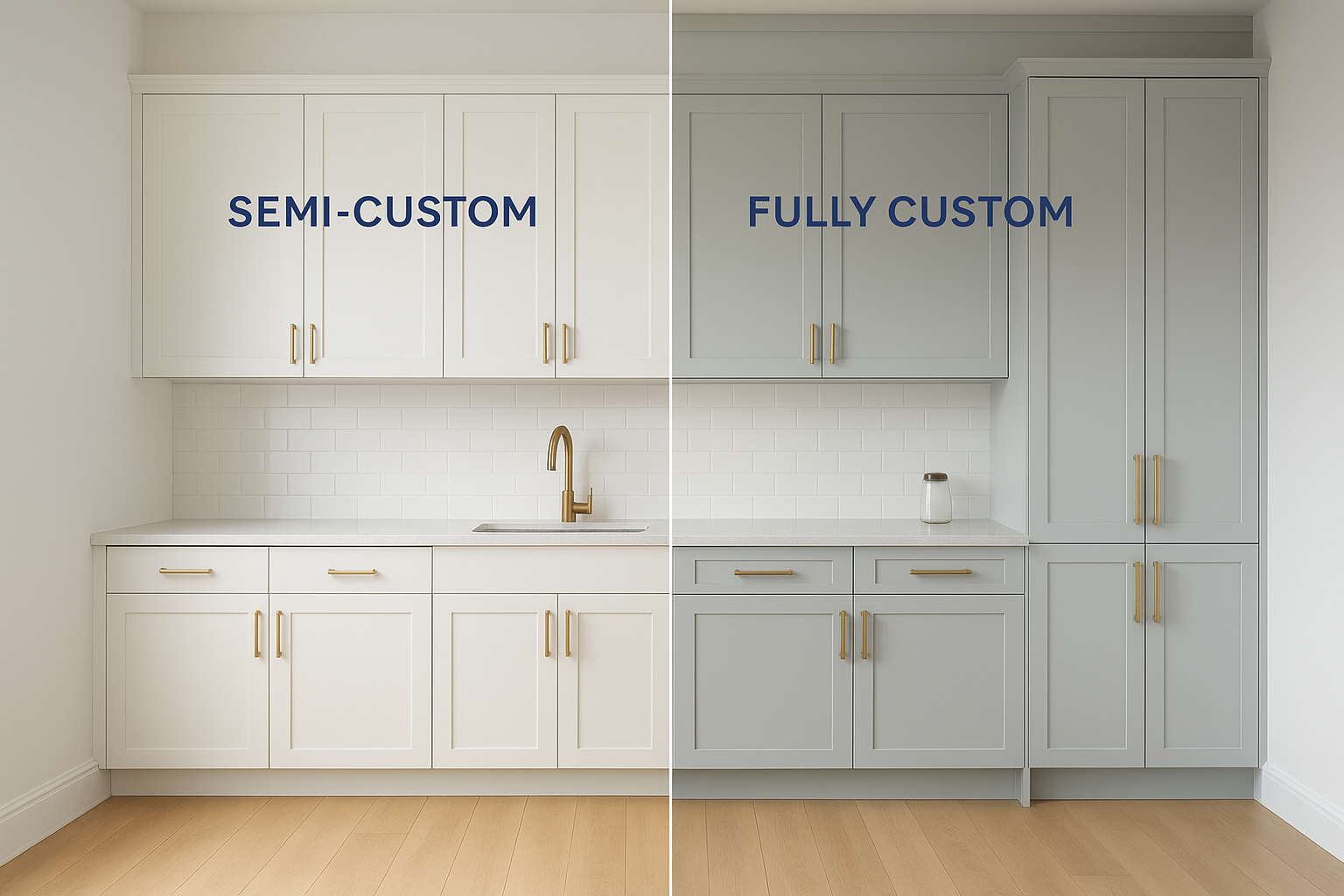
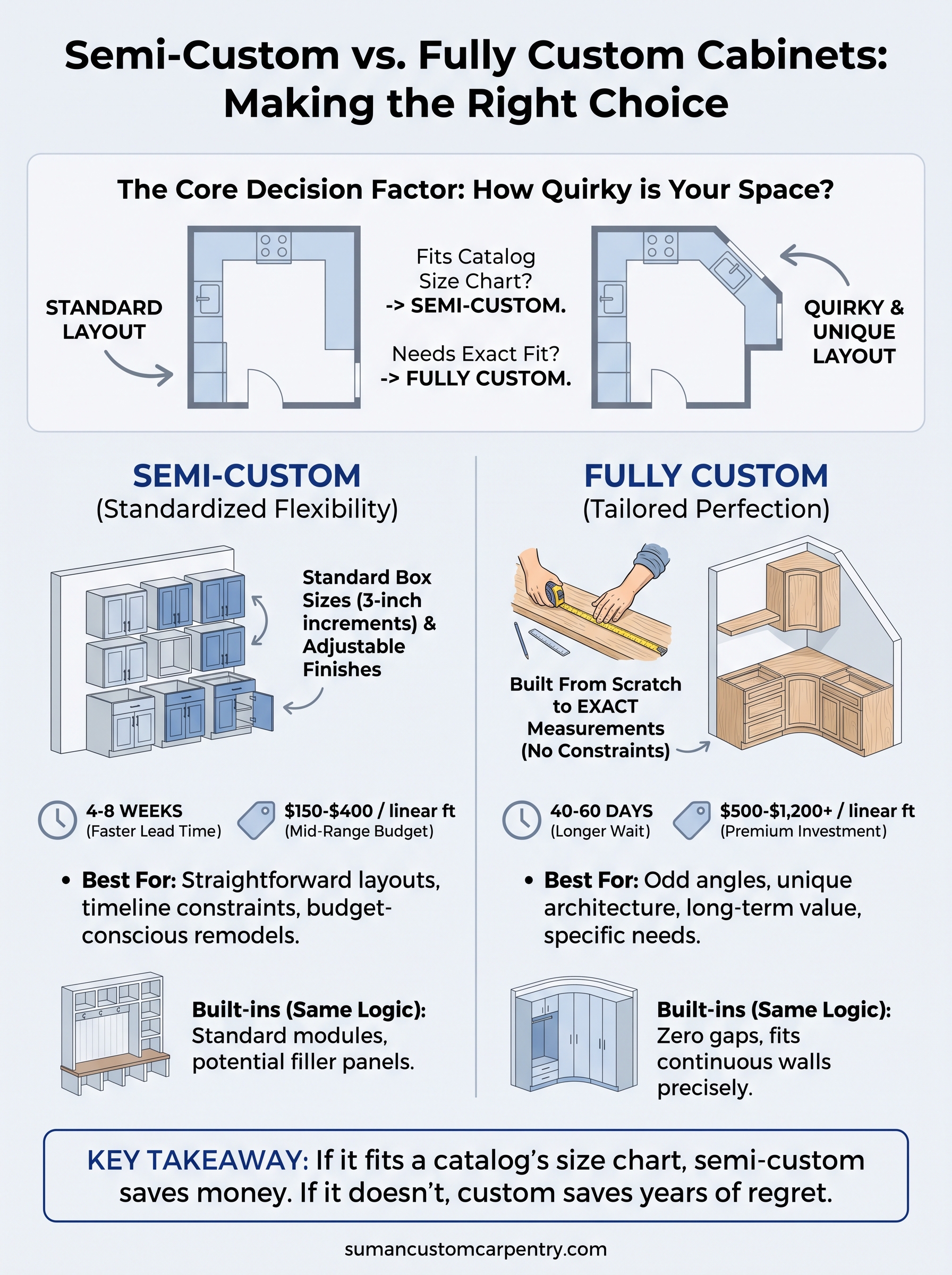
Deciding between semi-custom and fully custom cabinetry comes down to how much your kitchen deviates from a standard rectangle. Semi-custom works from a manufacturer’s existing box sizes and lets you adjust finishes, storage inserts, and a handful of dimensions in 3-inch increments. Full custom starts with a blank measurement of your actual walls, ceiling height, and appliance openings, then builds boxes to match that space exactly. Neither option is objectively better. The right pick depends on whether your kitchen has quirks a catalog can solve or quirks that need a carpenter standing in the room.
A side-by-side look at the real differences
Seeing the two side by side makes the tradeoffs easier to weigh than reading specs one at a time.
| Factor | Semi-Custom | Fully Custom |
|---|---|---|
| Lead time | 4-8 weeks | 40-60 days |
| Sizing flexibility | 3-inch increments | Built to exact measurements |
| Price per linear foot | $150-$400 | $500-$1,200+ |
| Warranty | Varies by manufacturer | Lifetime on boxes and doors (our standard) |
| Construction | Factory-assembled | Hand-built in-house |
If your kitchen fits a catalog’s size chart, semi-custom saves money. If it doesn’t, custom saves you from years of regret.
Where built-ins tip the scale toward custom
Outside the kitchen, semi custom built ins run into the same 3-inch ceiling that limits semi-custom kitchen boxes. A mudroom bench under a sloped ceiling, a bookshelf wall around a chimney chase, or a closet system with an odd corner rarely lines up with standard module widths. You end up with filler panels and awkward gaps that a factory line simply can’t avoid, because it wasn’t built to know your specific wall existed. Fully custom built-ins solve that by measuring the actual space first and building around it, which matters more in built-ins than in kitchens since built-ins usually fill one continuous wall with zero room for adjustment later.
The warranty gap most homeowners overlook
Manufacturers back semi-custom lines with warranties that vary widely, and many exclude finish issues after the first year or two. Custom shops that build in-house, ours included, can offer a lifetime guarantee on cabinet boxes and doors because we control every step of construction rather than assembling parts shipped from a third-party factory. That difference matters most for coastal homes, where humidity swings test finishes and joinery harder than a showroom warranty document ever accounts for.
Making the right choice for your kitchen
Most kitchens with standard dimensions do well with semi-custom kitchen cabinets. You get real design control over finish, storage, and door style, without waiting on a fully custom build or paying custom-shop rates. Save the extra money for countertops or hardware upgrades if your walls, ceiling height, and appliance openings fall within normal ranges.
Quirky spaces tell a different story. Angled walls, low soffits, or a layout that won’t sit still in 3-inch increments push semi-custom past its limits fast, and that’s when a hand-built kitchen actually costs less over time than chasing modifications on a catalog line. The same logic applies to built-ins, where one bad filler panel can ruin an otherwise clean wall.
Not sure which side of that line your kitchen falls on? Book a design consultation for custom kitchen cabinets on Cape Cod with our Hyannis shop and we’ll give you a straight answer before you spend a dollar.