
Most people picture a carpenter framing houses or installing kitchen cabinets. But what does a commercial carpenter do is a different question entirely, and the answer involves a distinct set of skills, materials, and project demands that separate it from residential work. Commercial carpenters build and install woodwork and structures in offices, retail spaces, hospitals, restaurants, and other non-residential buildings, often working alongside general contractors and large construction crews.
At Suman Custom Carpentry, we handle both residential and commercial custom carpentry projects from our shop in Hyannis, Cape Cod. We’ve built custom millwork for local businesses and know firsthand how commercial jobs differ from the kitchens and built-ins we craft for homeowners. The scope is bigger, the timelines are tighter, and the materials often go beyond traditional wood.
This article breaks down the daily duties, required skills, typical projects, and career path of a commercial carpenter. Whether you’re considering the trade as a career or you’re a property owner trying to understand who you need to hire, you’ll walk away with a clear picture of what this role actually involves and how it compares to residential carpentry.
What commercial carpenters build and install
Commercial carpenters work on a wide range of structures that go well beyond what you’d find in a home. The scope of what does a commercial carpenter do becomes clear when you look at the variety of buildings they work in: retail stores, office complexes, hospitals, hotels, schools, and restaurants. Each of these spaces has specific structural and finish requirements that residential work rarely demands, and the scale of a single commercial project can involve dozens of carpenters working across multiple floors simultaneously.
Structural framing and rough carpentry
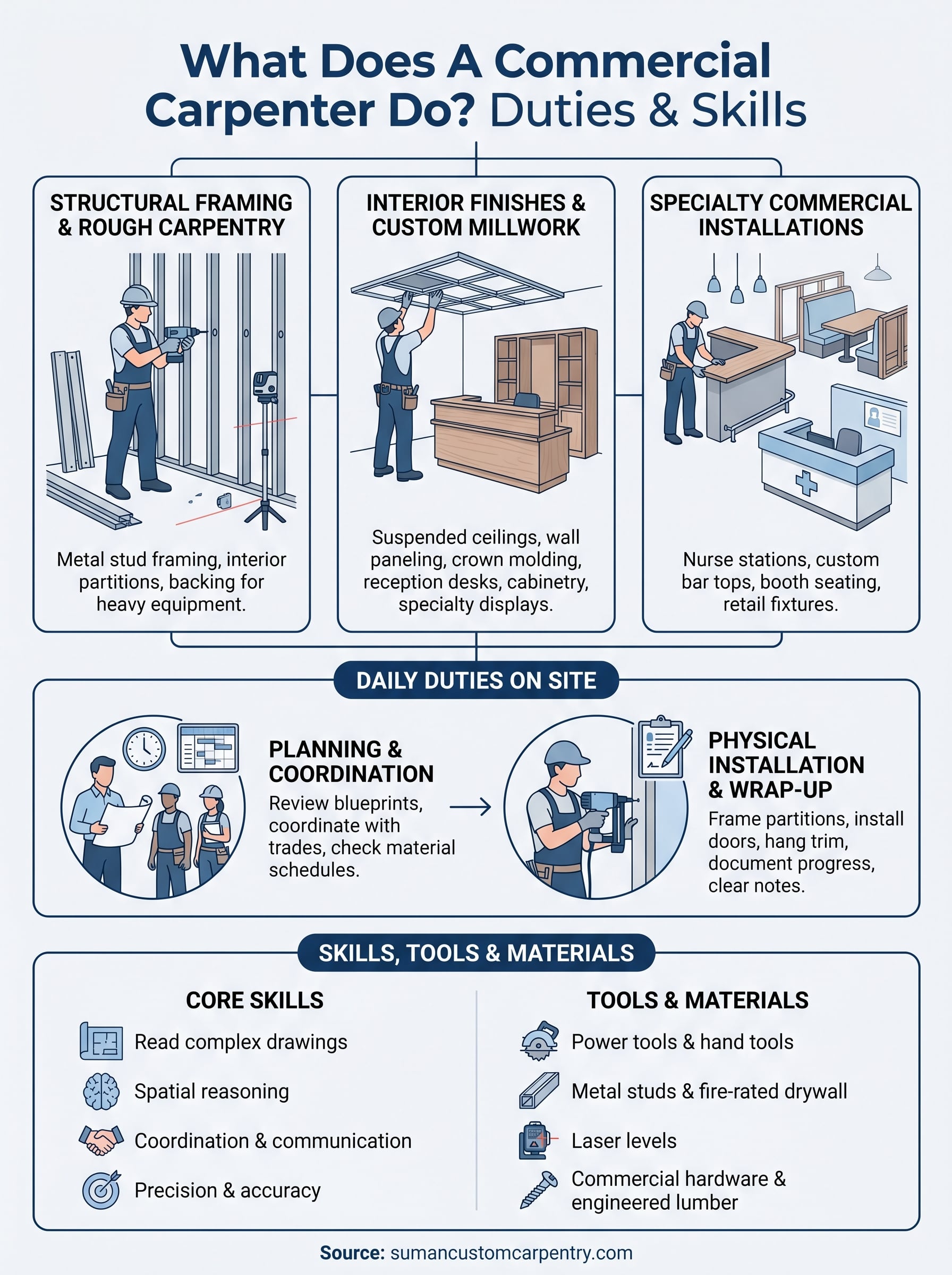
Before any walls get painted or floors get laid, a commercial carpenter handles the rough framing that gives a building its shape. In commercial construction, this often means working with metal stud framing rather than wood, since building codes in many commercial spaces require non-combustible materials. Carpenters measure, cut, and fasten steel studs to create interior partition walls, then install the blocking and backing needed to support everything that comes later, from heavy equipment mounts to built-in shelving systems. Getting this stage right directly affects every finish trade that follows.
Metal stud framing is one of the most fundamental skills that separates commercial carpenters from their residential counterparts.
Interior finishes and custom millwork
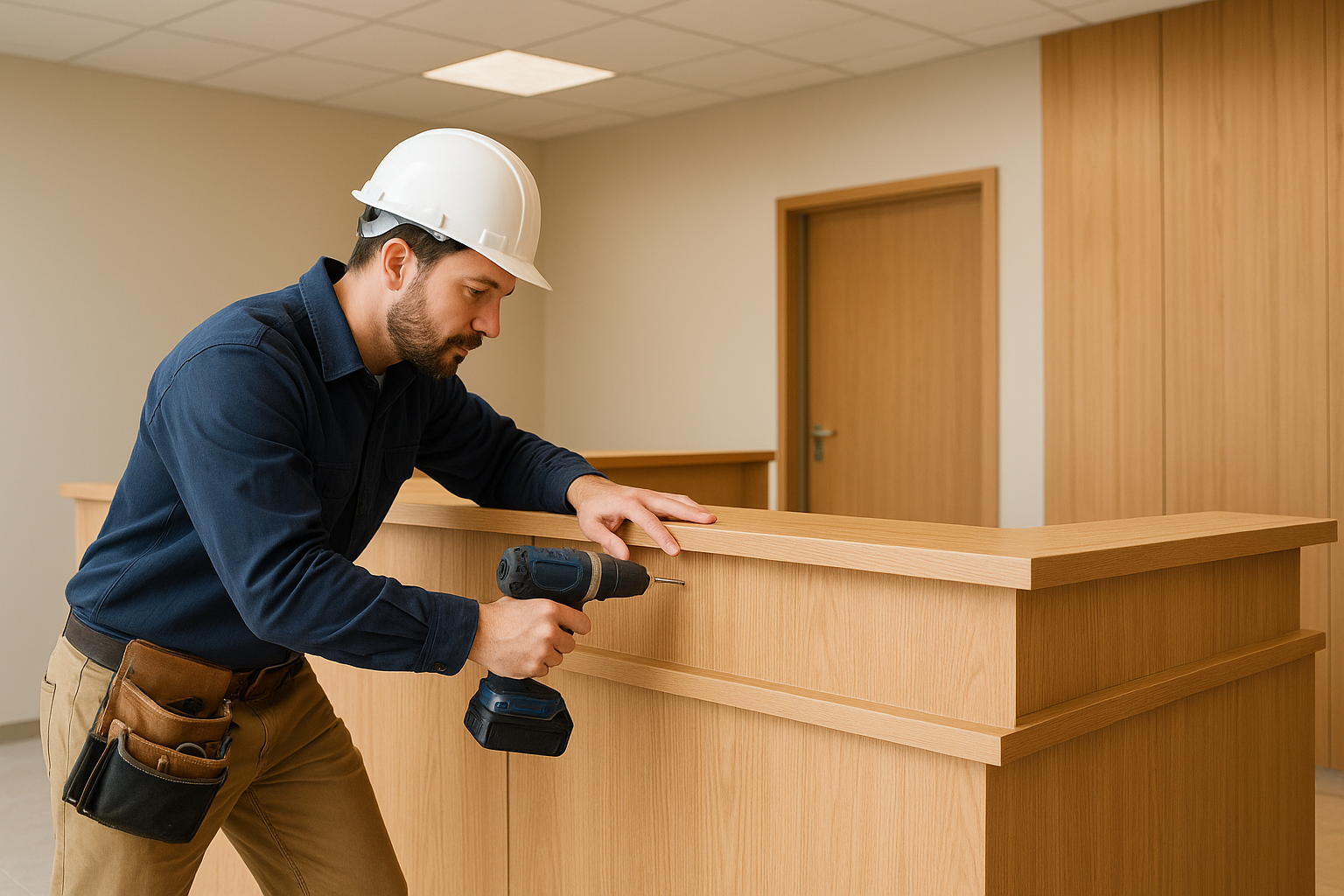
Once the rough structure is in place, commercial carpenters move into finish work. This includes installing suspended ceiling systems, acoustic tile grids, wall paneling, baseboards, crown molding, and door frames throughout large commercial spaces. In higher-end commercial projects, you’ll also see custom millwork: reception desks, built-in cabinetry, conference room walls, and specialty retail displays all fall under this category. The finishing details in a commercial space often carry the brand identity of the business, so precision and consistency across large areas matter significantly more than in a typical home renovation.
Specialty commercial installations
Some commercial carpentry work is highly project-specific. Carpenters working in hospitals install nurse stations and medical cabinetry built to strict hygiene and durability standards. Restaurant projects require custom bar tops, booth seating frames, and host stands built to handle heavy daily use. Retail buildouts involve fixture installation and display systems designed around specific product lines and floor plan requirements. Each setting brings its own set of demands, and experienced commercial carpenters adapt their methods and materials to match those conditions precisely.
Daily duties on a commercial job site
A commercial carpenter’s day starts before any cutting happens. You work alongside multiple trades simultaneously, and your schedule ties directly to what electricians, plumbers, and HVAC crews are doing. Understanding what does a commercial carpenter do on a given day means looking at both the physical work and the coordination responsibilities that keep a large project on track.
Reading plans and coordinating with trades
Each morning involves reviewing updated blueprints or shop drawings to confirm measurements before you pick up any tools. Changes happen frequently on commercial projects, and catching a revision before you cut saves hours of rework. You also spend time confirming that your framing or finish work won’t conflict with mechanical or electrical runs in the same walls.
Missing a plan revision on a commercial site doesn’t just affect your work, it can throw off every trade scheduled after you.
Common morning coordination tasks include:
- Checking for updated drawing revisions with the project superintendent
- Confirming sequencing with plumbers or electricians sharing the same wall cavities
- Reviewing material delivery schedules so your crew isn’t waiting on supplies
Physical installation and end-of-day wrap-up
On the tools side, you spend most of your time framing partitions, hanging doors, and installing trim. Commercial sites move fast, and your ability to work accurately under time pressure alongside other trades is what keeps a project on schedule.
Before finishing each day, you document your progress against the project schedule and flag anything that needs a foreman’s attention. Clear end-of-day notes prevent small issues from becoming costly delays the following morning.
Skills, tools, and materials they work with
Understanding what does a commercial carpenter do at a competency level means looking at three overlapping areas: the technical skills you develop over time, the tools you use daily, and the materials unique to commercial settings. These aren’t interchangeable with residential carpentry knowledge. Commercial environments demand faster execution, stricter tolerances, and familiarity with materials you’d rarely encounter in a home renovation.
Core skills you need
Commercial carpenters must read and interpret complex architectural drawings and construction documents accurately. A single misread dimension in a large commercial build can cascade into problems across multiple trades. Beyond blueprints, you need strong spatial reasoning and mathematical precision to lay out framing, calculate material quantities, and sequence your work around other crews. Communication also matters more than most people expect; you spend a significant part of your day coordinating with superintendents, subcontractors, and inspectors.
Accuracy with blueprints is not optional in commercial carpentry; it’s the baseline expectation before you pick up a single tool.
Tools and materials
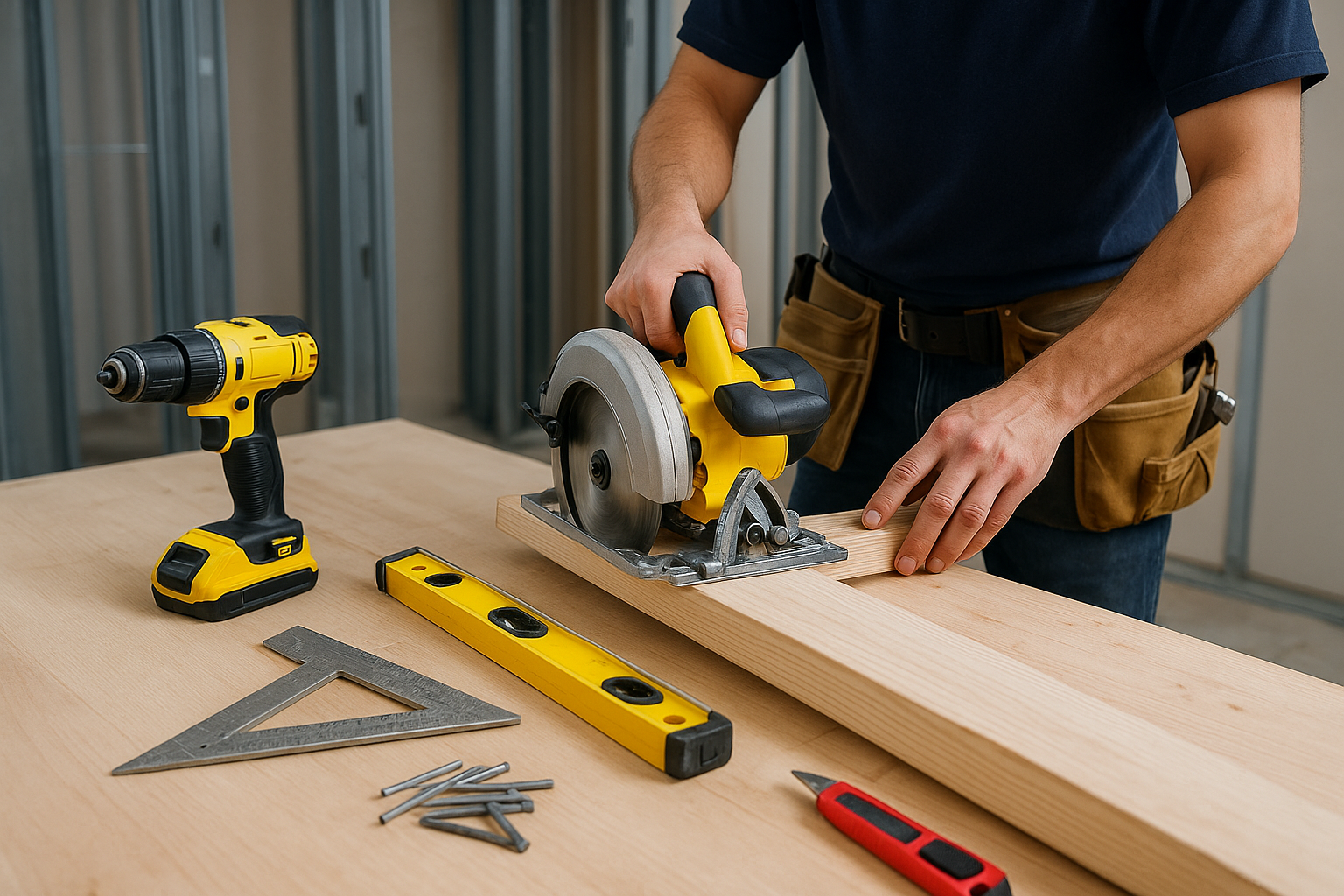
You use many of the same hand and power tools found in residential work, including circular saws, drills, nail guns, and levels. What shifts is your regular exposure to materials like metal studs, fire-rated drywall, commercial-grade hardware, and engineered lumber systems that rarely appear in home building. Laser levels and layout tools calibrated for large-scale spaces also become standard equipment, since small measurement errors compound quickly across hundreds of linear feet in a commercial environment.
Training, certifications, and career path
Most commercial carpenters start with a four-year apprenticeship through a union program or a joint apprenticeship training committee. These programs combine paid on-the-job hours with classroom instruction covering blueprint reading, building codes, and material handling. You don’t need a college degree to enter the trade, but completing a formal apprenticeship gives you a significant advantage over carpenters who only learn on the job.
Entry points and apprenticeship programs
The United Brotherhood of Carpenters runs one of the largest apprenticeship networks in the country, and enrolling through a regional council connects you to structured training that meets commercial site standards. Community college carpentry programs are another starting point, and they often feed directly into apprenticeships. Either route gets you working on real sites early, which is where the practical side of what does a commercial carpenter do actually takes shape.
The faster you get on a live commercial site, the faster you understand what separates classroom knowledge from real job performance.
Certifications and advancement
Once you complete your apprenticeship, you earn journeyman status, which opens the door to higher-paying commercial projects and leadership roles. Some carpenters pursue additional credentials in OSHA safety training, with the OSHA 30-Hour Construction certification being the most recognized standard on large commercial sites. From journeyman, the next step is foreman, then superintendent, and eventually project manager or contractor. Each level adds planning and coordination responsibilities on top of the hands-on work you already know.
Commercial vs residential carpentry
Understanding what does a commercial carpenter do compared to a residential carpenter comes down to three main differences: scale, materials, and accountability structure. Residential carpenters typically work with one homeowner on a single project, making decisions directly with the client on-site. Commercial carpenters answer to a general contractor, a project superintendent, and often a building owner who never visits the site, which changes how decisions get made and how quickly problems need to be resolved.
Scale and project structure
Commercial projects run on strict schedules tied to business opening dates or lease agreements, and delays cost real money. You’re not working alone or with a two-person crew; you’re coordinating with dozens of other tradespeople across a building that may span multiple floors. Residential work moves at a pace shaped partly by homeowner decisions and design changes, which creates a more flexible but less predictable workflow.
The accountability structure in commercial carpentry is tighter, and that changes how you approach every task on the site.
Skills overlap and what transfers
Many of the core techniques carry over between the two settings. Framing, finish carpentry, door installation, and trim work all appear in both commercial and residential jobs. What changes is the material set, the documentation requirements, and the pace. Residential experience gives you a strong technical foundation, but transitioning to commercial work means learning to operate within a larger system where your output directly affects multiple other crews downstream.
If you need custom commercial millwork
Now that you understand what does a commercial carpenter do, you can make a more informed decision when hiring for your next project. Commercial millwork requires a carpenter who handles the full scope, from initial design to final installation, with the kind of attention to detail that large-format commercial spaces demand. Off-the-shelf solutions rarely fit the specific layout, brand, or function requirements of a business interior.
At Suman Custom Carpentry, we build custom commercial millwork by hand at our Hyannis shop and manage every project from concept through installation. We work with business owners and property managers across Cape Cod who need built-ins, cabinetry, reception desks, and specialty woodwork that hold up to daily commercial use. Every piece carries our lifetime guarantee on cabinet boxes and doors. If you have a commercial project coming up, contact Suman Custom Carpentry to talk through what you need.