
You’ve walked through the kitchen cabinet aisle at a big box store and left more confused than when you started. Stock sizes that almost fit, finishes that look fine in the showroom but flat in your kitchen, and a salesperson who can’t answer basic questions about materials. If you’re searching for kitchen custom cabinets, you’re probably done settling for almost-right.
Here’s the direct answer: custom cabinets are built to your exact kitchen dimensions, your material choices, and your storage needs, not pulled from a warehouse and trimmed to fit. That means no wasted inches, no filler panels hiding gaps, and layouts designed around how you actually cook and store things. Whether you want a farmhouse look or custom modern kitchen cabinets with clean lines and hidden hardware, the process starts with design, not a catalog.
In this guide, we’ll break down what separates custom from stock and semi-custom, walk through the design and build timeline, and cover what pricing typically looks like on Cape Cod. We built this from years of hand-building cabinetry in our Hyannis shop, so you’ll know exactly what to expect before you order.
Why custom kitchen cabinets are worth the investment
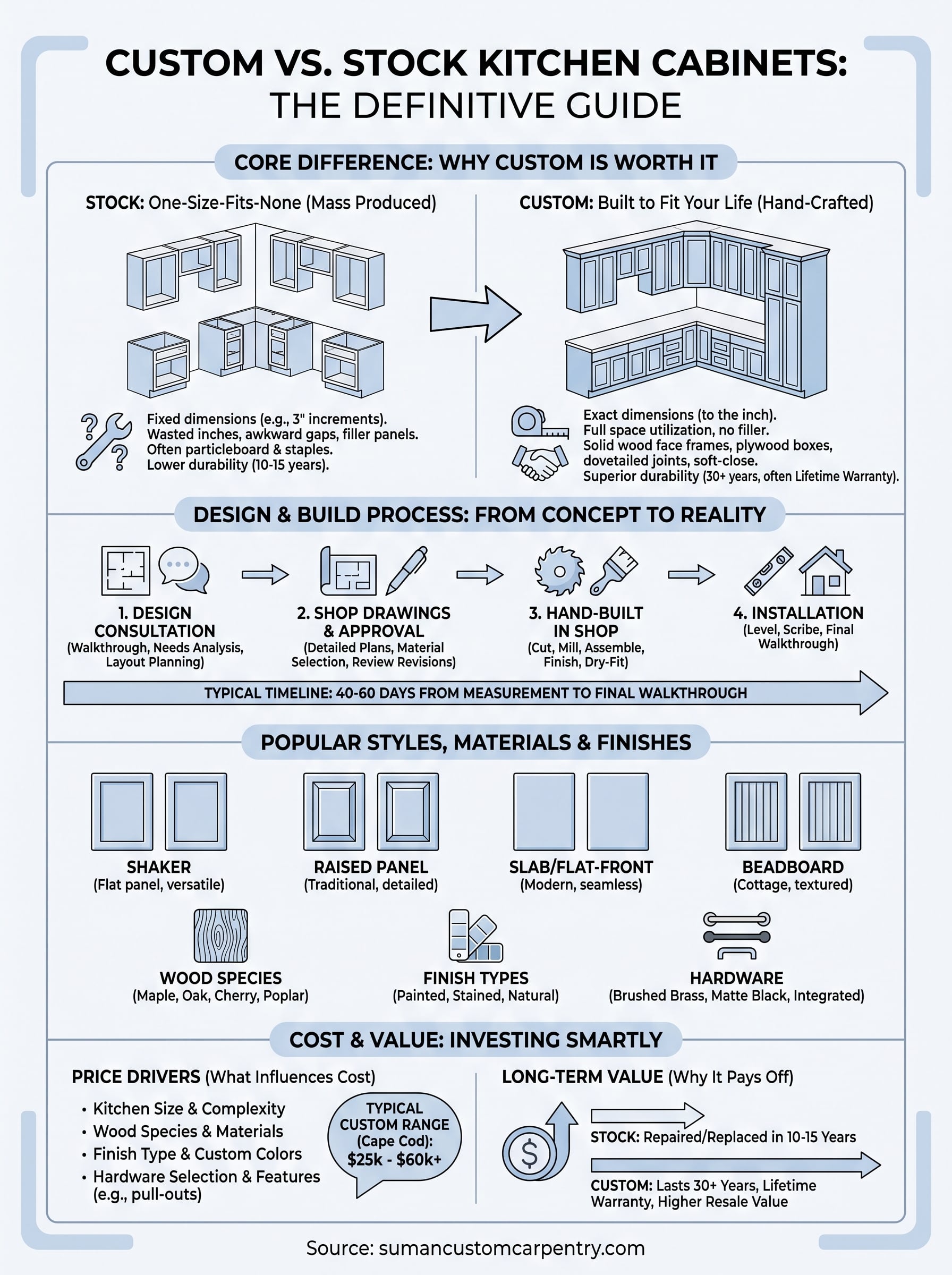
Stock cabinets come in fixed widths, usually 3-inch increments, which means your kitchen has to bend to fit the cabinets instead of the other way around. Custom cabinets kitchen designs start with a tape measure and end with cabinetry built to the exact inch, so you get full use of every corner, every soffit, and every awkward nook that a standard 36-inch run would waste. That precision alone often reclaims 15 to 20 percent more usable storage than a comparable stock layout, based on the walk-throughs we do with homeowners across Cape Cod.
A cabinet that fits your kitchen exactly will always outperform one that almost fits.
Quality matters just as much as fit. When you order custom made kitchen cabinets, you choose the plywood grade, the hardware, the finish, and the joinery method, not whichever spec keeps a factory’s costs down. Solid wood face frames, dovetailed drawer boxes, and soft-close hinges rated for tens of thousands of cycles show up standard in custom work, while many stock lines quietly swap those for particleboard and stapled joints you won’t notice until year three.
Longevity separates custom from mass-produced almost as much as fit does. A well-built custom kitchen, maintained normally, should last 30 years or more, while big box cabinetry often needs replacing or heavily repairing within 10 to 15 years, especially in a coastal climate like ours where humidity and salt air are hard on cheap materials. That’s why we back our custom-built kitchen cabinets with a lifetime warranty on the boxes and doors, something you won’t find at a big box counter.
Resale value follows the same logic. Buyers touring a home notice cabinetry before almost anything else in the kitchen, and custom work signals a level of care that translates into a stronger asking price. The National Association of Realtors consistently ranks kitchen updates among the renovations that recoup the highest share of cost at resale, and custom cabinetry tends to outperform stock upgrades in that comparison because it reads as intentional, not generic.
Ultimately, there’s the fit between your kitchen and your life. Off-the-shelf sizing assumes an average cook with average storage needs, and most people aren’t average. Ordering custom order kitchen cabinets means you decide where the pull-out trash bin goes, how deep the pantry pull is, and whether that odd 14-inch gap next to the fridge becomes a spice cabinet instead of a wasted sliver of counter.
How custom kitchen cabinets are designed and built
Building a kitchen from scratch starts long before anyone touches a saw. Design consultation comes first: we walk your space, measure every wall, and talk through how you actually use the room. Do you need a landing zone for groceries? A hidden charging drawer? That conversation shapes the layout before a single drawing gets made.
From sketch to shop drawing
Once we understand your goals, we move into detailed shop drawings that show every dimension, door style, and hardware placement. This is where you approve the plan and lock in materials, so there are no surprises once construction begins. Homeowners who order custom kitchen cabinets through us typically review two or three drawing revisions before signing off, which keeps costly mid-build changes to a minimum.
The best custom kitchens are won or lost at the drawing table, not the job site.
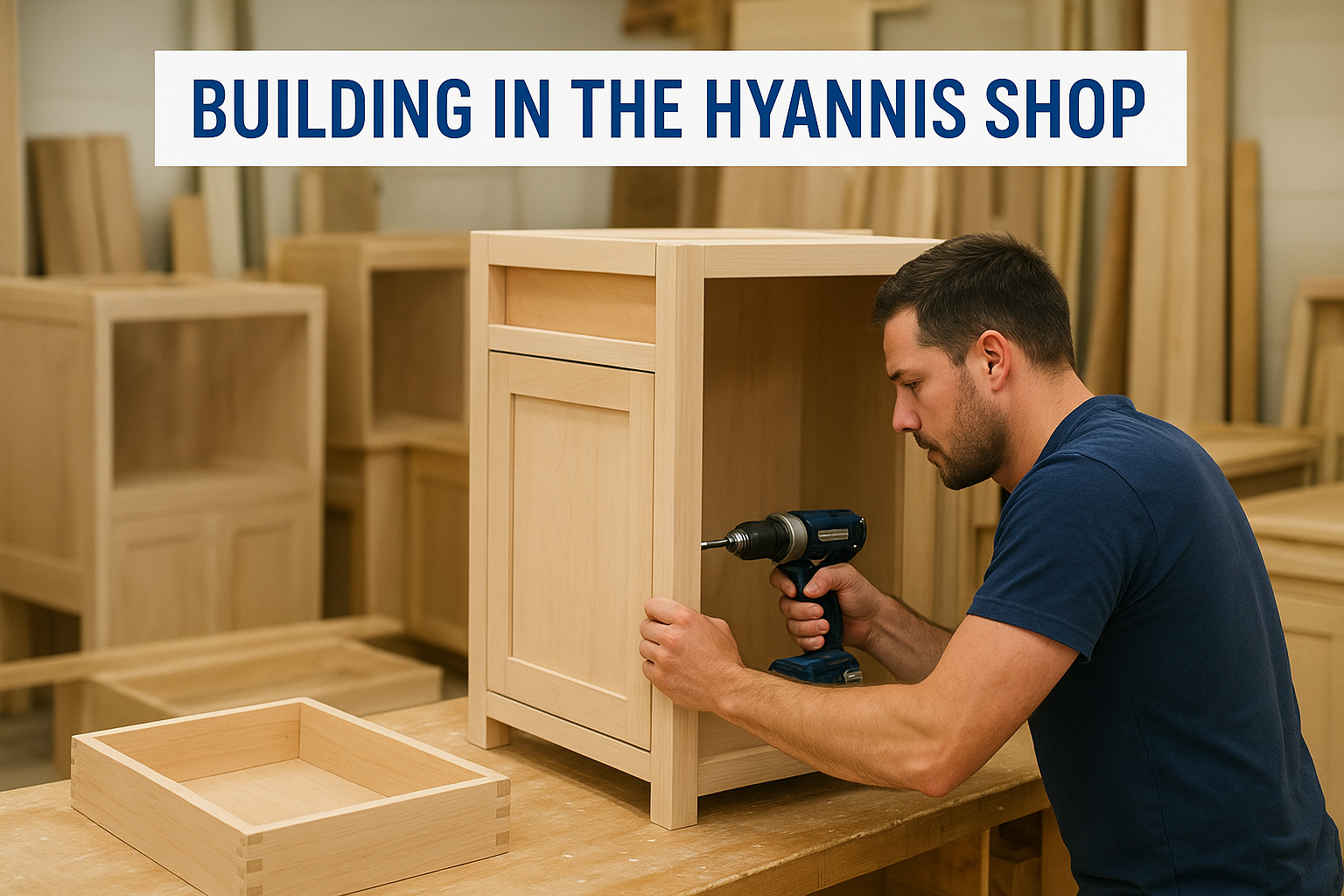
Building in the Hyannis shop
Every piece gets built in-house, not outsourced to a factory three states away. Our process for custom built kitchen cabinets generally looks like this:
- Cut and mill solid wood face frames and panels
- Assemble dovetailed drawer boxes and cabinet carcasses
- Sand, prime, and apply the chosen finish
- Install soft-close hinges and slides
- Dry-fit everything in the shop before it ever reaches your kitchen
That dry-fit step catches alignment issues while they’re still cheap to fix.
Installation and final walkthrough
Installation for a typical custom build kitchen cabinets project runs 40 to 60 days from first measurement to final walkthrough, though larger commercial jobs take longer. Our crew levels every box, scribes panels to your walls, and checks that doors close flush before calling the job finished. You walk through with us at the end, and nothing gets signed off until it’s right.
Popular styles, materials, and finishes to choose from
Walk into ten different kitchens on Cape Cod and you’ll see ten different personalities in the cabinetry. Custom contemporary kitchen cabinets with flat-panel doors and minimal hardware suit a beach-modern build, while a Cape or colonial-style home usually calls for raised-panel doors and a warmer wood tone. The point of custom work is that you’re never boxed into one look just because it’s what the factory stocks that month.
Style options at a glance
| Style | Door Profile | Best Fit |
|---|---|---|
| Shaker | Flat panel, square frame | Coastal, farmhouse, transitional |
| Raised panel | Traditional, detailed | Colonial, classic New England |
| Slab/flat-front | No frame, seamless | Modern, minimalist |
| Beadboard | Textured, cottage feel | Cape-style, beach houses |
The right cabinet style should match your home’s architecture, not just the latest trend.
Wood species and materials
Maple, oak, cherry, and painted poplar cover most requests we get for custom made cabinets for kitchen projects. Maple takes paint and stain evenly, which makes it the go-to for anyone chasing a specific color match. Oak shows more grain and holds up well in high-traffic kitchens, while cherry darkens naturally over time and adds warmth to older homes. Plywood boxes, not particleboard, form the structural core in every build we do, since plywood resists the humidity swings that coastal air throws at cabinetry.
Finishes and hardware
Finish choice changes the whole feel of a kitchen without changing a single dimension. Painted finishes in whites, grays, and navy blues dominate current requests, backed by our 3-year painting warranty, while stained wood finishes remain popular in traditional homes. Hardware, from brushed brass pulls to matte black bar handles, gets selected during the design phase so it matches the finish rather than getting bolted on as an afterthought.
What custom kitchen cabinets typically cost
Pricing scares people away from asking for a quote, but going in blind scares them more. Custom kitchen cabinets cost more upfront than stock, that’s true, but the range depends heavily on kitchen size, material choices, and how much detail you want in the design. On Cape Cod, a full custom kitchen typically runs higher than the national average for stock cabinetry, partly because of shipping costs for materials to the Cape and partly because labor and craftsmanship here reflect real skill, not a factory assembly line.
You’re not paying for a name on a box, you’re paying for a kitchen that fits your life exactly.
What drives the price up or down
Several factors move the number more than people expect:
- Kitchen size and layout complexity: More linear feet and more corners mean more labor
- Wood species: Cherry and hardwoods cost more than painted poplar or maple
- Finish type: Custom paint colors and specialty stains add time and material cost
- Hardware selection: Soft-close mechanisms and premium pulls add up across a full kitchen
- Storage features: Pull-out organizers, hidden drawers, and appliance garages each add build time
A rough price range
Most homeowners we work with land somewhere between $25,000 and $60,000 for a full custom kitchen, though smaller galley kitchens can come in lower and larger, feature-heavy kitchens can climb higher. Semi-custom cabinetry sits below that range, and stock cabinetry sits well below both, which explains why so many homeowners start at the big box store before realizing the compromises aren’t worth it long term.
Why the number is worth it
Comparing sticker prices alone misses the bigger picture. Stock cabinets often need replacement or major repair within 10 to 15 years, while a well-built custom kitchen, backed by a lifetime warranty on the boxes and doors, is designed to outlast that by decades. Factor in the added resale value custom cabinetry brings, and the true cost gap narrows considerably once you look past the invoice.
Deciding if custom cabinets are right for you
Custom cabinets make sense when you’re planning to stay in your home for years and want storage that actually works for how you live, not how a factory assumed you’d live. If you’re flipping a property fast or working with a tight budget, semi-custom or stock might get you through. But for kitchen custom cabinets built to last decades, hold up in coastal humidity, and add real resale value, custom is the smarter long-term call.
Only you know your timeline, budget, and how long you plan to stay put. What you do know now is what separates a cabinet that almost fits from one built exactly for your kitchen. If that’s the kitchen you want, don’t settle for another showroom compromise. Reach out to Suman Custom Carpentry and let’s talk through your space, your style, and what a real custom build looks like for you.