
You’ve got a wall that’s begging for books, or a stack of them piling up on the floor because your shelving doesn’t fit the space. Off-the-shelf units rarely solve this. They come in fixed widths, fixed depths, and generic finishes that ignore the actual dimensions of your room and the size of your collection. Custom book shelving fixes that by matching the design to your walls, your ceiling height, and how you actually use the space.
If you’re trying to figure out how to plan custom library shelving that fits a specific room instead of forcing your room to fit a shelf, this guide walks you through it. We’ll cover measuring your space correctly, choosing materials that hold up on Cape Cod’s humid, salt-air climate, and designing layouts for everything from a cozy reading nook to a full home library.
We’ve built custom shelving for homes across Hyannis and the surrounding coast, so this comes from actual installs, not theory. By the end, you’ll know what questions to ask a builder, what details separate good shelving from great shelving, and how to plan a design that holds up for decades.
We also break down when a built-in bookcase makes more sense than a freestanding unit.
What to know before designing custom shelving
Before you sketch a single shelf, get clear on a few basics that shape every decision after this. Custom book shelving isn’t just about picking a wood species and a color. It’s about understanding your wall structure, your book collection’s weight, and how the room’s humidity will treat the materials over time. Skip this groundwork and you’ll end up with sagging shelves or a design that looks great on paper but fights the room in real life.
Built-in vs. freestanding
Decide early whether you want a built-in bookcase or a freestanding unit, because this choice affects everything from framing to cost. Built-ins get anchored directly into wall studs and often extend floor to ceiling, which makes them feel like part of the architecture rather than furniture. Freestanding units give you flexibility if you rent, plan to move, or want the option to rearrange later.
| Feature | Built-in shelving | Freestanding shelving |
|---|---|---|
| Fits exact wall dimensions | Yes | No, standard sizes only |
| Can be relocated | No | Yes |
| Typical cost | Higher | Lower |
| Adds to home value | Yes | Minimal |
| Installation time | Longer | Shorter |
Structural load matters more than you think
Books are heavier than most people assume. A fully loaded shelf can carry 20 to 40 pounds per linear foot depending on the titles, so your shelf spacing and material thickness need to account for real weight, not just appearance. Thin plywood or particleboard will bow within a year under a dense hardcover collection.
Plan for your climate
Humidity swings are a real factor if you’re anywhere near the coast. According to the U.S. Department of Energy, uncontrolled indoor humidity leads to wood warping, swelling, and finish failure over time. That’s exactly what happens to cheap shelving near Cape Cod’s salt air.
Solid, well-finished shelving built for your local climate outlasts anything off the shelf.
Getting these three things right before design starts saves you from costly rework later.
Step 1. Measure your space and define your needs
Grab a tape measure before you look at a single design photo. Every wall is slightly different, and even a quarter-inch of error can throw off a custom book shelving installation once the panels are cut. Start by measuring width, height, and depth at multiple points along the wall, since older homes on Cape Cod often have walls that aren’t perfectly square or floors that aren’t level.
Measure every dimension that matters
Write down these numbers before you contact a builder:
- Wall width at the top, middle, and bottom
- Ceiling height, including any slope or beams
- Baseboard height and any outlets or vents in the way
- Depth available if the shelving needs to clear a door swing or walkway
- Total linear footage of books you currently own, plus room for growth
Measure twice, because a shelving unit built to the wrong dimensions is expensive to fix.
Define what the shelving needs to do
Beyond dimensions, think about function. Do you need closed cabinets at the base for clutter, or open shelves for display? Will the space double as a custom library shelving wall with a rolling ladder, or is it a simple reading nook? Consider whether you want adjustable shelf pins for flexibility as your collection changes, or fixed shelves for a cleaner look. Answering these questions now keeps your builder from guessing later, and it shapes every decision in the next step.
Step 2. Choose a layout and style
Once you know your measurements, start deciding how the shelving should look and function inside the room. Custom book shelving layouts generally fall into a few categories, and picking the right one depends on your ceiling height, wall width, and how much you want the shelving to become the room’s focal point. This is where the design starts to feel real instead of abstract.
Common layout options
Most homeowners choose from these configurations, sometimes combining two in the same room:
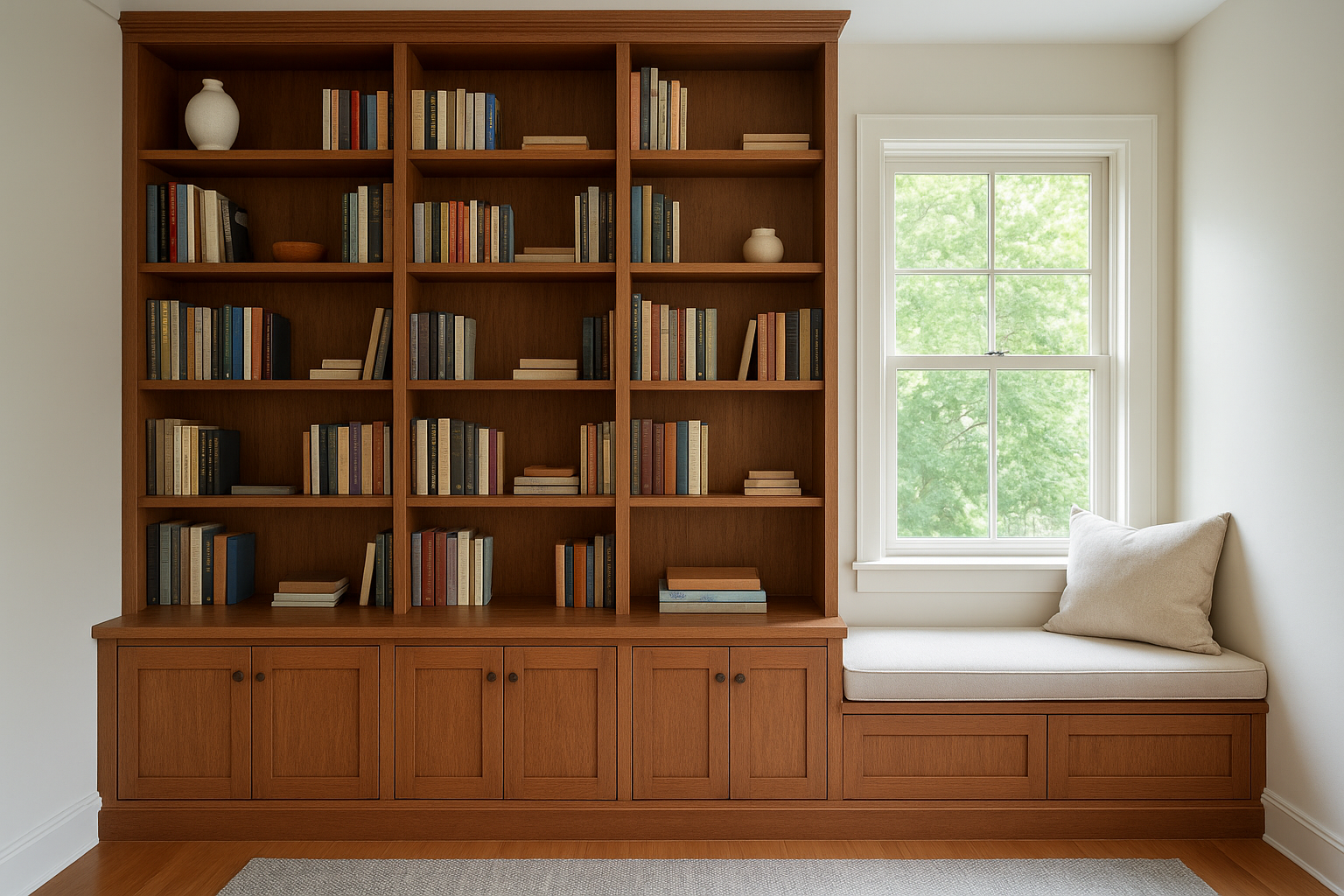
- Floor-to-ceiling built-ins: Maximize storage and make a strong architectural statement.
- Alcove shelving: Fits into existing niches beside a fireplace or window.
- Wraparound corner units: Uses wall space that’s usually wasted in a room.
- Window seat with flanking shelves: Adds seating and storage in one build.
- Modular sections: Lets you add more shelving later as your collection grows.
Match the style to your home
Style choices should follow the architecture already in the room, not fight against it. A Cape Cod cottage with exposed beams calls for a different look than a modern renovation with clean lines and minimal trim. Shaker-style face frames, flat-panel doors, and open shelving with exposed brackets all read differently, so pull a few reference photos before you meet with a builder. Consider whether custom library shelving in your space should feel like a quiet backdrop or a statement piece.
The best layout disappears into the room’s architecture instead of competing with it.
Think also about lighting. Built-in LED strips under upper shelves or inside glass-front cabinets add function after dark and make a real difference in how the finished shelving feels every evening.
Step 3. Select materials, finishes, and details
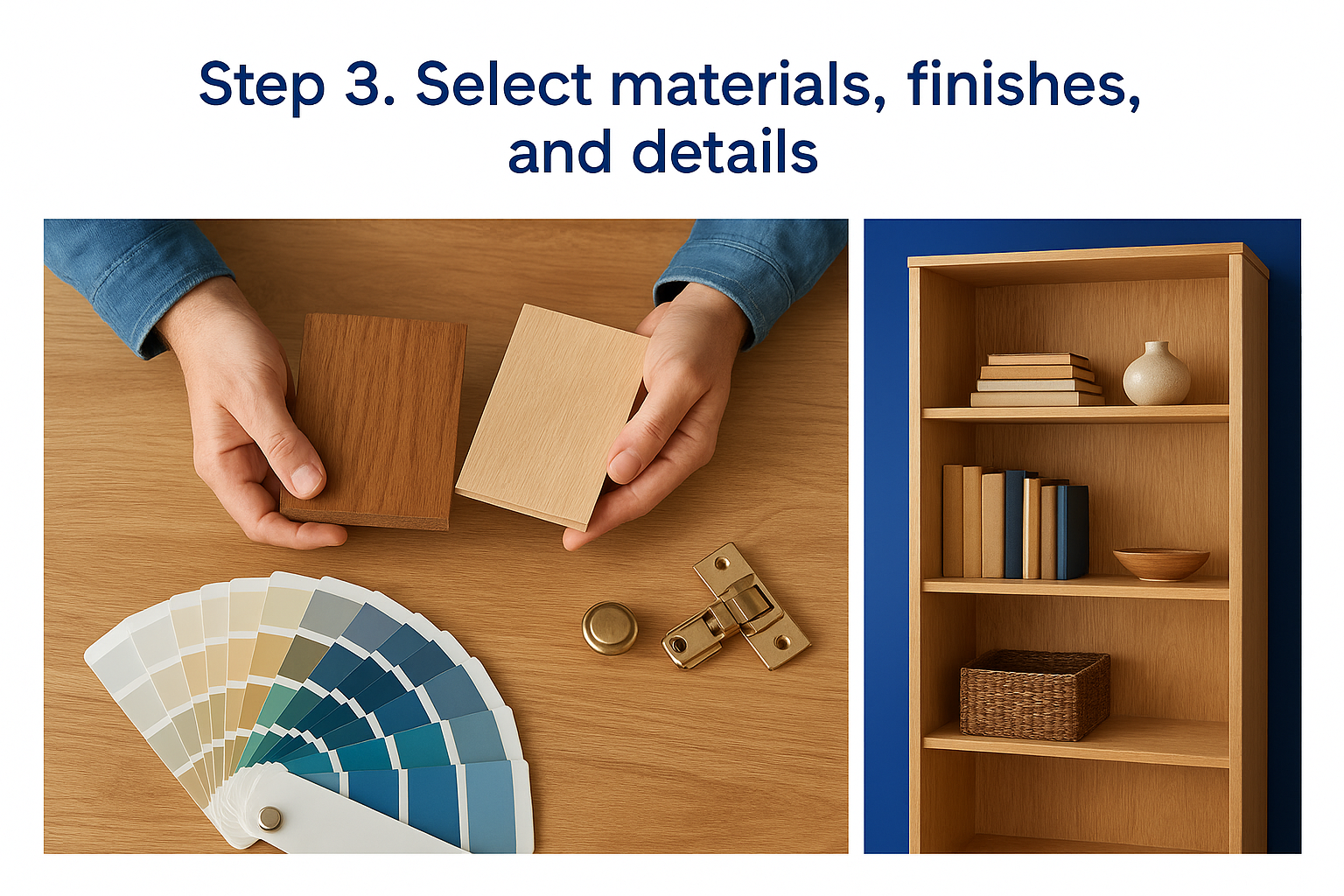
Material choice determines whether your custom book shelving lasts five years or fifty. Solid hardwoods like maple, cherry, and white oak resist sagging and take stain evenly, while plywood with hardwood veneer offers a budget-friendly middle ground that still outperforms particleboard. Skip anything labeled "engineered" without checking the core material, since some cheaper options use MDF cores that swell fast in humid rooms.
Compare your material options
| Material | Durability | Cost | Best for |
|---|---|---|---|
| Solid hardwood | Excellent | Highest | Visible faces, heavy loads |
| Plywood with veneer | Very good | Moderate | Full builds, painted finishes |
| MDF | Fair | Lowest | Painted trim, light loads only |
Pick a finish suited to the room
Finish protects the wood as much as it defines the look. Paint hides grain and works well for a classic, trim-matched built-in, while a clear coat or stain lets natural wood grain show through on statement pieces. Near the coast, ask your builder about moisture-resistant topcoats, since standard finishes break down faster under salt-air humidity.
The right finish protects your investment as much as any structural choice you make.
Don’t overlook the small details
Hardware, shelf pins, and edge banding seem minor until they fail. Soft-close hinges, solid brass pulls, and adjustable shelf pins rated for real weight all add years to your shelving’s usable life. These details separate shelving that looks good on installation day from shelving that still functions perfectly a decade later.
Step 4. Choose a builder and plan installation
Finding the right builder matters more than any material or layout decision, because even the best design fails in the hands of someone who cuts corners. Look for a shop that builds custom book shelving in-house rather than outsourcing to a factory, since that gives you direct control over quality and lets you walk through the shop to see work in progress. Ask how long they’ve operated locally, whether they carry insurance, and what warranty backs the cabinet boxes and doors.
Vet builders with a short checklist
Before signing a contract, confirm these points with any builder you’re considering:
- In-house fabrication versus outsourced parts
- Written warranty covering boxes, doors, and finish
- Portfolio of similar custom library shelving projects
- Clear timeline with milestones for design, build, and install
- Direct point of contact for questions during the project
A builder who answers these questions clearly is one you can trust with your walls.
Plan installation around your home
Installation day goes smoother when you prep the space beforehand. Clear the wall completely, including outlets, art, and old shelving, and confirm floor protection if you have hardwood or tile nearby. Timelines vary by project size, but most custom shelving builds run several weeks from final measurements to installed panels, similar to the 40 to 60 day window typical for a full kitchen build. Schedule installation after any painting or flooring work in the room, since built-ins get anchored directly to studs and are much harder to work around once other trades have finished.
Bringing your shelving plan to life
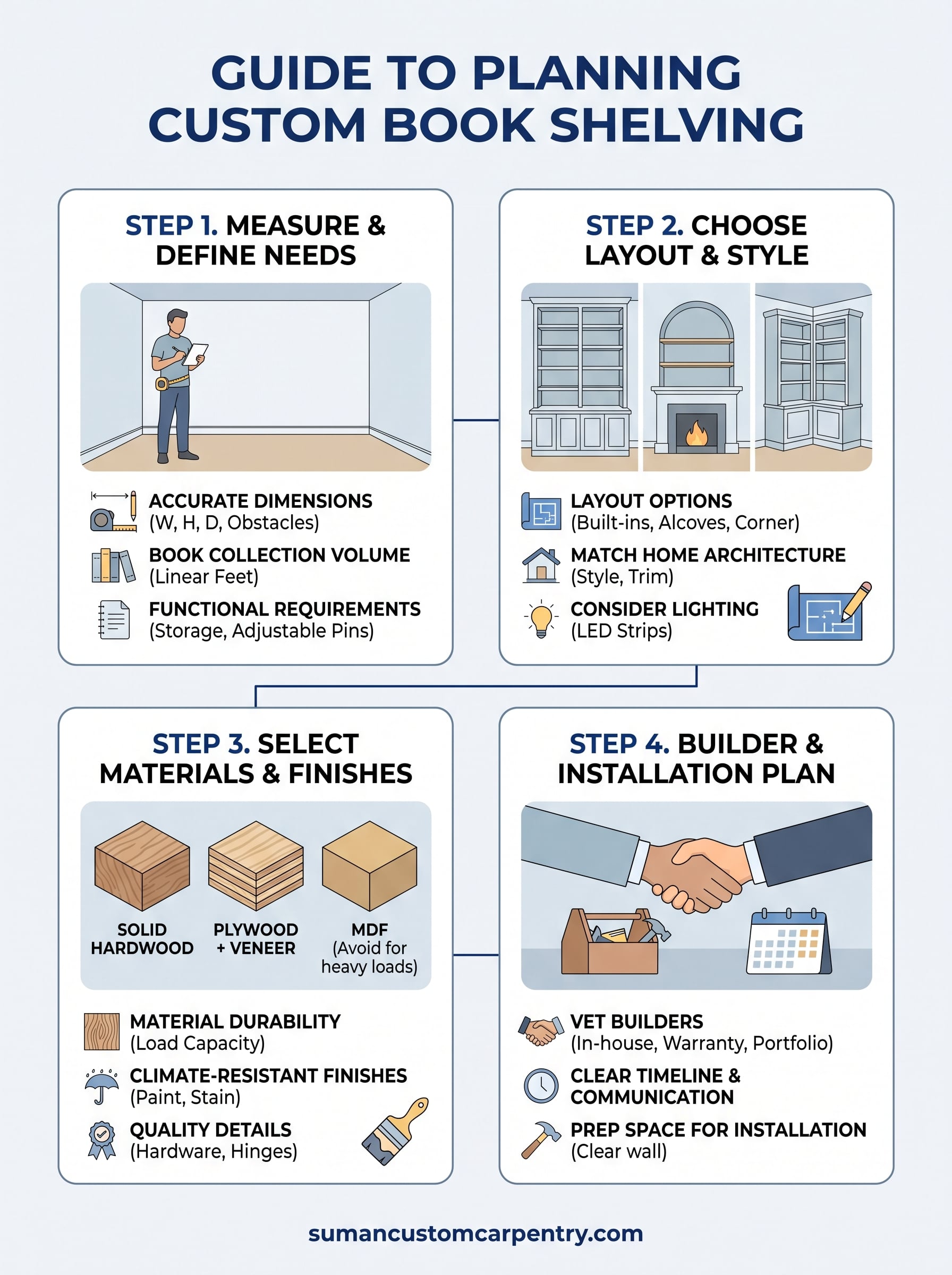
Good custom book shelving comes down to a handful of decisions made in the right order: accurate measurements, a layout that fits your architecture, materials that survive your climate, and a builder who stands behind the work. Skip any one of these steps and you end up with shelving that looks fine for a year before it warps, sags, or just feels wrong in the room. Get them right and you have a piece of the house that lasts decades, not a piece of furniture you’ll replace.
If you’re on Cape Cod and ready to move from planning to building, work with a shop that builds everything in-house and backs it with a real warranty. That’s exactly how we’ve approached every custom library shelving project since 2018. Reach out to Suman Custom Carpentry to start your design consultation and get a shelving plan built around your actual space, not a generic template.