
A bathroom vanity does more than hold your sink, it sets the tone for the entire room. Whether you’re working with a tight half-bath or designing a spacious master suite, the right custom bathroom vanity ideas can completely change how the space looks, feels, and functions. The challenge is finding a design that fits your room’s dimensions, matches your style, and actually solves your storage problems instead of creating new ones.
At Suman Custom Carpentry, we design and hand-build vanities at our shop in Hyannis for homeowners across Cape Cod. Every bathroom we work on is different, different layouts, different ceiling heights, different plumbing configurations. That’s exactly why custom vanities exist. They’re built to fit your space, not the other way around. Over the years, we’ve seen which designs hold up and which ones our clients love living with long after the renovation is done.
This article breaks down six vanity styles that work well in both small bathrooms and larger master baths. You’ll find practical design approaches you can adapt to your own project, along with details on why each option works, from floating vanities that free up floor space to double-sink configurations that make shared bathrooms easier to manage. Let’s get into it.
1. Made-to-fit vanity with Suman Custom Carpentry
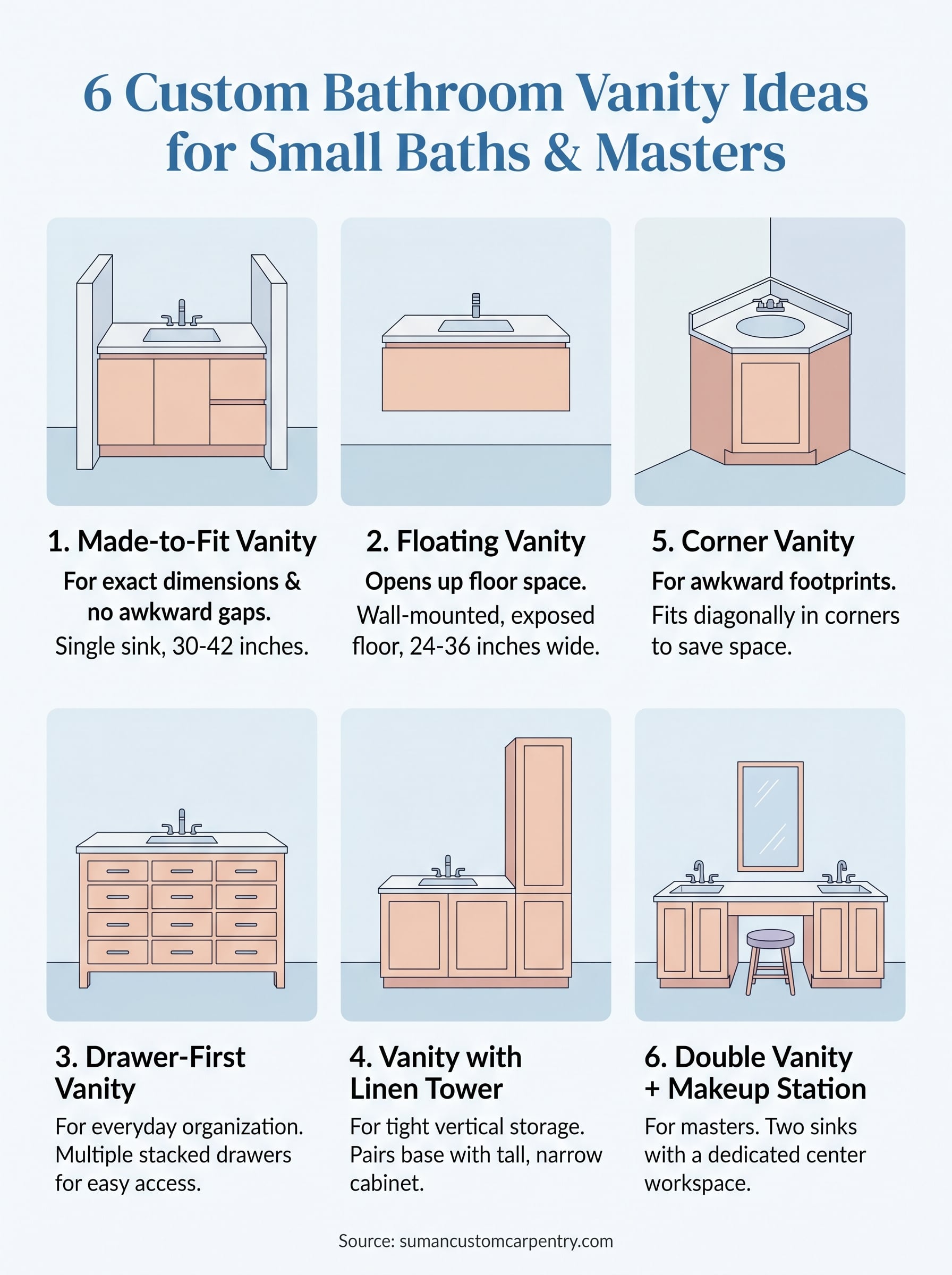
A made-to-fit vanity is built to match your bathroom’s exact dimensions rather than adjusted to squeeze into a space designed for something else. At Suman Custom Carpentry, every vanity starts with a site visit and detailed measurements. That means no awkward gaps, no filler strips, and no inches wasted in corners where storage could be instead. If you’ve been browsing custom bathroom vanity ideas and wondering what sets a fully custom build apart from semi-custom options, this is it.
Best layout and sizing
Your layout depends on two key factors: available wall space and plumbing location. For small bathrooms, a single-sink vanity in the 30 to 42-inch range tends to be the sweet spot, wide enough for useful storage but compact enough to keep the door swing clear. In master baths, you have more flexibility and can extend the vanity further along the wall without crowding the room. We work around whatever the plumbing dictates.
Style and material options
Shaker-style doors and flat-panel fronts are the most popular choices we build, and both work across traditional and modern interiors. For materials, we typically use solid wood frames with plywood cabinet boxes, which hold up better in humid bathroom environments than particleboard. Finish options range from painted to stained, depending on how much wood grain you want to show.
Storage and function upgrades
Your vanity interior should be designed around what you actually own, not a generic layout. Deep drawers for hair tools, divided trays for toiletries, and pull-out shelves behind cabinet doors are all options we build in from day one. Soft-close hinges and drawer slides throughout make a real difference in how the vanity feels to use over time.
Storage that fits your routine from the start is far easier to live with than something you try to organize around later.
Budget range and build timeline
Suman vanities fall in a mid-to-high investment range compared to stock options, and the material quality and craftsmanship reflect that. Plan for a 40 to 60-day build and installation timeline from the point your design is finalized.
Common mistakes to avoid
Underestimating counter space and drawer depth is the most common issue we see. Choosing a sink that’s too large leaves almost no usable surface on either side. Bring your daily routine into the conversation early so every design decision reflects how you actually use the space.
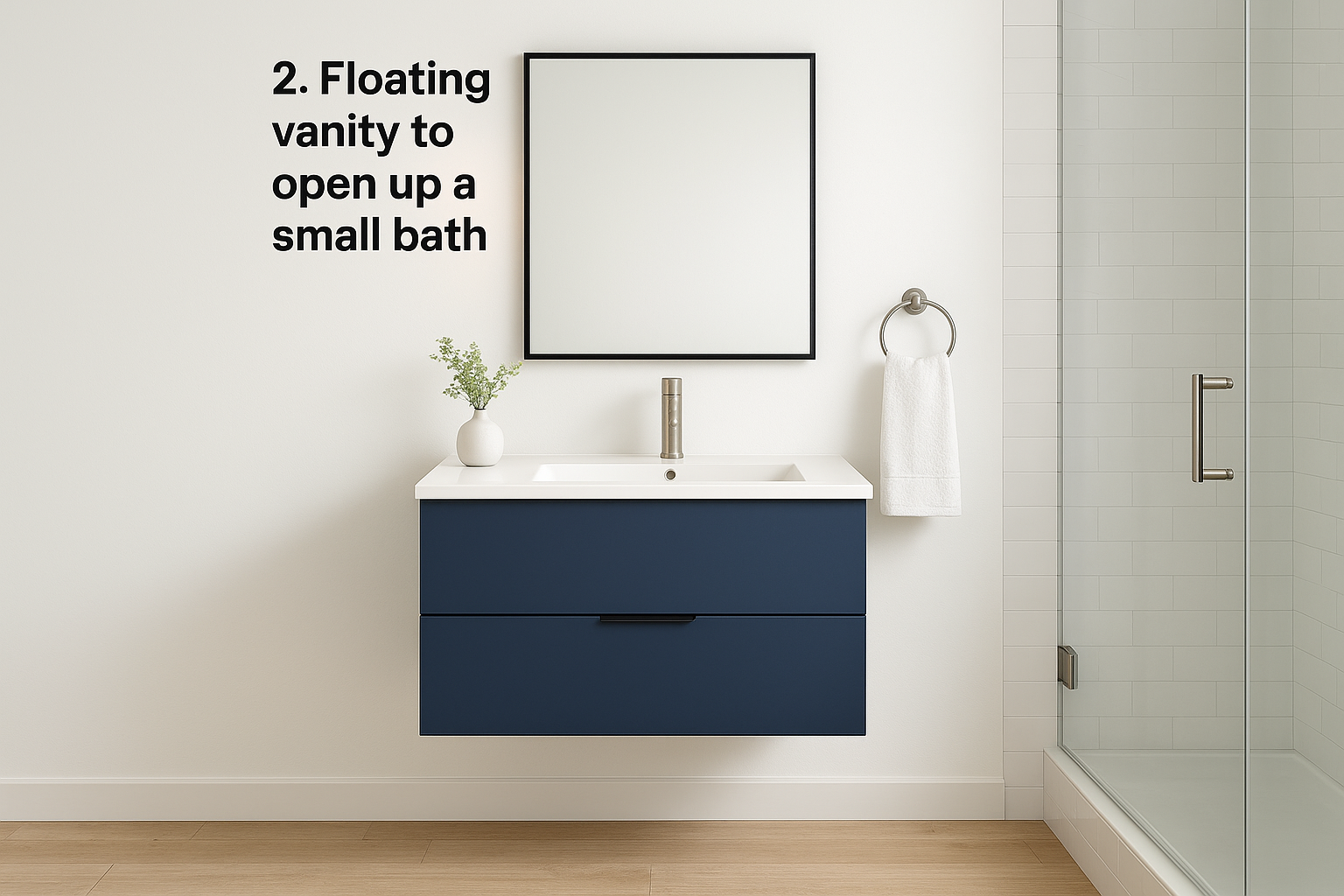
2. Floating vanity to open up a small bath
A floating vanity mounts directly to the wall, so no cabinet base touches the floor. That exposed floor space makes a small bathroom feel larger because your eye travels further across the room. If you’re browsing custom bathroom vanity ideas for a tight space, this design delivers a noticeable visual lift without requiring any extra square footage.
Best layout and sizing
This style works best when plumbing runs through the wall rather than up through the floor. A 24 to 36-inch width covers most small bathrooms comfortably, and you’ll want to set the mount height between 32 and 36 inches to suit everyone using it daily.
Style and material options
Flat-panel and slab-front doors pair naturally with floating vanities because they keep the look clean and uncluttered. Two-tone finishes or wood veneer fronts on a painted base are popular choices that add depth without visual noise.
Storage and function upgrades
Floating vanities are typically shallower than floor-standing units, so every inch needs to pull its weight. Stacked drawers on one side consistently outperform a single cabinet door for day-to-day access to toiletries and tools.
A few well-planned drawers will serve you far better than one large cabinet you have to dig through every morning.
Budget range and build timeline
Installation costs run slightly higher than floor-standing vanities because the wall needs solid blocking to carry the load safely. Build and installation time through Suman follows the same 40 to 60-day window as other custom projects.
Common mistakes to avoid
Skipping wall reinforcement is the most common mistake here. Without proper blocking inside the wall, the cabinet won’t hold its weight safely over time. Also avoid choosing a depth that conflicts with your existing plumbing, since rerouting adds both cost and time to the project.
3. Drawer-first vanity for everyday organization
A drawer-first vanity replaces the standard cabinet-and-door layout by making drawers the primary storage solution. Instead of one large cabinet door hiding a dark interior, you get multiple organized compartments you can open with one hand while getting ready. This setup works just as well in a compact bathroom as in a master, and it’s one of the most practical custom bathroom vanity ideas we build at Suman.
Best layout and sizing
Three to four drawers stacked vertically on at least one side of the vanity is the baseline worth targeting. In a 36 to 48-inch width, you can run drawers the full span on one side and keep a single cabinet on the other for taller items like cleaning supplies or a standing hair dryer.
Style and material options
Shaker-style drawer fronts work across the widest range of bathroom aesthetics. Painted finishes in white, warm gray, or navy stay consistently popular, while a stained wood front adds warmth for bathrooms with a more natural design direction.
Storage and function upgrades
Divided inserts in the top drawer keep small items like razors, makeup, and hair ties from sliding around every time you open it. Deeper lower drawers with pull-out trays handle bulkier tools without requiring you to crouch down and search.
Planning drawer sizes around what you actually own from the start beats buying organizers after the fact every time.
Budget range and build timeline
Drawer-heavy builds use more hardware than single-door layouts, which adds modest cost. Build and installation at Suman follows the standard 40 to 60-day timeline.
Common mistakes to avoid
Avoid building every drawer at the same depth. A mix of shallow top drawers and deeper lower ones gives you far more usable storage than a uniform layout that ignores what you’re actually putting inside.
4. Vanity with a linen tower for tight storage plans
A linen tower pairs a standard vanity base with a tall, narrow cabinet column built to the same height as the room allows. This combination gives you dedicated vertical storage without requiring a larger footprint, making it one of the more practical custom bathroom vanity ideas for bathrooms where floor space is limited but wall height is available.
Best layout and sizing
The tower typically sits flush alongside the vanity base, either on the left or right depending on your door swing and plumbing location. A 12 to 18-inch width for the tower is enough to store folded towels, extra toiletries, and cleaning supplies without crowding the room.
Style and material options
Building the tower and vanity base from the same material and finish creates a built-in look that makes the storage feel intentional rather than added on. Shaker-style doors on both units keep the design cohesive across traditional and transitional bathroom styles.
Storage and function upgrades
Adjustable shelving inside the tower gives you flexibility as your storage needs change over time. Adding a pull-out hamper or laundry bin to the lower section keeps the floor clear without dedicating a separate spot for it.
Vertical storage that matches your vanity turns an empty wall into functional square footage without touching the floor plan.
Budget range and build timeline
Building a matched tower and vanity base adds modest cost over a standalone vanity since it involves more material and hardware. Suman builds both units together within the standard 40 to 60-day timeline.
Common mistakes to avoid
Avoid making the tower too narrow to hold anything useful or too wide to sit comfortably beside the sink. Confirm the door clearance on both units won’t conflict before you finalize any dimensions.
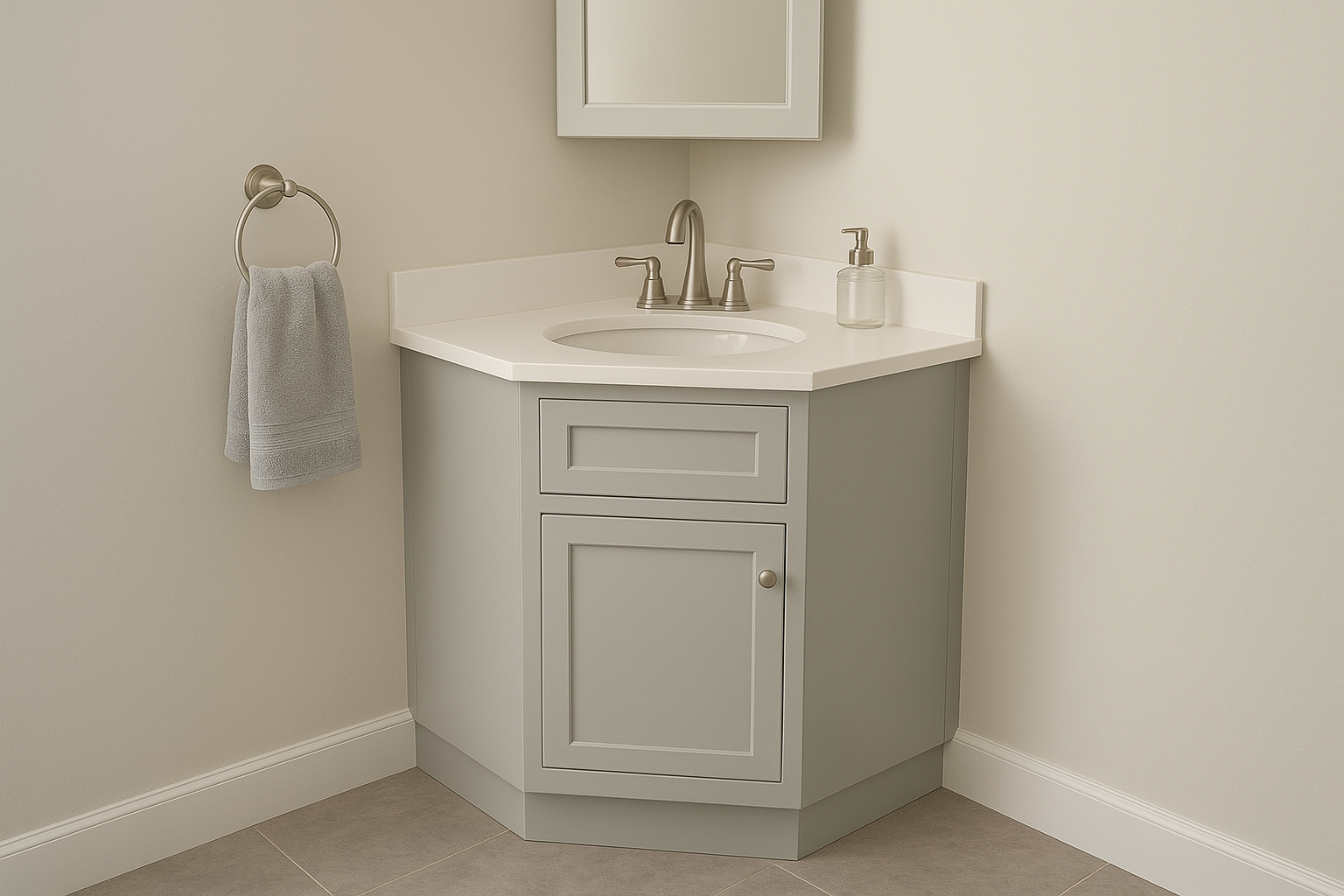
5. Corner vanity for awkward footprints and half baths
A corner vanity fits diagonally into a room corner, using space that typically goes to waste. This is one of the more practical custom bathroom vanity ideas for half baths and powder rooms where every inch counts. The angled cabinet sits at 45 degrees to the walls, freeing up the rest of the room for door clearance and traffic flow.
Best layout and sizing
Corner vanities work best in rooms smaller than 50 square feet where a standard vanity would block traffic. The diagonal face typically runs 24 to 36 inches, which fits a single sink and still leaves workable counter space on each side.
Style and material options
Simple door fronts without heavy ornamentation keep corner vanities from feeling too bulky in tight rooms. Painted finishes in lighter tones help the cabinet recede visually rather than dominate a small space.
Storage and function upgrades
A single cabinet door with an interior shelf covers the basics for a half bath. Adding one or two small drawers below the sink cutout gives you quick access to hand soap, paper goods, and everyday items without cluttering the counter.
Use the vertical wall space above the vanity for a medicine cabinet or open shelving since the floor footprint is already committed.
Budget range and build timeline
Corner builds require careful templating to match angled walls accurately, which adds fabrication complexity. Suman builds this style within the standard 40 to 60-day timeline.
Common mistakes to avoid
Avoid a corner unit too large for your door’s swing radius or too small to hold a functional sink. Confirm your plumbing position relative to the corner before finalizing the design, since rerouting supply and drain lines adds cost.
6. Double vanity with a center makeup station for masters
A double vanity with a center makeup station turns your master bath into a workspace built for two people with different routines. This layout separates sink zones on each end while dedicating the middle section to seating, lighting, and detail work.
Best layout and sizing
A total width of 84 to 96 inches works best for this configuration. Each sink section typically takes 30 to 36 inches, leaving the center station at 24 inches wide with enough knee clearance for a built-in stool.
Style and material options
Shaker or flat-panel doors suit this layout well in both traditional and contemporary master baths. Mixing a stained wood center section with painted outer cabinets adds visual definition and helps separate your makeup zone from the sink areas.
Storage and function upgrades
The center station benefits most from dedicated power outlets and integrated LED task lighting mounted at eye level. Shallow drawers for brushes and palettes, combined with a pull-out mirror insert, keep your workspace organized without cluttering the counter.
Task lighting at the right height makes more practical difference than any other single upgrade in a makeup station.
Budget range and build timeline
This is one of the larger custom bathroom vanity ideas we build at Suman, and material costs reflect the scale. Build and installation follows the standard 40 to 60-day timeline.
Common mistakes to avoid
Avoid building the center section too narrow for comfortable seating clearance. Also confirm your overhead lighting plan works with the makeup station before finalizing the cabinet design.
Next steps for your vanity plan
You now have six custom bathroom vanity ideas to work from, each built around a specific set of space constraints and daily habits. The right choice depends on your bathroom’s footprint, your plumbing layout, and how many people share the space. Review each option against those factors before settling on a direction.
From there, the most useful step is a site visit. Talking through dimensions and wishlist items in the actual room gives you far more clarity than working from photos alone. Measurements, plumbing location, and door clearance all influence which design works and which one creates problems down the road.
If you’re ready to start planning your vanity project, reach out to Suman Custom Carpentry to schedule a consultation. Every build starts with a conversation about your space and your priorities, and we take it from there.