
Getting a kitchen renovation quote can feel like trying to hit a moving target. Material costs shift, labor rates vary by region, and the gap between a basic refresh and a full gut renovation can be tens of thousands of dollars. Without a clear framework, most homeowners either overshoot their budget or underestimate the real scope of the work, and both mistakes are expensive.
At Suman Custom Carpentry, we build custom kitchens from our shop in Hyannis, Cape Cod, from initial design through final installation. Over seven-plus years of building kitchens for homeowners across the Cape, we’ve walked clients through every stage of the budgeting process. We know exactly where costs hide, where they balloon, and where smart planning saves real money.
This guide breaks down how to estimate your total kitchen renovation cost before you commit to a single contractor or cabinet order. You’ll learn what drives pricing, how to use cost calculators effectively, what to budget for materials versus labor, and how to build a realistic number you can actually work with. Whether you’re planning a modest cabinet upgrade or a full custom kitchen build, this article gives you the tools to walk into your next consultation prepared, not guessing.
What a kitchen renovation quote includes
A formal kitchen renovation quote is more than a single number on a page. It’s a structured breakdown of every cost category in your project, from the first day of demo to the final hardware installation. Most homeowners are surprised to find that cabinets and countertops represent only a portion of the total, and that labor, permits, and contingency fees can push the final number well above initial expectations.
Labor and installation costs
Labor is typically the largest variable in any renovation estimate, and it’s the category homeowners underestimate most often. A complete kitchen renovation requires multiple trades working in sequence: a carpenter or general contractor, a plumber, an electrician, and often a tile setter or painter. Each trade bills separately, and coordinating all of them adds real management time to the project. On Cape Cod specifically, skilled tradespeople work on tight schedules, especially during peak summer months when regional demand runs high.
Labor alone can account for 30 to 50 percent of your total renovation budget, depending on the scope and complexity of the work.
Materials, cabinets, and fixtures
Your materials budget covers everything you can physically touch in the finished kitchen. This includes cabinets and hardware, countertops, backsplash tile, flooring, sink, faucet, lighting, and appliances. Each category carries a wide price range. Stock cabinets might run $80 to $150 per linear foot installed, while custom hand-built cabinetry from a local shop can run $500 to $1,200 per linear foot or more, depending on wood species, finish, and design complexity.
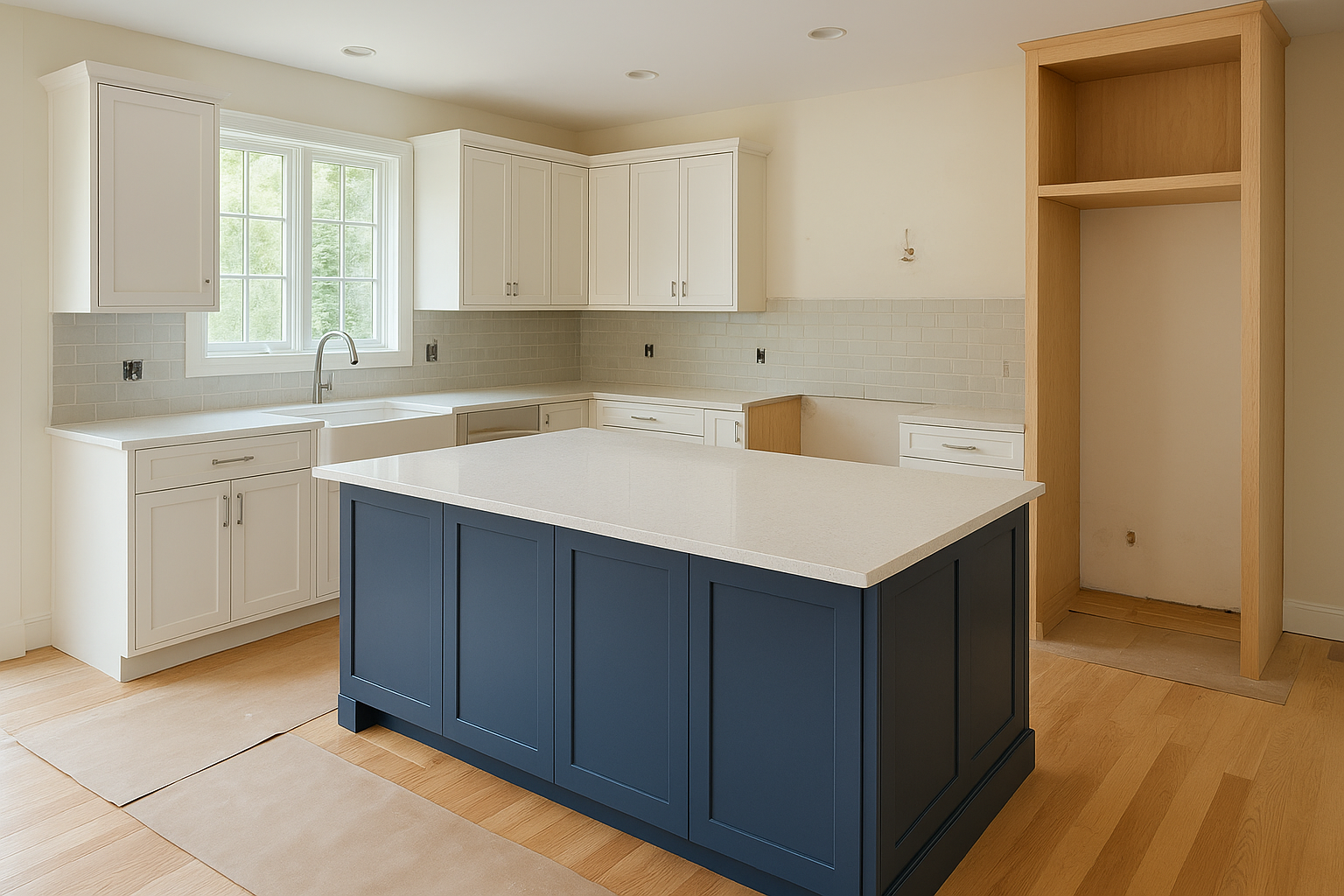
Here’s a simplified breakdown of typical cost ranges for a mid-size kitchen:
| Category | Budget | Mid-Range | High-End |
|---|---|---|---|
| Cabinets (installed) | $5,000-$15,000 | $15,000-$35,000 | $35,000+ |
| Countertops | $1,500-$4,000 | $4,000-$8,000 | $8,000+ |
| Appliances | $2,000-$5,000 | $5,000-$12,000 | $12,000+ |
| Flooring | $1,000-$3,000 | $3,000-$6,000 | $6,000+ |
| Plumbing fixtures | $500-$1,500 | $1,500-$4,000 | $4,000+ |
Contingency and soft costs
Every honest quote includes a contingency line, and you should be skeptical of any contractor who leaves it out. In older Cape Cod homes, opening walls frequently reveals outdated wiring, water damage, or non-standard framing that adds cost mid-project. Budget a contingency of 10 to 20 percent on top of your baseline estimate. Soft costs, including design fees, building permit fees, and demo disposal, are also real line items that belong in your estimate from the start, not as last-minute surprises.
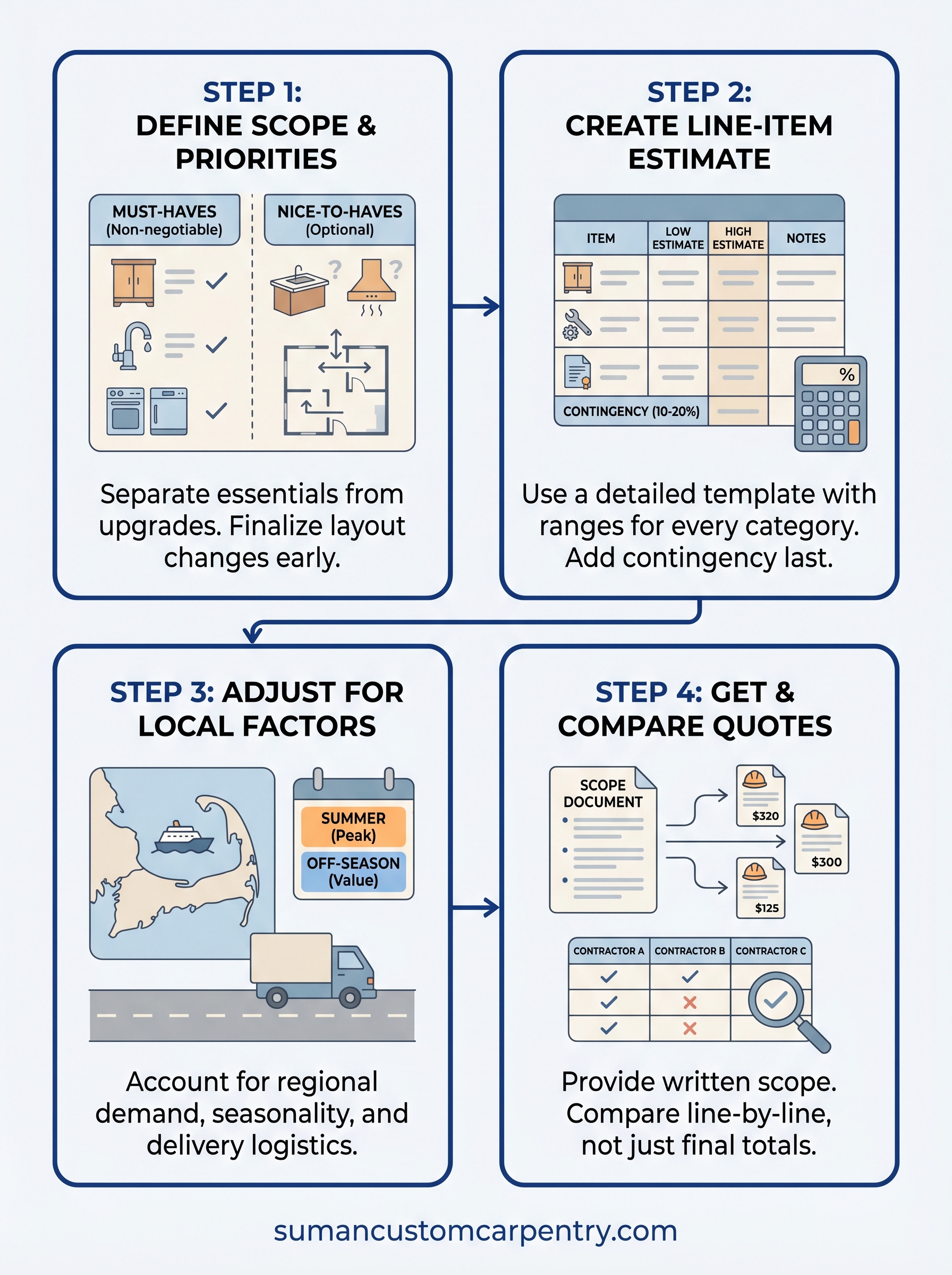
Step 1. Define your scope and must-haves
Before you request a single kitchen renovation quote, you need a clear picture of what your project actually includes. Most budget overruns start here, not in the contractor’s math, but in the homeowner’s vague idea of what "renovating the kitchen" means. Deciding your scope upfront lets you compare contractor quotes accurately and avoid paying for change orders down the line.
Separate your must-haves from your nice-to-haves
Start with a simple two-column list. On one side, write down every element you consider non-negotiable: new cabinets, functional countertops, better storage, updated appliances. On the other side, list the upgrades you want but could live without: a statement range hood, a kitchen island, custom pull-out drawers, or high-end stone countertops.
This separation gives you a working budget floor, the minimum your project will cost, and a ceiling, the maximum if everything goes in.
When money gets tight mid-project, you’ll make faster decisions and protect your priorities if you’ve already ranked them. Your contractor will also give you sharper pricing when you come in with a defined list rather than a general wish.
Nail down your layout changes
Layout changes are the single biggest cost driver in any kitchen renovation. Moving a sink means rerouting plumbing. Shifting a wall means structural assessment and permits. If you can keep your appliances and plumbing fixtures in their current positions, you’ll reduce labor costs significantly.
Walk your kitchen and answer these questions before your first consultation: Do you need more square footage, or just better use of the existing space? Are you removing walls or windows? Do you want to change where the sink or range sits? Write down your answers and bring them to every contractor meeting.
Step 2. Build a line-item cost estimate
Once you know your scope, the next step is putting real numbers against each element of your project. A line-item estimate forces you to think in specifics rather than vague totals, and it gives you a document you can hand to any contractor when requesting a kitchen renovation quote.
Start with a simple spreadsheet template
Open a spreadsheet and list every cost category your project includes. Assign a low and high estimate to each line based on your early research. This range approach keeps you from locking in a number too early while still giving you a realistic working budget to plan around.
Here’s a basic line-item template you can copy directly:
| Line Item | Low Estimate | High Estimate | Notes |
|---|---|---|---|
| Demo and disposal | $500 | $2,000 | Varies by scope |
| Cabinets (installed) | $10,000 | $40,000 | Custom vs. stock |
| Countertops | $2,000 | $10,000 | Material dependent |
| Appliances | $3,000 | $15,000 | Mid-range vs. pro |
| Plumbing labor | $1,500 | $5,000 | Fixture moves add cost |
| Electrical labor | $1,000 | $4,000 | New circuits and lighting |
| Tile and flooring | $2,000 | $8,000 | Material plus install |
| Painting and trim | $1,000 | $3,500 | Full kitchen |
| Permits | $300 | $1,500 | Town-specific |
| Contingency (15%) | calculated | calculated | Add this last |
Assign realistic numbers to each line
Fill in your ranges using current local pricing, not national averages pulled from renovation websites. Call supply houses, visit showrooms, and ask contractors for rough figures before you finalize anything.
Plugging in regional numbers from the start is what separates a useful estimate from a number that falls apart the moment a contractor walks through your door.
Your total low column is your budget floor. Add your contingency on top of the high column total, and that figure becomes the true ceiling you plan around before committing to any contractor.
Step 3. Adjust for Cape Cod labor and logistics
Your line-item estimate gives you a working national baseline, but Cape Cod operates on its own cost structure. Skilled tradespeople on the Cape are in high demand, supply chains run through a narrow corridor of roads and ferries, and seasonal scheduling creates real pricing pressure that generic renovation calculators never account for. Adjusting your numbers for local conditions is what turns a generic estimate into an accurate kitchen renovation quote.
Seasonal demand affects your timeline and cost
Contractors across the Cape are booked months in advance during the spring-to-fall window, when summer homeowners compete with year-round residents for the same limited pool of skilled tradespeople. If you start your project between May and September, expect longer lead times and, in some cases, premium labor rates due to competition for availability.
Scheduling your kitchen renovation for the off-season, typically November through March, often shortens your wait time and gives you more leverage when negotiating with contractors.
If your timeline is flexible, plan your consultation in late fall and lock in your start date before the spring rush. This approach keeps your project from getting pushed back repeatedly as contractors prioritize clients who scheduled earlier.
Factor in material delivery and access logistics
Cape Cod’s geography adds a real cost layer that mainland projects don’t face. Large material deliveries, including cabinet crates, stone slabs, and appliance pallets, often require coordination with local suppliers who understand regional access limitations. Narrow roads, tight driveways, and limited staging areas in older neighborhoods can add delivery fees or require smaller loads spread across multiple trips.
When you build your estimate, add $500 to $1,500 as a logistics buffer for delivery and handling, particularly if your home sits on a tight lot or at the end of a private road.
Step 4. Turn your estimate into contractor quotes
Your line-item estimate is now your most valuable tool when requesting a kitchen renovation quote from contractors. Instead of asking a contractor to "give you a number for the kitchen," you hand them a specific scope document and ask them to price against it. This approach forces apples-to-apples comparisons across multiple bids and removes the ambiguity that leads to disputes mid-project.
Send a scope document, not just a verbal description
Write up a one-page scope summary before you contact any contractor. Include your layout decisions, a list of every trade involved, your material selections where you’ve made them, and your target start date. Send the same document to every contractor you approach.
A basic scope document should cover these five points:
- Project overview: kitchen dimensions, layout changes, and fixture move decisions
- Materials you’re supplying: appliances, fixtures, or specialty items you’re purchasing directly
- Materials you want the contractor to supply: cabinets, countertops, flooring, tile
- Trade coordination: whether you need them to manage sub-trades or quote labor only
- Timeline: your target start date and any hard deadlines
Contractors price jobs faster and more accurately when you hand them a written scope rather than walking them through the kitchen verbally.
Compare quotes line by line
When quotes come back, resist comparing totals as your first move. Open each quote and check whether every line item in your estimate appears in the contractor’s response. A low total often means missing scope items, not a better price.
Build a simple comparison table with each contractor’s name across the top and your line items down the left column. Fill in each cell as quotes arrive. Any blank cell is a question you need to ask before you sign anything.
Conclusion
Estimating your total renovation cost before you contact a contractor puts you in a fundamentally stronger position. You’ve seen how to break down what a kitchen renovation quote actually includes, how to define your scope before you spend a dollar, and how to build a line-item estimate that reflects real Cape Cod pricing rather than national averages that don’t apply here.
Take that estimate and scope document into every contractor conversation you have. Compare quotes line by line, ask questions about any blank cells, and protect your contingency budget from the start. The homeowners who stay on budget are the ones who do this preparation work before anyone picks up a hammer.
If you’re ready to get a custom kitchen quote from a shop that hand-builds every cabinet in Hyannis and has done it for seven-plus years on the Cape, reach out to Suman Custom Carpentry and tell us what you’re planning.