
You’ve probably hit a wall shopping for kitchen cabinets. Stock boxes from a big box store feel flimsy and never quite fit your layout, but a fully custom kitchen quotes out at a price that makes you wince. Semi custom kitchen cabinets sit in the middle, and for most Cape Cod homeowners, that middle ground is exactly where the smart decision lives.
So what does semi custom actually mean? It’s a set of standard cabinet boxes with adjustable sizing, finishes, and storage options layered on top, giving you real flexibility without paying for a from-scratch design. You get more say over dimensions, wood species, and interior organization than stock offers, at a cost well below full custom builds, which is why kitchen cabinets semi custom searches spike among people renovating on a real budget but refusing to settle for generic.
In this article, we’ll break down exactly how semi custom compares to stock and custom in price, lead time, and design control, then walk through what to expect during the buying process. If you’re weighing your options before committing to a kitchen renovation, this will help you figure out which path actually fits your home and budget.”
Why semi-custom cabinets matter for your renovation
A kitchen renovation lives or dies on the details you can’t see in a showroom, like how a cabinet run handles an out-of-square wall or a low ceiling. Semi-custom kitchen cabinets solve that problem because manufacturers build in modifications for height, depth, and width that stock lines simply don’t offer. On Cape Cod, where a lot of housing stock dates back decades and settling is common, that flexibility often decides whether your new kitchen looks tailored or looks like a patch job.
Semi-custom cabinets give you the fit of a custom kitchen without the custom-kitchen invoice.
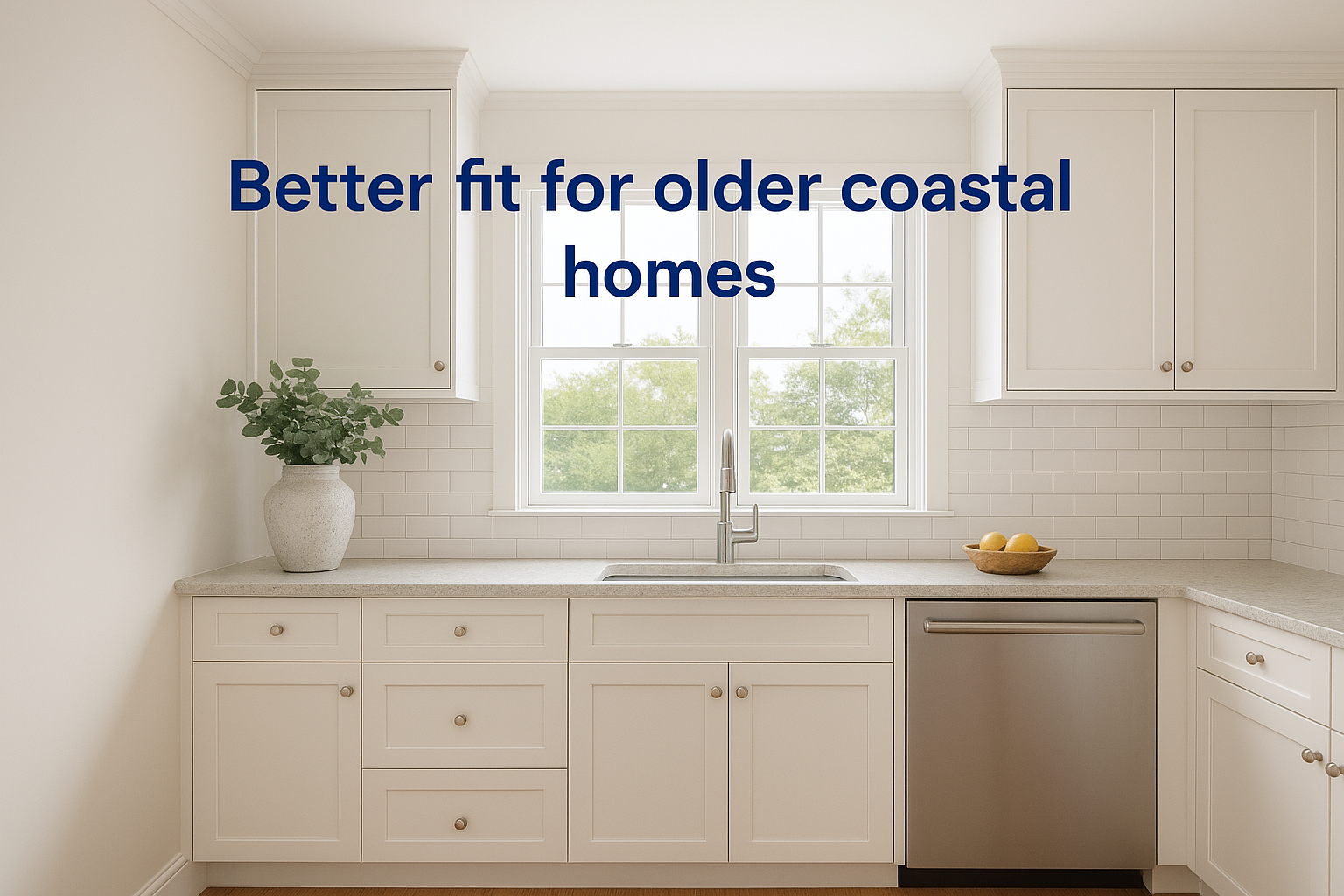
Better fit for older coastal homes
Older homes rarely have perfectly level floors or evenly spaced windows, and stock cabinets assume both. Semi-custom lines let you adjust filler panels, toe kicks, and cabinet depth in small increments, so the finished kitchen reads as one continuous design instead of a row of boxes with gaps patched by trim. This matters even more in coastal properties, where humidity and settling shift a house’s frame over the years in ways that make exact-fit cabinetry worth the upgrade.
Room to personalize without a blank check
Beyond dimensions, semi-custom options open up finish choices and interior storage that stock cabinets lock down. You can usually pick from a wider range of wood species, stains, and paint colors, and add features like pull-out trash bins, spice racks, or soft-close drawers as line items rather than full redesigns. That means your kitchen can reflect how you actually cook and store things, without the six-figure quote that scares off most homeowners considering a full custom build.
A realistic middle ground for most budgets
For the majority of renovation projects, semi-custom cabinets hit the sweet spot between what a homeowner wants and what a project actually costs. You’re not settling for generic, and you’re not overpaying for craftsmanship your layout doesn’t require. That balance is exactly why so many Cape Cod homeowners land here before ever requesting a fully custom quote.
How to choose the right semi-custom cabinets
Picking semi-custom cabinets isn’t just about matching a door style to your countertop. You need to think through layout constraints, storage habits, and long-term durability before you ever look at a finish sample. The best choice on paper means nothing if it doesn’t match how your kitchen actually functions day to day.
The right semi-custom cabinets fit your kitchen’s quirks, not just your color scheme.
Start with your layout, not the catalog
Walk your kitchen with a tape measure before browsing options. Note wall irregularities, appliance clearances, and ceiling height, since these details determine which modification options you’ll actually need from a manufacturer.
Match storage to how you cook
Think about what frustrates you in your current kitchen. If you’re short on space, prioritize:
- Pull-out organizers for pots and pans
- Vertical dividers for baking sheets
- Deep drawers instead of lower cabinet shelves
- Corner solutions like lazy Susans or blind-corner pullouts
Check the build, not just the brochure
Ask about box construction and warranty terms before comparing prices. Plywood boxes with dovetail drawers hold up longer than particleboard, and a real warranty tells you whether the manufacturer stands behind that construction. Skipping this step is how homeowners end up with cabinets that look great at installation and sag within a few years.
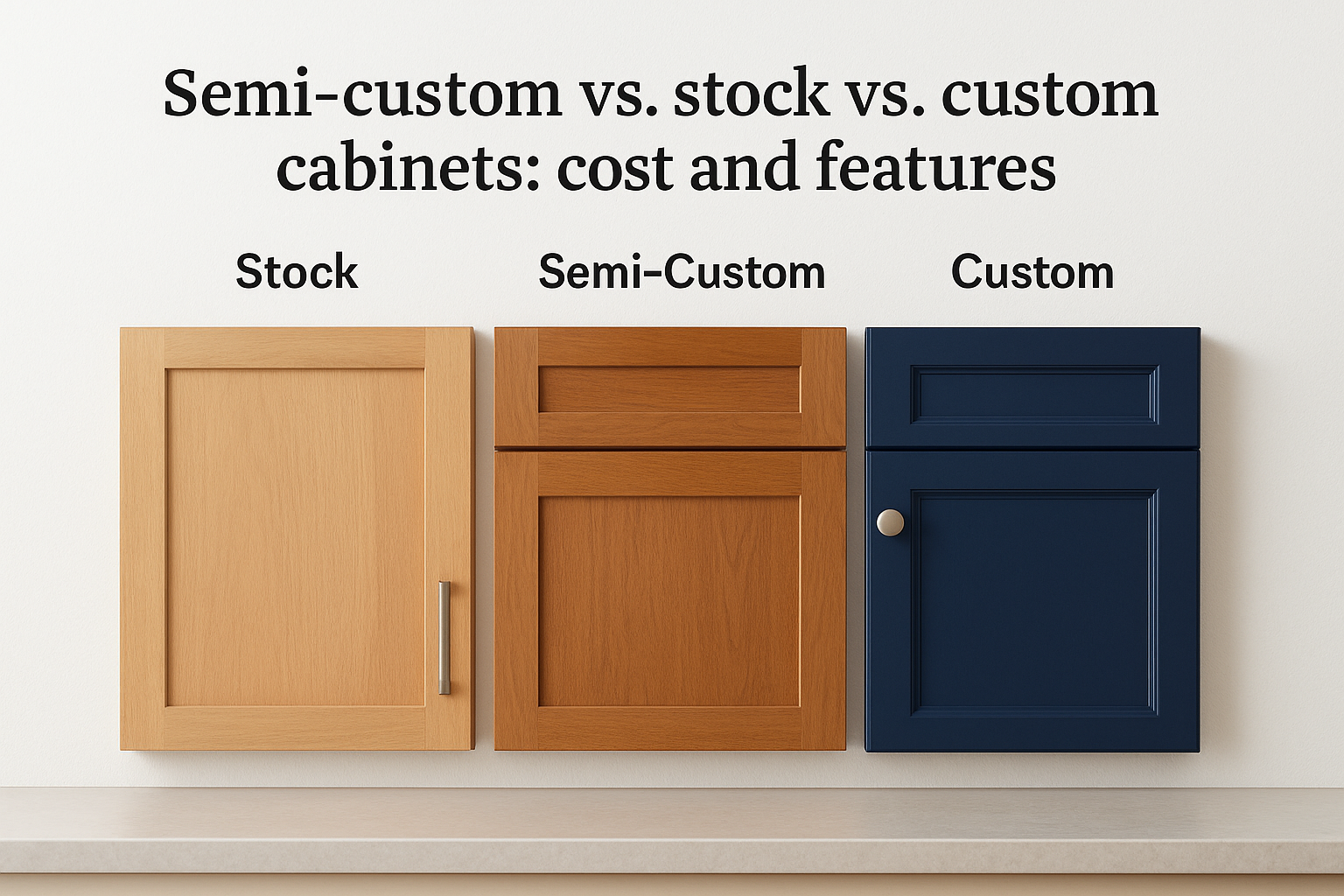
Semi-custom vs. stock vs. custom cabinets: cost and features
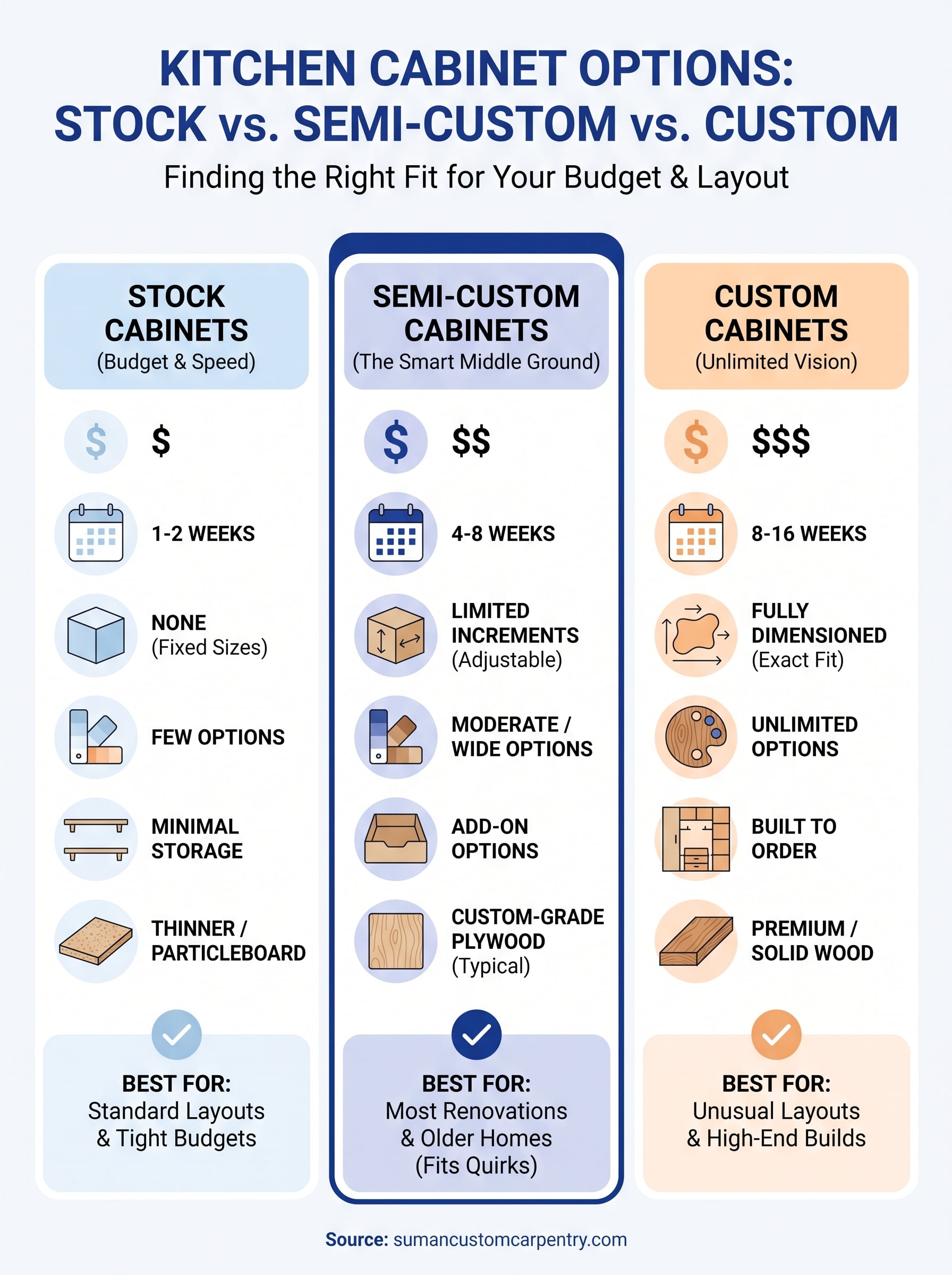
Once you understand what semi-custom offers, the choice gets easier when you see all three options side by side. Price, lead time, and design control move together, so pushing one up or down shifts the other two. Stock cabinets ship fast and cost the least, but you’re locked into fixed sizes and limited finishes. Fully custom cabinets give you total design freedom, but you’ll wait longer and pay significantly more for it.
| Feature | Stock | Semi-Custom | Full Custom |
|---|---|---|---|
| Price range | $ | $$ | $$$ |
| Lead time | 1-2 weeks | 4-8 weeks | 8-16 weeks |
| Size adjustments | None | Limited increments | Fully dimensioned |
| Wood/finish options | Few | Moderate to wide | Unlimited |
| Storage customization | Minimal | Add-on options | Built to order |
| Best for | Tight budgets, standard layouts | Most renovations, older homes | Unusual layouts, high-end builds |
Stock cabinets fit a budget, custom cabinets fit a vision, and semi-custom fits almost everyone in between.
Quality construction matters at every tier, but the gap widens fastest between stock and semi-custom. Stock boxes often use thinner materials because manufacturers cut costs to hit a low price point across thousands of identical units. Real semi-custom lines, on the other hand, usually match custom-grade plywood construction, just with less flexibility in sizing than a from-scratch build. That’s the trade-off worth understanding before you sign a quote: you’re not sacrificing durability by going semi-custom, you’re sacrificing some design freedom to save real money.
When fully custom cabinetry makes more sense
Semi-custom covers most kitchens, but some projects outgrow it fast. When your layout has unusual angles, non-standard appliances, or a design vision that modification increments can’t reach, full custom stops being a luxury and starts being the only option that actually works.
When your kitchen breaks the mold, cabinets built from scratch are the only ones that won’t fight it.
Unusual layouts and structural quirks
Older Cape Cod homes sometimes have kitchens with odd angles, low beams, or oversized appliances that no manufacturer’s modification chart accounts for. If filler panels and adjusted toe kicks still leave gaps or awkward transitions, you’re past what semi-custom can fix. Full custom builds start with your exact measurements, not a base template, so every inch gets used instead of trimmed around.
High-end material or design goals
Homeowners chasing a specific look, like matched grain paneling, integrated appliance panels, or furniture-style detailing, need a shop that builds to that spec rather than picks from a catalog. Consider full custom when you want:
- Book-matched wood grain across doors and panels
- Fully concealed appliance integration
- One-of-a-kind storage built around a specific collection or habit
- A design that needs to match existing millwork exactly
If any of those describe your project, the higher price and longer lead time buy you a kitchen that fits nothing else could.
Finding the right fit for your kitchen
Most kitchens don’t need a from-scratch design, they need cabinets that adjust to fit the space and storage habits you already have. Semi-custom kitchen cabinets give you that flexibility without the price tag or wait time of a full custom build, which is why they work for the majority of Cape Cod renovations. Structural quirks and high-end design goals are the exception, not the rule, and now you know how to tell which category your project falls into.
Getting this decision right means walking your kitchen, matching storage to how you actually cook, and checking construction quality before you compare prices. Once you’ve done that homework, the choice between stock, semi-custom, and full custom stops feeling like guesswork.
If your layout has quirks a catalog can’t solve, or you just want a local shop to walk you through your options in person, reach out to Suman Custom Carpentry for a design consultation.