
A custom built-in entertainment center cost can range anywhere from $2,000 to $15,000 or more, depending on materials, design complexity, and where you live. That’s a wide spread, and if you’re a Cape Cod homeowner trying to budget for one, you need real numbers, not vague estimates. The good news is that understanding what drives the price up or down puts you in control of the project from day one.
At Suman Custom Carpentry, we design and hand-build custom entertainment centers and built-ins right here in our Hyannis shop. We’ve seen the full range of projects, from straightforward media walls to elaborate floor-to-ceiling units with integrated lighting, hidden storage, and fireplace surrounds. That hands-on experience gives us a clear picture of what these projects actually cost in 2026, not just nationally, but specifically on Cape Cod.
This guide breaks down current pricing for custom built-in entertainment centers, including labor and material costs, size and style variables, and budget-friendly alternatives like DIY builds and IKEA modifications. Whether you’re planning a full custom build or exploring more affordable routes, you’ll walk away with the numbers you need to make a confident decision. Let’s get into the real costs you can expect.
Why custom built-ins cost what they do
Custom built-ins are not furniture you pull off a shelf and fit into a corner. Every unit gets designed to match your specific wall dimensions, work around existing electrical outlets, HVAC vents, and architectural features, and align with the style and finish of your home. That design-and-build process takes real time, significant skill, and quality materials. Those three factors account for most of the price difference between a true custom unit and a prefab cabinet stack you’d piece together over a weekend.
It starts with design and planning
Before a single board gets cut, a carpenter spends time measuring your space, discussing your needs, and producing a detailed design plan. On larger or more complex projects, that can mean multiple consultations, technical drawings, and material selections before the build even begins. At Suman Custom Carpentry, we work through the design with you from the start, which means the unit we build fits your wall exactly and accounts for every cable run, outlet location, speaker placement, or lighting fixture you want integrated. That planning phase carries real labor cost, and cutting corners on it is exactly how projects end up with gaps, misaligned doors, or cabinets that block a wall switch.
A built-in designed around your exact space and electrical layout costs more upfront than a stock unit, but it eliminates the expensive fixes that come from a poor fit later.
Materials account for a significant portion of the budget
The wood species, plywood grade, and finish you select have a direct effect on the final price. Solid hardwoods like maple, cherry, or white oak cost significantly more than MDF or lower-grade plywood, but they last decades longer and hold up far better in coastal environments like Cape Cod, where humidity and salt air degrade inferior materials over time. Paint-grade MDF is a popular middle-ground option for homeowners who want a clean, polished look at a lower material cost without sacrificing structural integrity on shelving and cabinet boxes.
Your choice of hardware and add-ons also adds up faster than most people expect. Soft-close hinges, full-extension drawer slides, LED strip lighting, glass-front doors, and integrated cord management systems all carry their own material and installation costs. None of those items are expensive on their own, but across a large wall unit with multiple cabinets and open shelving sections, the combined total can add several hundred dollars to your materials bill before labor is factored in.
Labor is the largest single line item
The biggest driver of the custom built in entertainment center cost is skilled labor. A custom unit requires a carpenter who can design, cut, join, finish, and install the piece with precision at every stage. That process takes days, not hours, and the skill level involved sits well above standard construction work. Joinery, face frame alignment, fitting doors to tight tolerances, and achieving a finish that looks built into the room all require experience that reflects directly in the rate you pay per hour.
At a shop like ours, the unit gets fully built in-house before it ever arrives at your home. That approach means fit issues get resolved at the shop rather than on installation day, which saves time and prevents costly on-site improvisation. Installation then requires careful leveling, scribing to walls and ceilings, integrating with existing trim profiles, and blending with your paint or stain finish. Every hour of that skilled on-site work shows up in the final quote you receive.
2026 cost ranges for built-in entertainment centers
Understanding current price ranges helps you set a realistic budget before you contact a single contractor. The custom built in entertainment center cost in 2026 falls into three broad tiers based on scope, materials, and complexity. Where your project lands within those tiers depends on decisions you make during the design phase, which is exactly why understanding the numbers early gives you real leverage.
Entry-level and mid-range builds
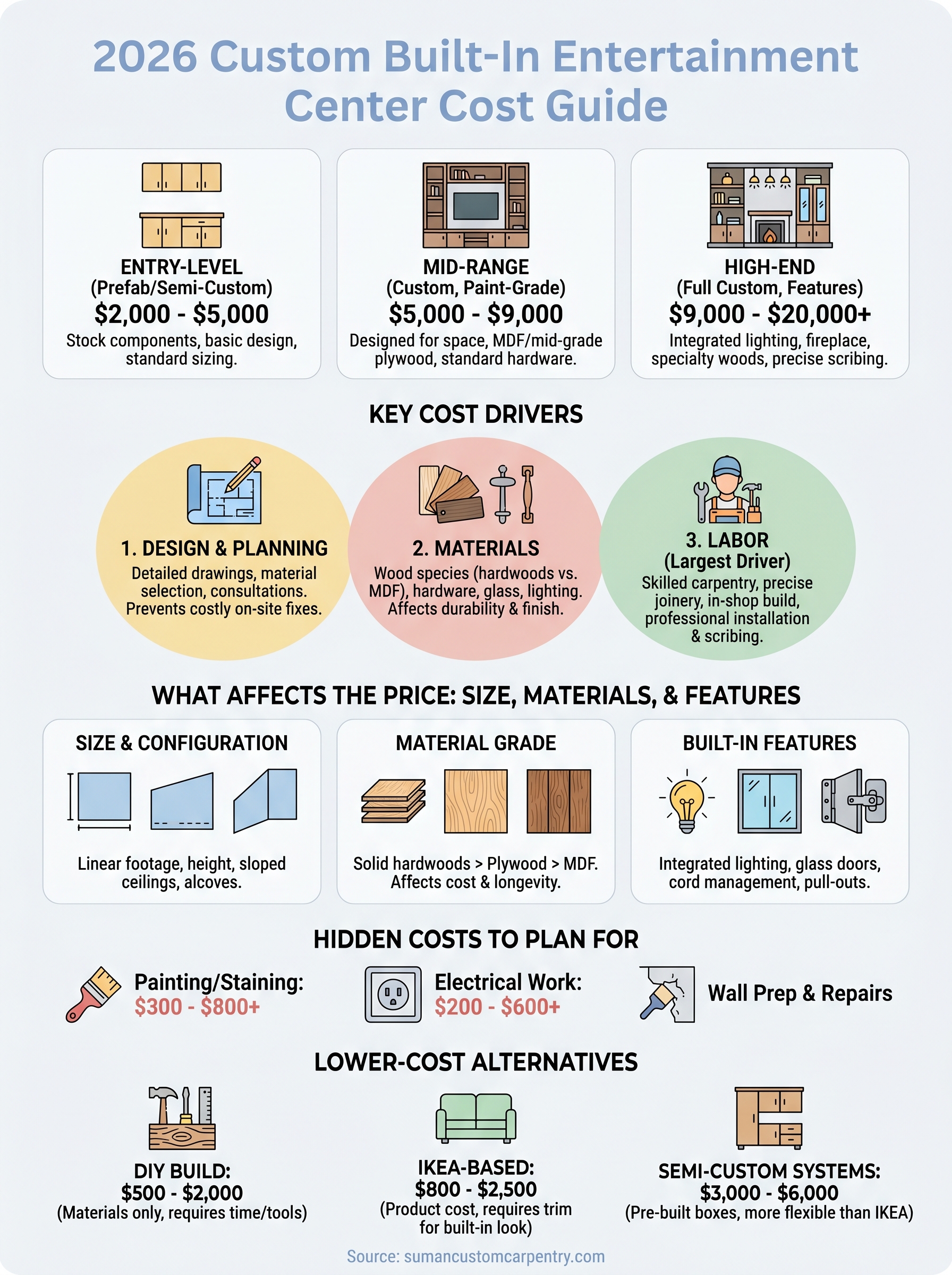
At the lower end of the market, prefab or semi-custom units assembled from stock cabinet components typically run between $2,000 and $5,000 installed. These builds use standard cabinet boxes, limited finish options, and minimal custom detailing. They work for straightforward media walls where the dimensions are forgiving and the design stays simple.
Mid-range custom builds, meaning units designed to fit a specific wall but built with paint-grade MDF or mid-grade plywood and standard hardware, generally fall in the $5,000 to $9,000 range. This tier covers most single-wall entertainment centers with a mix of open shelving, closed lower cabinets, and a centered TV section. For many Cape Cod homeowners, this is the realistic starting point for a unit that looks truly built-in rather than assembled.
If your goal is a seamless, furniture-grade result that integrates with your trim and flooring, expect your budget to start at $5,000 at minimum for a mid-size wall.
High-end and fully custom builds
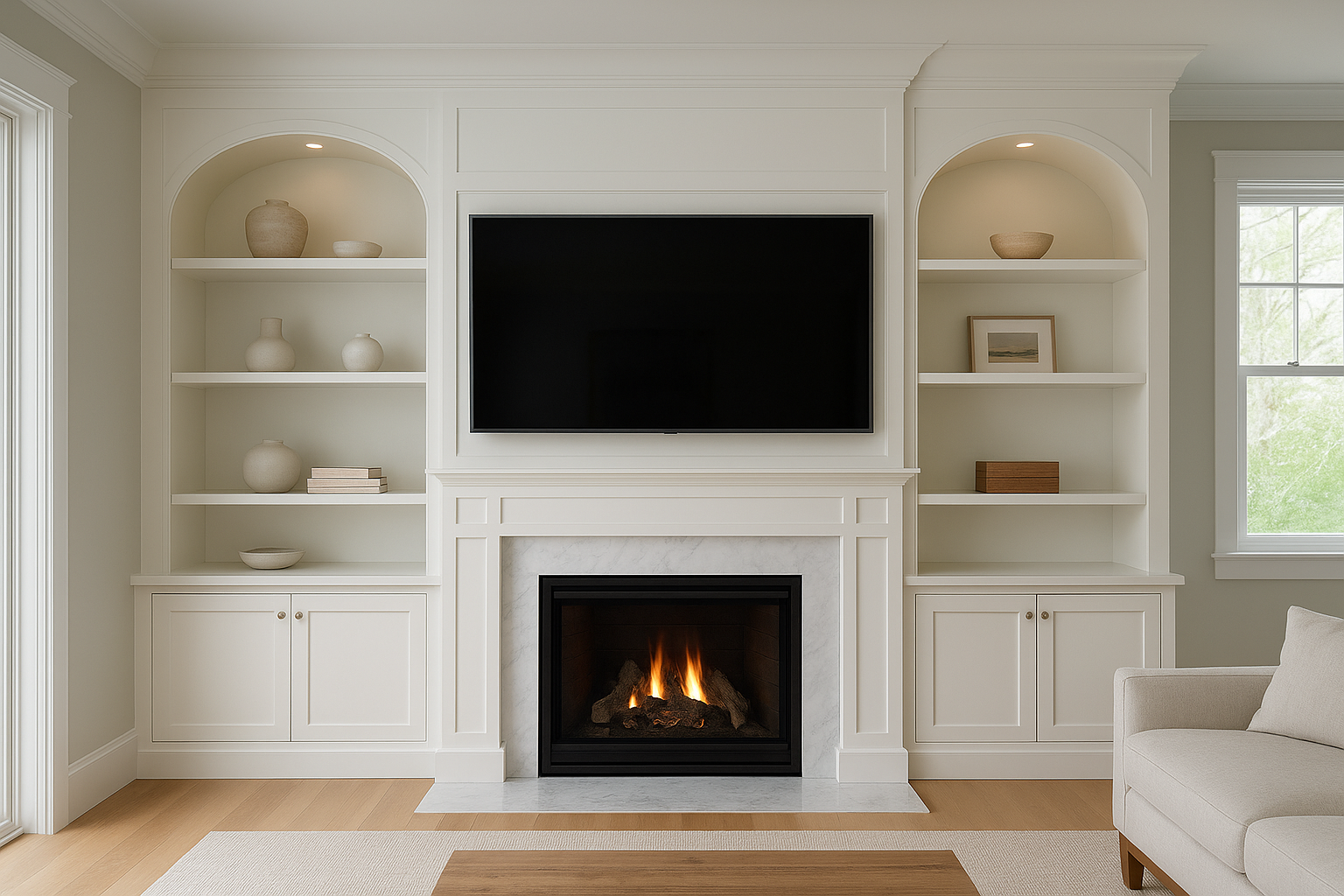
Floor-to-ceiling units with integrated features like built-in lighting, a fireplace surround, hidden cable management, glass-front uppers, or specialty wood species push costs into the $9,000 to $20,000+ range. At this level, every component gets designed, built, and finished to exact specifications. The carpenter scribes the unit to your ceiling and walls, matches your existing millwork profiles, and delivers a result that looks like the house was built around it.
On Cape Cod specifically, material and labor costs run higher than national averages due to regional demand, the cost of skilled trades, and the premium on quality materials that hold up in coastal conditions. A project quoted at $8,000 in the Midwest might realistically cost $10,000 to $12,000 on the Cape. Factor that regional adjustment into any national estimate you find online.
What drives the price: size, materials, and features
Three variables account for most of the variation you’ll see when researching the custom built in entertainment center cost: how big the unit is, what it’s built from, and what features get integrated into the design. Adjusting any one of those three factors moves the price in a meaningful way, which gives you real control over where your project lands within your budget.
Size and wall configuration
Linear footage is the most straightforward pricing factor. A compact eight-foot media wall costs less than a twelve-foot floor-to-ceiling unit, simply because the larger build requires more material and more labor hours. Height adds cost in a different way: taller units require scribing to the ceiling, more structural support, and additional face frame sections, all of which take time. Angled walls, alcoves, or rooms with sloped ceilings add complexity that pushes labor hours higher regardless of the overall square footage.
Material grade and finish selection
The species and grade of material you choose affects both the upfront cost and the longevity of the finished piece. Paint-grade MDF works well for a clean, contemporary look and keeps material costs lower, while solid hardwoods like white oak or maple carry a higher price per board foot but deliver a result that holds up for decades, which matters in a coastal environment like Cape Cod. Plywood cabinet boxes also vary in quality, and higher-grade sheets with fewer voids cost more but produce significantly stronger shelving and door frames.
Spending more on material grade now reduces the chance you’re replacing or repainting the unit in five years due to warping, delamination, or finish failure.
Built-in features and add-ons
Individual features stack up faster than most homeowners expect when they’re reviewing a final quote. LED lighting, glass-front doors, soft-close hardware, integrated cord management, and pull-out drawers each carry their own material and installation cost. A single cabinet run with eight doors and four drawers can add $300 to $600 in hardware alone before you factor in the extra labor to fit and align each component. Prioritizing the features you’ll actually use daily is the most practical way to control this part of your budget without sacrificing the overall look you’re after.
Labor, installation, and hidden costs to plan for
The line items you see on a quote don’t always tell the full story. Labor and installation make up a large portion of the custom built in entertainment center cost, and several additional expenses tend to surface mid-project if you haven’t accounted for them in your initial budget. Knowing what to expect ahead of time keeps the process smooth and prevents sticker shock when your contractor submits the final invoice.
What skilled labor costs per hour
Custom carpentry labor in Massachusetts runs between $75 and $150 per hour depending on the complexity of the work and the experience level of the craftsperson. A mid-size entertainment center typically requires 20 to 40 hours of combined shop and installation time. That range puts labor alone at $1,500 to $6,000 before materials, hardware, or finishing costs are added. On Cape Cod, expect rates to sit at the higher end of that range given regional demand for skilled trades.
Paying for experienced labor upfront costs less than paying to fix a unit that was installed incorrectly or finished poorly.
What installation day actually involves
Installation is not simply carrying cabinets into a room and fastening them to the wall. Your carpenter needs to level and plumb each section, scribe the unit to your ceiling and walls, integrate with existing baseboard and crown molding profiles, and fit all doors and drawers to tight tolerances. Electrical coordination adds time if outlets need to be relocated or new circuits run for integrated lighting. That on-site work can run one to three full days depending on the size of your unit and how much site prep is required.
Hidden costs that catch homeowners off guard
Several costs fall outside the main build quote and are worth budgeting for separately. Painting or staining after installation often gets handled by a finishing carpenter or painter and adds $300 to $800 depending on the unit size and finish type. Wall patching and prep work before installation also carries a cost if your existing walls need repair. Finally, electrician fees for outlet relocation or new lighting circuits can add $200 to $600 to the total project cost depending on your existing wiring setup.
DIY, semi-custom, and IKEA-based alternatives
Not every homeowner needs a fully custom build. If your wall dimensions are forgiving, your design goals are straightforward, and you have the time to manage the process, lower-cost alternatives can deliver a result that looks close to custom without the full price tag. Understanding where each option falls on the cost-versus-quality spectrum helps you decide which path makes sense before weighing it against the custom built in entertainment center cost.
Building it yourself
A full DIY build using plywood or MDF typically costs $500 to $2,000 in materials depending on the size of the unit and the hardware you select. You skip labor costs entirely, which is where the savings come from. The trade-off is time and skill: a single-wall entertainment center takes most experienced DIYers two to four full weekends to measure, cut, assemble, and finish properly.
Before starting a DIY build, confirm you have access to or can rent the following:
- A table saw or track saw for breaking down sheet goods
- A pocket hole jig or biscuit joiner for cabinet assembly
- A nail gun for face frames and trim
- Clamps and a reliable flat surface for gluing assemblies square
IKEA-based builds
IKEA’s KALLAX and BESTA systems are the most common starting point for budget media wall projects. A wall of BESTA units with doors and hardware runs $800 to $2,500 in product costs before installation. The units look clean when done well, but they ship in standard dimensions, which means gaps at the ceiling and walls require separate trim work to close.
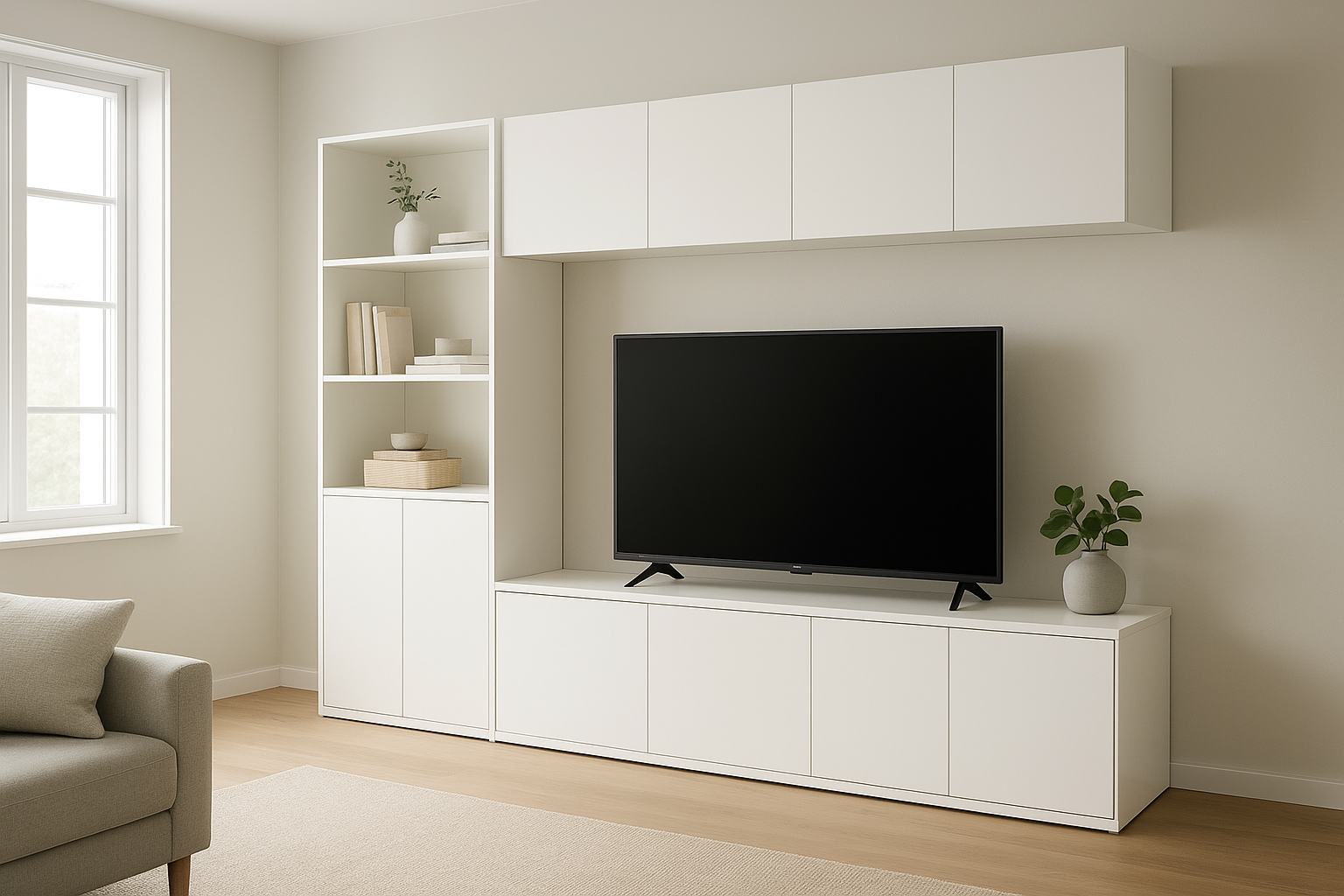
IKEA-based builds save money upfront but require additional carpentry work to look truly built-in, which narrows the cost gap more than most buyers expect.
Semi-custom cabinet systems
Semi-custom systems from home improvement retailers sit between IKEA and a full custom build. Pre-built cabinet boxes come in standard sizes and accept custom doors, hardware, and finishes, giving you more flexibility than flat-pack furniture without paying for fully bespoke millwork. Installed cost typically runs $3,000 to $6,000 for a mid-size wall. The limitation is that standard sizing still requires filler strips and trim to bridge gaps, and the quality of cabinet boxes varies widely across product lines.
How to get an accurate quote and avoid surprises
Getting an accurate quote for your custom built in entertainment center cost starts before you pick up the phone. Contractors can only give you a reliable number when they have clear information about your space, goals, and timeline. Walking into a consultation unprepared leads to vague estimates that leave room for cost increases later, which is exactly the situation you want to avoid.
What to prepare before you contact a contractor
Bring three things to your first conversation: accurate wall measurements, a clear sense of what features you want, and a realistic budget range you’re comfortable sharing. Measurements should include the wall width, ceiling height, and the location of any outlets, vents, or switches on that wall. Contractors need that information to assess scope and price the job without guessing.
Sharing your budget upfront lets a good contractor design to your number rather than present something you can’t afford and have to scale back later.
You should also gather visual references from home improvement sites or interior design platforms that show the style and finish you’re after. Photos take the ambiguity out of conversations about trim profiles, door styles, and finish preferences, which reduces the chance of misunderstandings mid-project.
Questions to ask during the estimate
Once you’re in the conversation, ask specific questions rather than waiting to see what the quote includes. A thorough contractor will cover these points without prompting, but you should verify each one directly:
- What materials are included in the base price, and what upgrades cost extra?
- Does the quote cover installation labor and finishing, or are those separate line items?
- Who handles electrical coordination if outlets need moving or lighting circuits need adding?
- What is the payment structure, and when are deposits due?
- What does the warranty cover, and for how long?
Getting written answers to those questions before signing anything protects you if disputes come up later. A contractor who hesitates to put specifics on paper is a contractor worth walking away from. Detailed written quotes are the standard for any professional carpentry project, and you should expect nothing less on a build of this size.
Next steps for your media wall plan
You now have a clear picture of the custom built in entertainment center cost from material choices to labor rates to the hidden expenses that catch most homeowners off guard. The next step is moving from research to an actual conversation with a craftsperson who can look at your wall, understand your goals, and give you a real number based on your specific project, not a national average.
At Suman Custom Carpentry, we design and hand-build every unit in our Hyannis shop before installation, which means fewer surprises on site and a finished result that looks like it belongs in your home. We work with Cape Cod homeowners through every stage, from the first measurement to the final coat of paint. If you’re ready to get specific numbers for your project, reach out to Suman Custom Carpentry and we’ll set up a consultation to talk through your wall and your budget.