
Soft Close Hinges for Kitchen Cabinets: What They Are & How They Work
Slamming cabinet doors get old fast, especially in a busy kitchen where every drawer and door sees daily abuse. If your cabinets bang shut, rattle, or slowly work their hinges loose, you’re dealing with hardware that hasn’t caught up to how kitchens actually get used. Soft close hinges for kitchen cabinets solve this with a built-in damping mechanism that slows the door in the last few inches, so it settles shut quietly instead of crashing closed.
This guide breaks down exactly what these hinges are and how the mechanism works, whether you’re outfitting new cabinets or retrofitting an older kitchen. You’ll learn the difference between hydraulic and mechanical dampers, how hinge overlay affects fit, and what separates a hinge that lasts ten years from one that fails within months. We also cover installation basics so you know what to expect whether you’re doing it yourself or having a pro handle it.
We build custom kitchens here in Hyannis and hand-fit every hinge ourselves, so we’ve seen firsthand which hardware holds up to Cape Cod humidity and daily wear, and which doesn’t. This article gives you that same practical knowledge before you buy.
Why soft close hinges matter for your kitchen cabinets
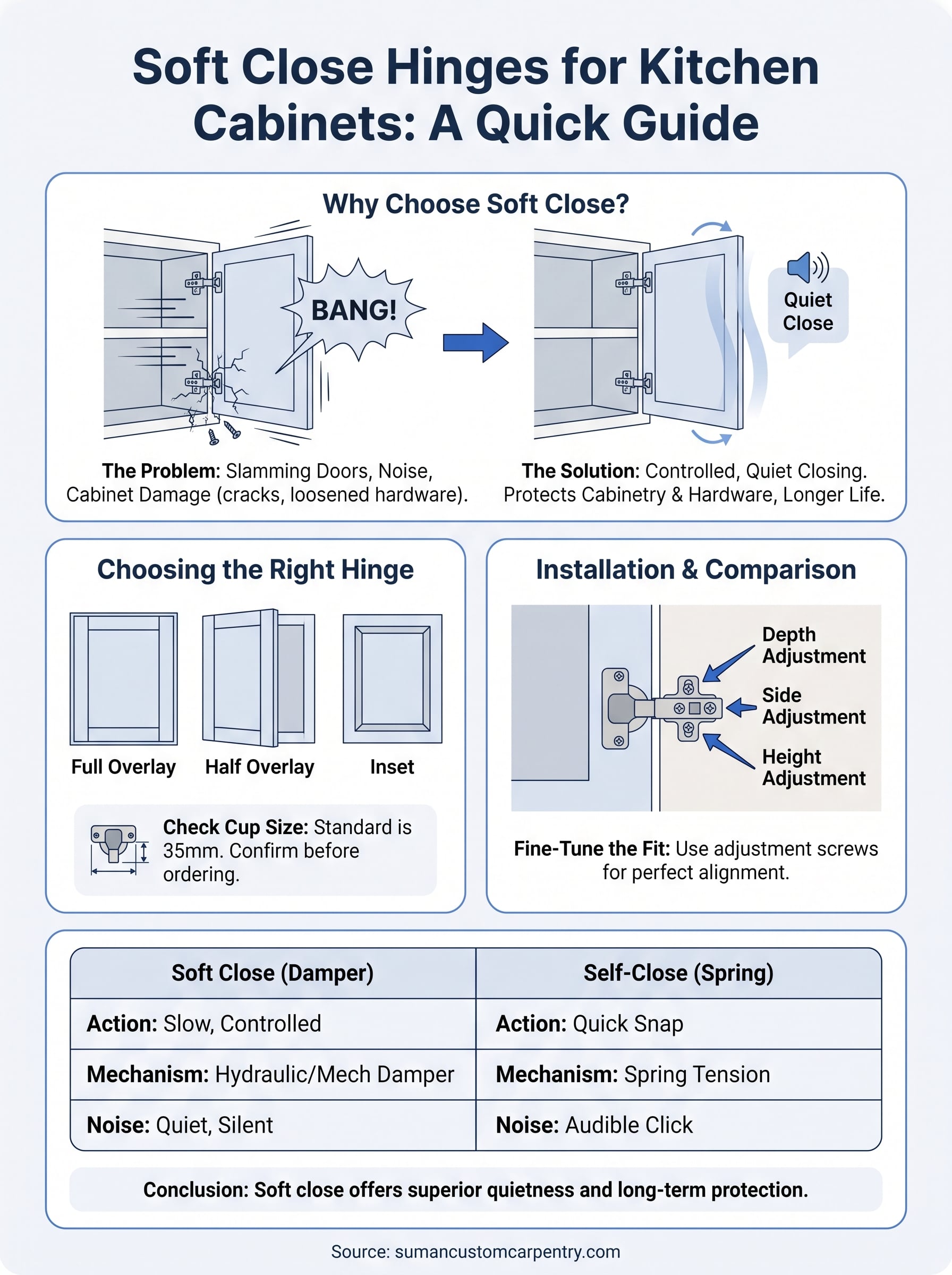
Cabinet doors that slam shut aren’t just annoying, they’re doing real damage every time they close. Standard hinges let the door swing freely until it hits the cabinet frame, and that impact loosens screws, cracks veneer, and eventually causes the hinge cup to work its way out of the door. Over a few years of daily use, that repeated shock is what turns a tight, well-built cabinet into one with sagging doors and rattling hardware. Soft close hinges for kitchen cabinets eliminate that impact entirely by controlling the last two to three inches of travel before the door meets the frame.
A cabinet door that closes gently outlasts one that slams by years, not months.
Beyond the mechanical wear, there’s a quality-of-life argument that matters just as much in a real kitchen. Families with young kids know how often a door gets pushed shut in a hurry, and older hinges turn that into a sharp bang that echoes through an open floor plan. Guests notice it too, especially in kitchens designed for entertaining, where a quiet close feels like part of the finish quality rather than an afterthought. Homes on Cape Cod often have open layouts connecting the kitchen to living and dining spaces, so noise from cabinets carries further than people expect.
Protecting your cabinetry investment
Good custom cabinetry is a long-term purchase, and the hardware you choose either supports that lifespan or undermines it. Screws that back out from repeated slamming leave stripped holes in the cabinet box, and repairing that damage in solid wood or high-end plywood construction is far more involved than swapping a hinge. This is exactly why we build every kitchen with soft close hardware standard and back the cabinet boxes and doors with a lifetime guarantee, since we’ve seen what cheap hinges do to otherwise well-built boxes over time.
Everyday convenience adds up
Small daily frictions shape how much you actually enjoy your kitchen, and hinge quality is one of those details people underestimate until they live with better hardware. A door that closes itself the last few inches means you can nudge it shut with an elbow while your hands are full, without worrying about a slam. Consider what changes once you upgrade:
- No more waking a sleeping baby with a cabinet door
- Fewer stripped screws and loose hinge plates over time
- Doors that stay aligned instead of sagging at the corners
- A noticeably quieter kitchen during busy meal prep
These aren’t dramatic changes individually, but together they add up to a kitchen that feels more finished and easier to live with.
How to choose the right soft close hinges for your cabinets
Picking hardware off a shelf without checking your cabinet’s overlay style is the most common mistake we see homeowners make. Soft close hinges for kitchen cabinets aren’t universal, and the wrong overlay or cup size means doors that don’t sit flush or won’t close at all. Before you order anything, measure how your existing doors sit against the cabinet frame, since that measurement drives every other decision.
Match the hinge to your cabinet door overlay
Overlay refers to how much the door covers the cabinet frame, and hinges are built specifically for each type. Getting this wrong is the fastest way to end up with gapped or overlapping doors.
| Overlay type | Door coverage | Common use |
|---|---|---|
| Full overlay | Covers almost the entire frame | Modern, frameless cabinets |
| Half overlay | Covers half the frame, shares with adjacent door | Face-frame cabinets |
| Inset | Sits flush inside the frame | Traditional, custom builds |
Buy hinges for your overlay, not the other way around.
Check cup size and mounting plate compatibility
Most kitchen cabinets use a 35mm cup, but older or imported cabinetry sometimes uses smaller sizes, so confirm before drilling new holes. Mounting plates also vary in height, and mismatched plates throw off door alignment even when the hinge itself is correct. If you’re unsure, bring an existing hinge or door sample to the hardware supplier rather than guessing from memory. For custom kitchens, we spec hinges during design so overlay, cup size, and plate height are locked in before a single door gets hung, which avoids the trial-and-error homeowners run into with off-the-shelf replacements.
How to install and adjust soft close hinges
Installing soft close hinges for kitchen cabinets is straightforward once you have the right cup size and overlay, but the adjustment afterward is where most DIY jobs go wrong. Drilling the cup hole off-center or too shallow means the door never sits flush, so measure twice before you touch a drill. Most hinges use a standard 35mm forstner bit for the cup and come pre-marked for the mounting plate screws, which keeps the process fast if your cabinet is already prepped for hinges.
Step-by-step installation basics
Follow this order to avoid the most common mistakes:
- Confirm overlay type and cup size before drilling anything.
- Drill the cup hole to the manufacturer’s specified depth, usually around 12-13mm.
- Attach the hinge to the door first, then mount the plate to the cabinet frame.
- Hang the door on the plate and check that it swings freely without rubbing.
- Test the soft close action by pushing the door from a few inches out.
A hinge installed a millimeter off will fight you every time you adjust it.
Fine-tuning the fit
Once the hinge is mounted, three adjustment screws handle almost every alignment issue. The depth screw moves the door in and out relative to the frame, the side screw shifts it left or right, and the height screw raises or lowers it. Turn these in small increments, a quarter turn at a time, and re-check the gap against neighboring doors before making another adjustment. Doors that look crooked are usually just one screw away from sitting perfectly level.
Humidity on Cape Cod causes wood to expand and contract more than in drier climates, so seasonal adjustment is worth building into your routine. We check hinge alignment on every kitchen we install after the first year, since that’s when wood movement from a full seasonal cycle typically shows up in door gaps.
Soft close vs. self-close hinges: which is right for you
Self-close hinges use a spring mechanism that pulls the door shut once it passes a certain point, but they don’t slow the door down first. That means the door still swings with force right up until the spring grabs it, so you get a quick snap rather than a slam, but not the gentle settle you get from true soft close hinges for kitchen cabinets. Some homeowners confuse the two because both keep doors from swinging open on their own, but the closing experience is completely different.
Comparing the mechanisms
Understanding the difference matters most when you’re comparing price tags, since self-close hardware is often cheaper but wears differently over time.
| Feature | Soft close | Self-close |
|---|---|---|
| Closing action | Slow, controlled, silent | Quick snap into place |
| Mechanism | Hydraulic or mechanical damper | Spring tension |
| Noise level | Nearly silent | Audible click |
| Long-term wear | Low stress on frame | Moderate stress on frame |
| Typical cost | Slightly higher | Lower |
If quiet matters to you, soft close is the only option that actually delivers it.
Which one fits your kitchen
Families with kids, anyone who cooks late at night, or homeowners who just want a kitchen that feels high-end should go with true soft close hardware every time. Budget renovations or rental properties sometimes lean on self-close hinges since they cost less upfront and still prevent the worst slamming, but they wear their spring tension out faster under heavy daily use. Given how often kitchen cabinets open and close each day, the small price difference between the two rarely justifies settling for the louder, less durable option in a home you plan to stay in long-term.
Getting the details right in your kitchen
Hinges seem like a small line item compared to cabinet boxes and countertops, but they’re what you touch every single day. Soft close hinges for kitchen cabinets protect your investment, keep doors aligned longer, and make the whole kitchen feel quieter and more finished. Getting the overlay, cup size, and mounting plate right up front saves you from the trial-and-error most homeowners run into with off-the-shelf hardware, and a few minutes of adjustment each season keeps everything sitting flush despite Cape Cod’s humidity swings.
Jumping between hinge specs and mounting plates isn’t why you started thinking about a new kitchen in the first place. Good hardware should just work, quietly, for decades. If you’re planning a kitchen renovation on Cape Cod and want cabinetry that’s hand-built with the right hinges specified from day one, reach out to Suman Custom Carpentry and we’ll walk you through the details together.