
Your cabinets set the tone for the entire kitchen. They cover more square footage than almost any other element in the room, which means the style, color, and material you choose will shape how the space looks and feels for years. If you’re searching for kitchen cabinet design ideas ahead of a 2026 remodel, you’re in the right place, and you’re smart to start here before picking up a hammer or signing a contract. The design phase is where great kitchens are won or lost.
At Suman Custom Carpentry, we design and hand-build custom cabinetry at our shop in Hyannis, Cape Cod. Since 2018, we’ve worked with homeowners across the Cape to bring their kitchen visions to life, from layout and material selection all the way through installation. That hands-on experience has given us a clear view of what’s working in real kitchens right now, not just on Pinterest boards.
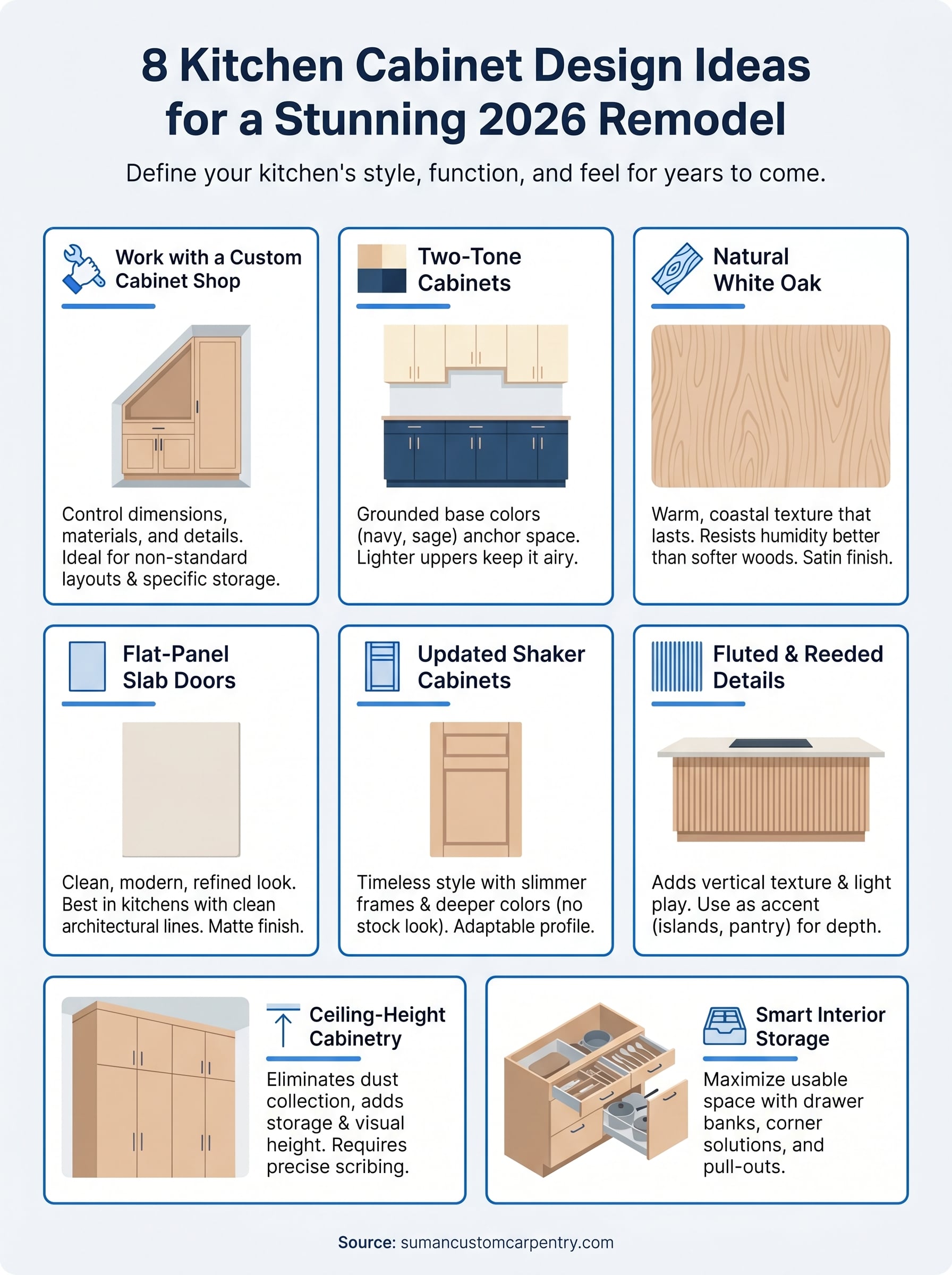
Below, we’re breaking down eight cabinet design ideas that are defining 2026 remodels. Each one includes practical considerations so you can figure out what actually fits your home, your lifestyle, and your budget. Whether you’re leaning toward something bold or prefer a more timeless approach, this list will help you narrow your options and walk into a design consultation with confidence.
1. Work with a Cape Cod custom cabinet shop
Before you commit to any kitchen cabinet design ideas you’ve saved, consider the source of the cabinets themselves. Custom cabinetry built locally gives you control over dimensions, materials, and details that stock or semi-custom cabinets simply can’t match.
Where custom cabinetry makes the biggest difference
Custom cabinets shine in kitchens with non-standard layouts or specific storage needs that stock sizing can’t accommodate. If your kitchen has an angled wall, an unusual ceiling height, or appliances that don’t align with standard sizing, a custom shop can build around those constraints instead of working against them.
Custom cabinets are built to your space, not adapted to fit it.
This matters especially in older Cape Cod homes where wall angles and ceiling heights shift from room to room, and standard cabinet runs leave visible gaps and awkward filler strips that compromise the finished look.
Design decisions to make before the shop drawings
Walk into a design consultation with a clear sense of your priorities: storage capacity, door style, color direction, and any appliances you plan to integrate. You don’t need a finished vision, but knowing whether you want drawer-heavy bases or more door storage will move the shop drawings forward faster and reduce revision rounds.
Your shop will also ask about panel materials, interior finishes, and hinge preferences early in the process. Having answers to the big-picture questions saves time and keeps your project timeline on track.
Material and finish options that hold up on the coast
Cape Cod kitchens face humidity and salt air that stress certain materials over time. At Suman Custom Carpentry, we steer coastal clients toward solid wood construction with moisture-resistant finishes rather than MDF-heavy builds that absorb humidity and swell at joints. For painted cabinets, a catalyzed conversion varnish holds up far better than standard latex paint in coastal conditions.
For stained or natural-finish cabinets, species like white oak and maple take sealers well and resist seasonal movement better than softer woods.
Budget and timeline expectations for 2026
A full custom kitchen in 2026 typically runs higher than semi-custom options, but the gap narrows when you factor in longevity, the resale value you add to your home, and the lifetime warranty we back our cabinet boxes and doors with. Lead times at most custom shops run 40 to 60 days from signed drawings to installation, so plan your start date accordingly if you’re targeting a summer or fall completion.
Getting quotes early also protects you from material cost increases that have continued into 2026, and it gives your shop enough lead time to source the specific materials your design calls for.
2. Two-tone cabinets with a grounded base color
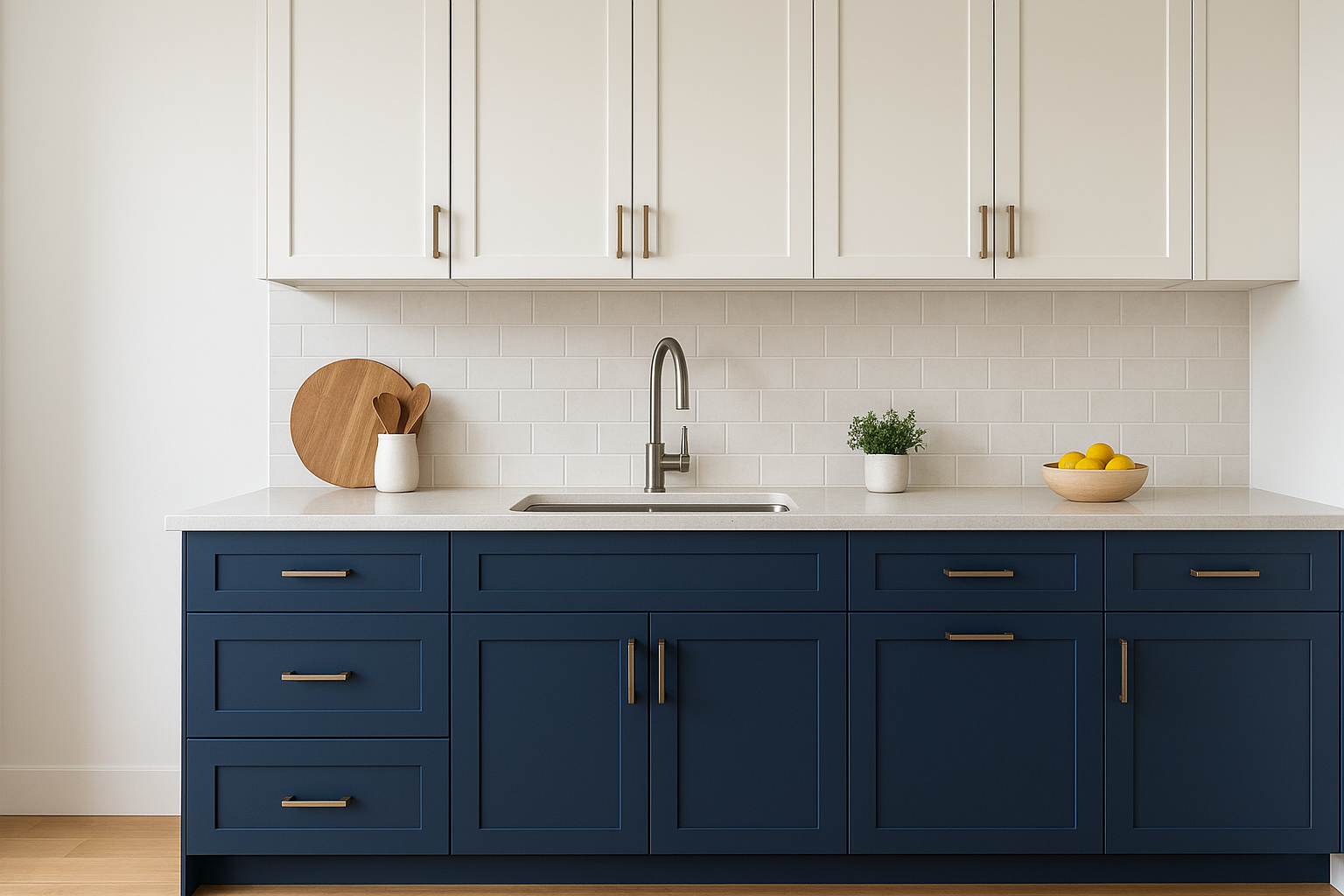
Two-tone cabinets remain one of the most versatile kitchen cabinet design ideas heading into 2026. The concept is straightforward: darker or more saturated colors anchor the lower cabinets, while lighter or more neutral tones keep the uppers from making the space feel heavy or closed in.
Two-tone pairings that look current in 2026
The pairings that hold up well in 2026 lean toward earthy, grounded base colors paired with off-whites or warm creams on top. Deep navy, sage green, and warm charcoal on the lowers work particularly well with a linen or soft white upper that reflects light without going stark.
Avoid pairing two trendy colors together – one grounded neutral gives the combination staying power through multiple design cycles.
How to split colors so the kitchen feels balanced
Your most reliable split point is the countertop line, which keeps the transition logical and architecturally clean. If your kitchen includes an island, treating it as a third design element in the darker base color ties the room together without overcomplicating the layout.
Countertop and backsplash matches that rarely clash
Warm-toned quartz or honed natural stone countertops bridge most two-tone combinations cleanly because they pull from both registers. For the backsplash, a simple tile with a neutral grout lets the cabinet colors lead without visual competition pulling attention in different directions.
Cost, repainting, and touch-up considerations
Planning your two-tone split before shop drawings are finalized adds minimal cost at the build stage. Make sure your shop provides documented paint codes and stain formulas at project close so touch-ups years down the road match exactly.
3. Natural white oak cabinets for warm, coastal texture
White oak has moved past trend status and into genuinely lasting territory. Its warm grain and natural variation bring a texture to kitchen cabinetry that painted finishes simply can’t replicate, and its tonal range works with the light and landscape that Cape Cod homes are built around.
Why oak fits Cape Cod homes and modern remodels
Oak pairs naturally with the coastal palette of soft blues, warm whites, and sand-toned stone that dominates interiors across the Cape. Its density and stability also make it a smarter choice than softer species in homes that see seasonal humidity swings, which is a real consideration for any kitchen cabinet design ideas you’re evaluating in a coastal market.
White oak holds its shape better than most domestic hardwoods when humidity levels shift seasonally.
Rift-sawn vs plain-sawn looks and what to choose
Your cut choice determines how much grain character shows on the door face. For kitchens with flat-panel or simple Shaker doors, the cut you select will define whether the result reads as modern or relaxed:
- Rift-sawn: tight, linear grain, minimal figure, cleaner and more contemporary
- Plain-sawn: wider cathedral grain, more natural variation, warmer and more casual
Stain, clear coat, and sheen choices that age well
A light natural stain or a clear hardwax oil finish lets the wood read as honest material rather than something imitating a different species. For sheen level, satin finishes hold up better than high gloss over time and hide minor surface scratches more effectively in daily-use environments.
Maintenance and wear patterns to plan for
Your white oak cabinets will develop a gentle patina over years of use that most homeowners come to appreciate. Wipe spills quickly near the sink, and plan to reapply a topcoat every few years on high-contact surfaces to keep the finish performing well long-term.
4. Flat-panel slab doors for a clean modern look
Slab doors are among the most requested kitchen cabinet design ideas for 2026 remodels. A full flat-panel door with no frame, rail, or profile gives the kitchen a continuous, graphic surface that reads intentional and refined. The style rewards careful planning from layout through lighting, and every other element in the room needs to earn its place.
When slab fronts look best and when they fall flat
Slab doors perform best in kitchens with clean architectural bones: flat ceilings, squared walls, and modern fixtures that match the style’s level of refinement. If your kitchen carries traditional trim profiles or decorative moldings, slab fronts will create visual tension rather than cohesion with the rest of the room.
Slab doors amplify everything around them, so the rest of your kitchen needs to carry the same level of simplicity.
Handleless, edge pulls, and minimal hardware options
Your hardware choice defines how the slab reads up close. Integrated finger pulls routed directly into the door edge keep the surface completely uninterrupted. If you prefer a tactile grip, thin bar pulls in brushed nickel or matte black add minimal visual weight while giving each door a deliberate finish detail that doesn’t compete with the clean face.
How to keep a slab kitchen from feeling cold
Slabs in painted finishes, especially whites and grays, can read flat and clinical without the right supporting elements around them. Warming the space with natural wood open shelving, a textured stone backsplash, or warm-toned pendant lighting shifts the atmosphere significantly without abandoning the modern direction you’re after.
Fingerprints, scratches, and finish durability notes
High-gloss slab surfaces show fingerprints immediately in an actively used kitchen, which is worth accounting for before you commit to a finish. A satin or matte lacquer hides daily contact marks far better and holds up to regular cleaning without dulling noticeably over months of use.
5. Updated Shaker cabinets for a timeless remodel
Shaker cabinets remain the most requested kitchen cabinet design ideas category we work with, and in 2026 they’ve earned that position for a real reason. The five-piece frame-and-panel construction gives you a clean, adaptable profile that fits equally well in traditional Cape Cod homes and more contemporary coastal remodels without forcing you to commit to a single aesthetic direction.
2026 updates that keep Shaker from looking basic
The Shaker cabinet of 2026 looks notably different from the stock versions that saturated the market a decade ago. Slimmer stile and rail widths paired with deeper, more grounded color choices pull the style toward something more considered and less builder-grade.
Narrowing your stile width by even half an inch shifts a standard Shaker door from stock to custom in the way it reads across a full cabinet run.
Frame widths, rail proportions, and door detailing
Your door proportions carry more visual weight than most people expect going into a remodel. Stiles and rails in the 2 to 2.5-inch range read as more refined than the standard 2.75-inch width common in stock cabinetry. A slightly thicker door panel also adds depth and shadow that elevates the finished cabinet face without adding complexity to the design.
Hardware styles that modernize without dating fast
Unlacquered brass and matte black pulls in simple cylindrical or bar profiles modernize Shaker cabinets without locking the style to a narrow trend window. Keep the profile clean and understated if longevity matters to you.
Price differences vs slab and inset builds
Shaker doors sit mid-range in price compared to slab and inset builds. Inset construction, where the door sits flush inside the face frame, adds cost but delivers a furniture-grade finish that earns its place in higher-visibility kitchens.
6. Fluted and reeded details for depth and light play
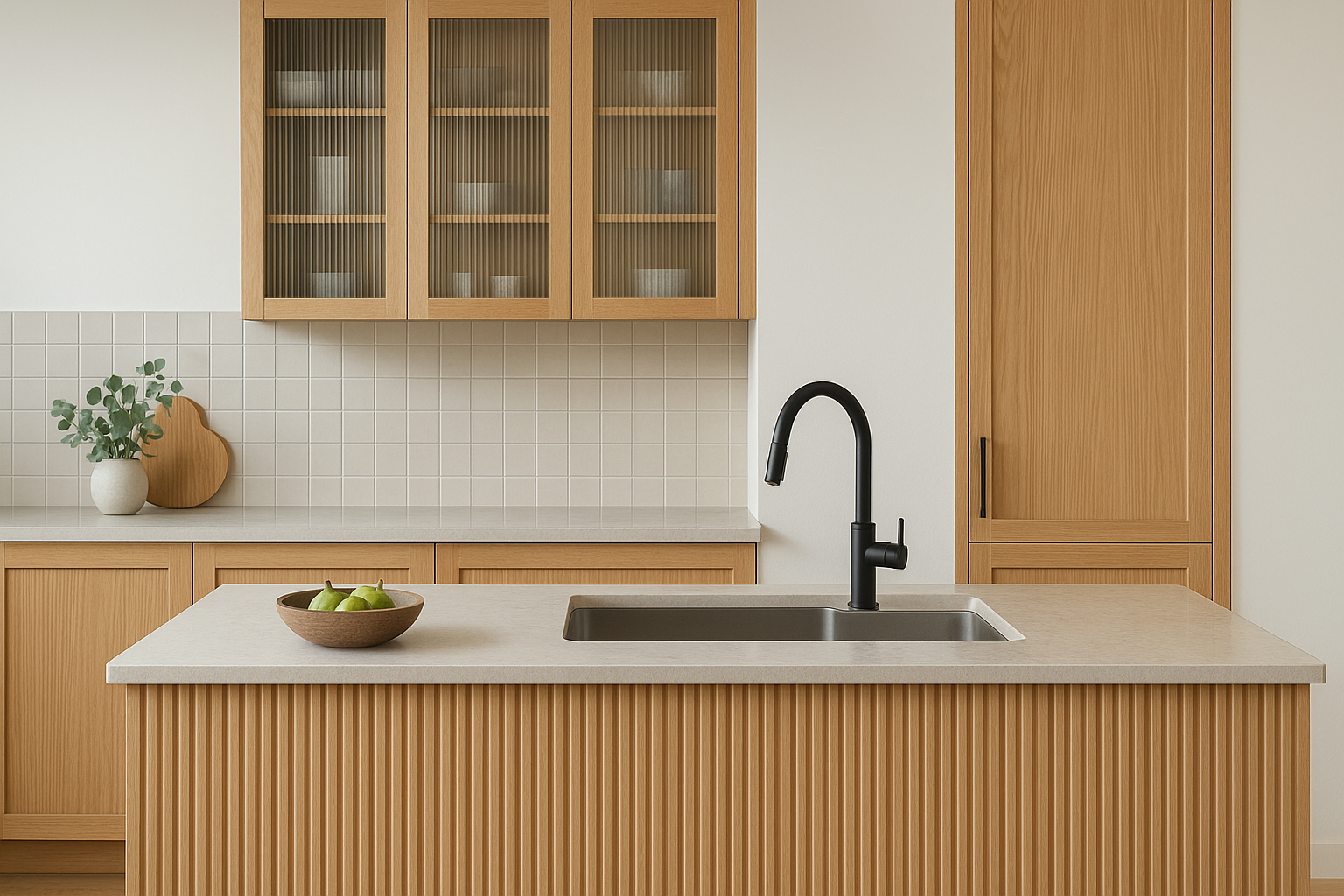
Fluting and reeding add vertical texture to cabinet fronts that flat or frame-and-panel doors simply can’t deliver. If you’re looking for kitchen cabinet design ideas that introduce visual interest without adding color, a fluted or reeded surface catches light in a way that shifts throughout the day as natural light moves through your kitchen.
Where fluting looks intentional, not busy
Fluting works best as an accent application rather than a full-kitchen treatment. Island panels, a single tall pantry cabinet, or a dedicated bar section carry fluted fronts without overwhelming the space. Limiting fluted doors to one or two focal points lets the texture read as a deliberate design choice rather than a pattern that competes with itself across every surface in the room.
Fluting on a full island base draws the eye without requiring you to change a single other element in the kitchen.
Fluted wood vs reeded glass and how to choose
Fluted solid wood gives you warmth and depth, while reeded glass inserts add a translucent layer that softens the look and lets light pass through upper cabinet doors. If your kitchen already carries warm wood tones, reeded glass on the uppers balances the visual weight. If your cabinets are painted, fluted wood panels in the same finish add texture without introducing a second competing material.
Pairing textured fronts with simple surfaces
Keep your countertop and backsplash selections straightforward when you include fluted or reeded details. A honed stone countertop or a simple subway tile backsplash gives the textured fronts room to register without surface competition that flattens the impact of both elements.
Cleaning and long-term upkeep realities
Fluted grooves collect dust and grease faster than flat surfaces, so consider placement carefully near your cooktop. A soft bristle brush or narrow microfiber tool cleans between the ridges efficiently without damaging the finish or lifting the stain over time.
7. Ceiling-height cabinetry and a true pantry wall
Ceiling-height cabinetry is one of the most functional kitchen cabinet design ideas you can bring into a remodel. Running your uppers all the way to the ceiling eliminates the dead space above standard-height cabinets that collects grease and dust, and it adds significant visual height that makes smaller kitchens feel considerably larger.
How to plan uppers to the ceiling without regrets
Measure your ceiling height before you finalize door proportions. Cabinets that terminate at an awkward height relative to your ceiling line look unresolved, so your shop needs the exact ceiling dimension before drawing begins. For ceilings above 9 feet, a step stool becomes part of the storage plan, so keep that in mind when deciding what to store in the highest sections.
The top 12 inches of a ceiling-height cabinet works best for rarely used items, not everyday dishware.
Pantry wall layouts that hide clutter and appliances
A well-planned pantry wall groups your storage, appliances, and prep tools into one organized column that keeps the rest of the kitchen visually clear. Build the layout around a few core components that pull the most weight:
- Pull-out shelving for canned goods and dry storage
- Integrated appliance panels that hide countertop appliances behind doors
- Deep drawer banks at the base for bulky cookware
Molding, fillers, and alignment details that matter
Your crown molding and filler strips need precise scribing to the ceiling and wall surfaces to achieve a true built-in finish. Gaps or misaligned transitions undermine the entire effect, so confirm your shop accounts for ceiling variations in the drawings before fabrication starts.
Storage capacity gains vs added cost
Ceiling-height cabinetry adds roughly 20 to 30 percent more storage volume over standard-height uppers. That gain makes the added material and installation cost worthwhile for most kitchens, particularly when you factor in the reduction in visible clutter it produces across the rest of the room.
8. Smart interior storage that changes daily use
Interior storage is the kitchen cabinet design idea that most homeowners overlook until after installation, and it’s the one that changes how your kitchen works every single day. Thoughtful interior organization built into the cabinet structure itself outperforms any after-market organizer you drop in later.
Drawer-first base cabinets and why they win
Replacing door-and-shelf base cabinets with full-depth drawer banks gives you immediate, visible access to everything stored inside. You stop crouching to reach the back of a lower cabinet, and every item sits at hand level without stacking or digging.
Drawer-first bases recover more usable storage per square foot than any other base cabinet configuration.
Corner solutions that actually stay accessible
Standard corner cabinets waste the most space in any kitchen layout. Full-extension pull-out trays or a well-designed swing-out unit bring everything at the back of the corner forward to you, which means you actually use what’s stored there instead of losing it behind other items.
Trash, recycling, and compost pull-outs that fit right
A dedicated pull-out cabinet for trash, recycling, and compost keeps bins off the floor and out of sight without requiring you to open multiple doors. Size the cabinet to fit the bin dimensions you actually use, not a standard size that forces you to buy new containers after installation.
Appliance garages and coffee zones that reduce clutter
An appliance garage with a tambour or lift door keeps your countertop clear while keeping daily-use appliances plugged in and ready. Building a dedicated coffee zone with an outlet strip, a small drawer for supplies, and a pull-out shelf for the machine turns a scattered counter setup into a contained, functional station.
Next steps for your cabinet plan
You now have a solid foundation of kitchen cabinet design ideas to work from, and the next step is turning that inspiration into a real plan. Narrowing your list to two or three directions before reaching out to a shop will make your first consultation more productive and help your designer give you accurate feedback on what works in your specific space.
Your cabinets will define how your kitchen looks and functions for the next twenty years, so choosing a builder who controls quality from design through installation matters more than finding the lowest bid. At Suman Custom Carpentry, we hand-build every cabinet in our Hyannis shop and back the work with a lifetime warranty on cabinet boxes and doors. If you’re planning a 2026 kitchen remodel on Cape Cod, reach out to our team to schedule a design consultation and get your project started on the right timeline.