
Floating shelves do two things at once: they give you a place to put things, and they make your walls look intentional. That’s why floating shelves ideas for living room spaces are worth spending real time on before you commit to a design. The right shelves can anchor a room, display what matters to you, and free up floor space you didn’t know you were wasting.
But there’s a catch. A floating shelf is only as good as its build and installation. Cheap brackets sag. Thin materials bow under the weight of books. And a poorly mounted shelf on a Cape Cod plaster wall? That’s a repair bill waiting to happen. Getting the design right matters, but so does getting the construction right, and that’s where most off-the-shelf options fall short.
At Suman Custom Carpentry, we hand-build custom shelving and built-ins at our shop in Hyannis, Cape Cod. We’ve spent over seven years designing storage solutions that fit the way our clients actually live, not just what looks good in a catalog. So when we put together this list, we pulled from real project experience and practical know-how, not just Pinterest boards. Every idea here is something we’d confidently build and install, backed by our lifetime guarantee on craftsmanship.
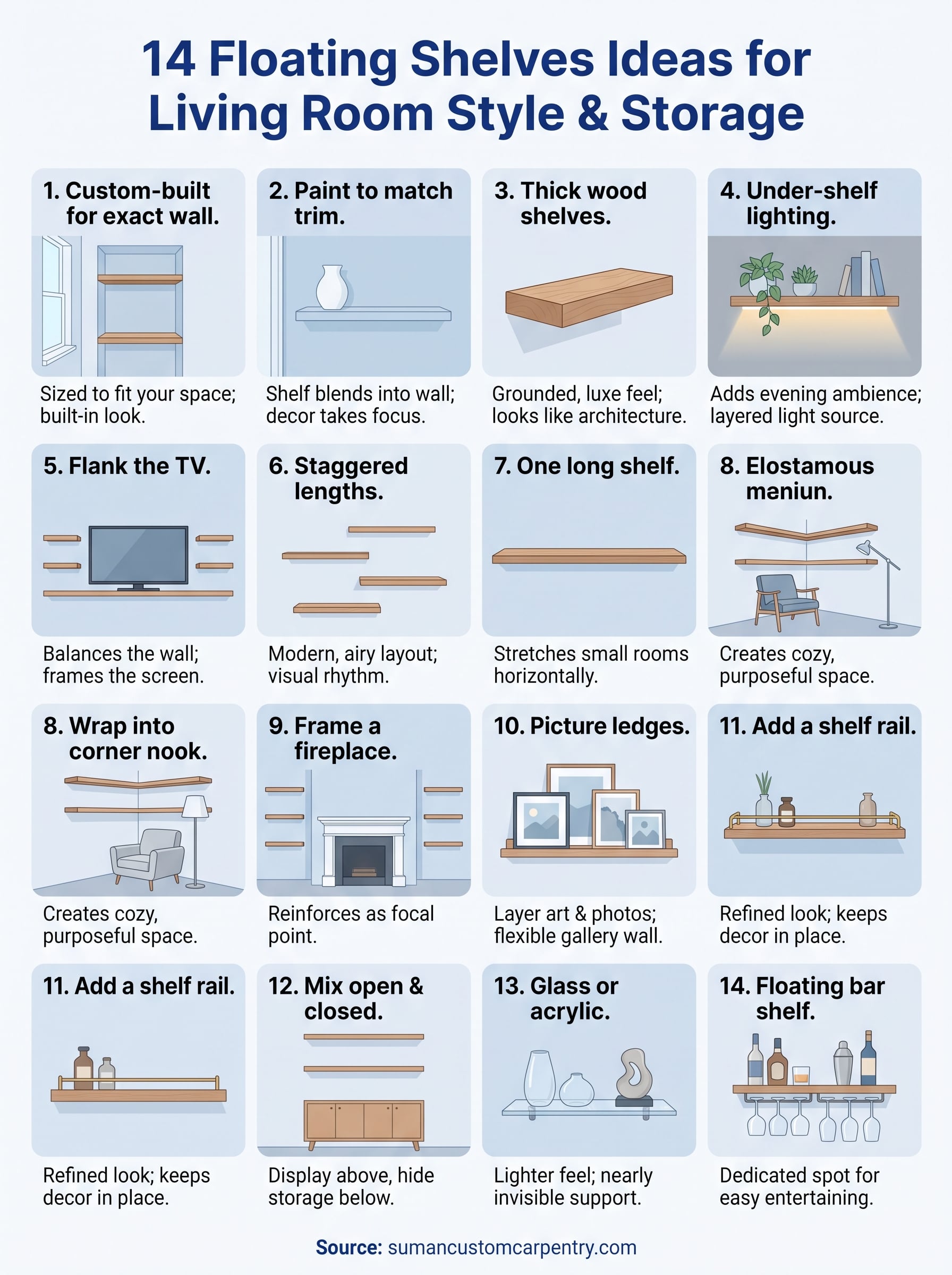
Below, you’ll find 14 floating shelf ideas that range from minimalist and modern to warm and coastal. Whether you’re looking to style an empty wall or solve a genuine storage problem, there’s something here to work with. Let’s get into it.
1. Build custom floating shelves for your exact wall
Most off-the-shelf shelving comes in fixed lengths: 24", 36", 48". Your wall doesn’t care about those dimensions. Custom-built floating shelves are sized to your exact space, so you get shelves that feel like they belong rather than shelves that were adjusted to fit.
The look you get
Custom shelves can be designed to fill a wall from side to side, stop short for visual balance, or wrap around architectural features like windows or doorways. The result is a built-in look that store-bought shelves can’t replicate, because every measurement, profile, and finish gets decided for your specific room rather than a generic showroom.
A shelf built for your exact wall will always look more intentional than one that was trimmed down to fit.
What to put on it
Because custom shelves are sized to your space, you can plan your styling before the shelves even go up. This makes the decorating process much simpler. A few ideas that work well on custom-length shelves:
- Books grouped by size or color for a clean line
- A mix of framed photos and small plants at varying heights
- One larger anchor object, like a ceramic vase, with smaller items around it
- Baskets or bins for items you need to access but don’t want fully on display
Varying the height between shelf runs gives you flexibility for taller objects like stacked books or sculptural pieces without the shelves looking cramped.
Build and install notes
This is where custom work earns its price. A well-built floating shelf uses internal steel rods or a hidden cleat system to carry the load without visible hardware. Material matters too. Solid wood holds fasteners better than MDF and handles the humidity swings common in Cape Cod homes near the water. Wall type determines your mounting approach, since stud walls, plaster over lath, and standard drywall all require different fasteners and spacing.
At Suman Custom Carpentry, we build shelves with species-matched wood and a finish profile that ties into your existing millwork, so the shelves look like they were always part of the room. If custom floating shelves ideas for living room walls are on your renovation list, this is the right starting point.
2. Paint shelves to match your trim and walls
One of the simplest floating shelves ideas for living room walls is also one of the most effective: paint your shelves the same color as your trim. When the shelf disappears visually into the wall, your decor takes center stage instead of the shelf itself.
The look you get
This technique works especially well in rooms with white or off-white millwork, which is common in Cape Cod homes. The shelf blends into the wall plane, creating a clean, architectural look that feels more intentional than a wood-tone shelf sitting against painted walls. The overall effect is a quieter, more cohesive room where nothing competes for attention.
Matching your shelf color to your trim is one of the lowest-cost upgrades that consistently makes a room look more finished.
What to put on it
Because the shelf itself recedes visually, objects with color, texture, and height do the heavy lifting. Try grouping:
- Bold-spined books or stacks of art books lying flat
- Terracotta or glazed ceramic pots with trailing plants
- Framed prints with strong mat borders
Avoid overcrowding. When the shelf blends with the wall, negative space between objects reads as part of the design, not as emptiness. Fewer, well-chosen pieces will always outperform a cluttered shelf.
Build and install notes
Paint adhesion depends on the substrate, so the material you choose matters. MDF takes paint evenly and is a good option here, though solid wood edges need proper priming to prevent grain raise.
Either way, use a satin or semi-gloss finish so the shelf surface is easy to wipe down. Matching the sheen level across your shelf and surrounding trim pulls the whole look together without any extra work.
3. Use thick wood shelves for a grounded, luxe feel
Shelf thickness changes everything about how a shelf reads in a room. A standard 3/4" board looks fine in a utility space, but in a living room, a shelf with 2" to 3" of depth and height carries visual weight that signals quality. This is one of those floating shelves ideas for living room walls that costs more upfront but changes how the entire wall looks.
The look you get
Thick shelves read as furniture, not hardware. They bring a sense of permanence and craftsmanship to the wall, especially when built from hardwood species like white oak, walnut, or maple. The profile itself becomes a design element. A chunky, clean-edged shelf in a natural finish complements coastal interiors with their mix of natural textures and relaxed elegance.
Thick wood shelves stop looking like shelves and start looking like architecture.
What to put on it
Because the shelf already has visual mass and presence, you don’t need to load it up to make an impact. Let a few well-chosen objects carry the styling. A sculptural ceramic, a small stack of hardcover books, and one trailing plant is often enough. Resist the urge to fill every inch.
Build and install notes
Solid wood at this thickness is genuinely heavy, so the mounting system has to handle the combined load of the shelf and everything on it. Hidden steel rod systems work well here because they distribute weight through the wall studs rather than relying on surface fasteners. Proper stud location and rod depth are non-negotiable for a shelf this substantial.
4. Add under-shelf lighting for evening ambience
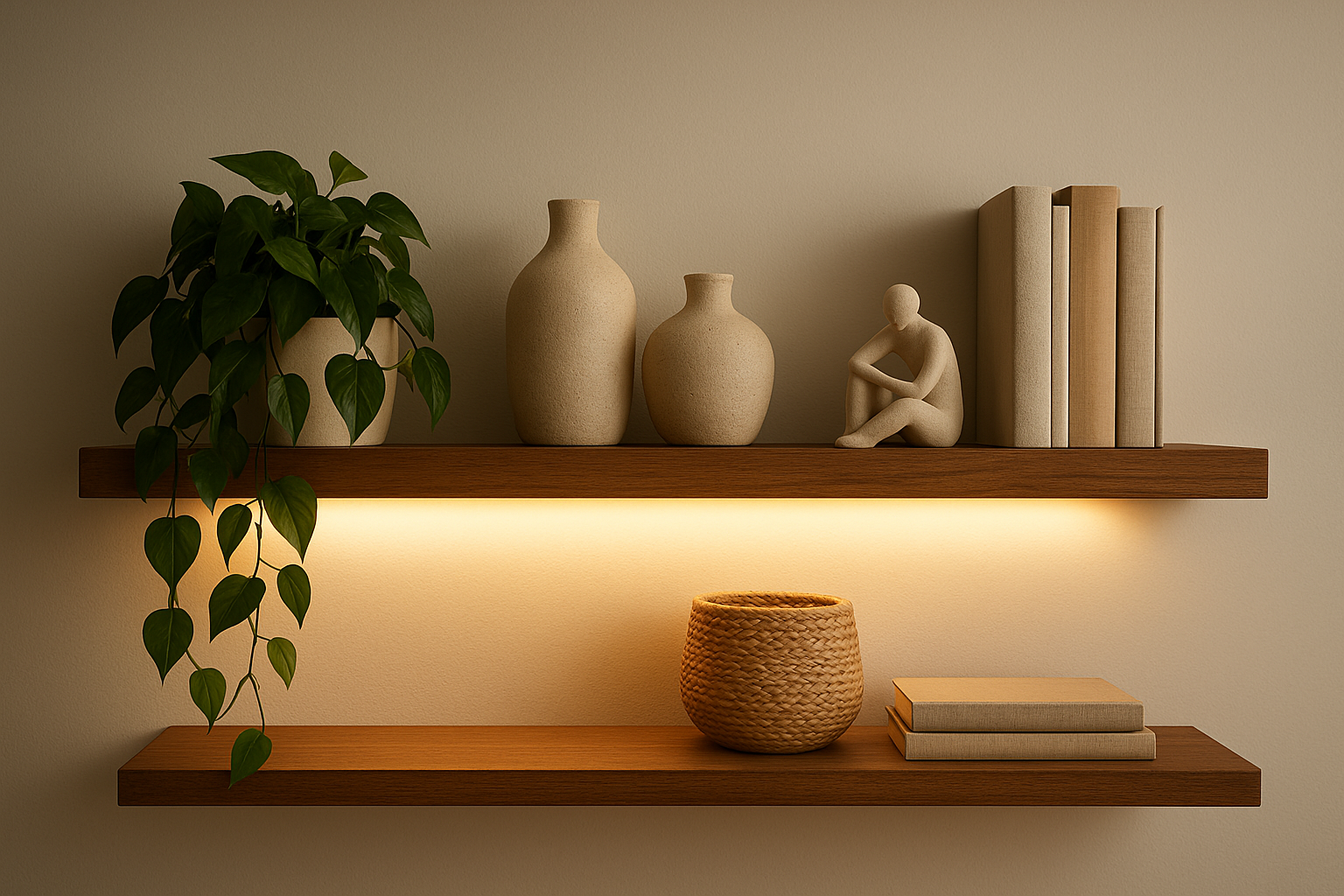
Lighting changes the entire feel of a shelf. LED strip lights or puck lights mounted to the underside of floating shelves cast a warm glow down onto your decor and across the wall, turning an ordinary display into something you actually want to look at after dark. This is one of the most practical floating shelves ideas for living room spaces where you want both function and atmosphere without adding a floor lamp.
The look you get
Under-shelf lighting creates a layered light source that sits between your overhead fixtures and the floor. The effect is soft and directional, drawing the eye to whatever sits on or below the shelf. In the evening, this kind of accent lighting makes a room feel intentional and finished in a way that overhead lighting alone can’t achieve.
Under-shelf lighting does more work per dollar than almost any other lighting upgrade in a living room.
What to put on it
Objects with texture and depth respond best to directional light. Try placing ceramic vessels, woven baskets, small sculptures, or trailing plants directly on the shelf so the light catches their surfaces. Books with interesting spines also benefit from this treatment since the light grazes the titles and gives the whole arrangement a warm, library-like quality.
Build and install notes
Recessing the light strip behind a front lip on the shelf hides the hardware entirely, so you see only the glow, not the source. Plan the wire routing before installation, since running power after the shelf is already mounted is much harder on plaster or tile walls.
5. Flank the TV with shelves to balance the wall
A TV mounted to the wall without anything around it tends to look isolated, like a black rectangle floating in empty space. Flanking it with matching floating shelves on both sides solves the visual imbalance while giving you storage and display space that the TV wall would otherwise waste entirely.
The look you get
Two shelves running symmetrically on either side of a mounted TV create a built-in entertainment wall feel without the cost or commitment of full cabinetry. The shelves frame the screen and anchor the whole wall as a single composition rather than a collection of unrelated elements. This is one of the most practical floating shelves ideas for living room walls where the TV dominates.
Symmetry around a TV turns a functional wall into a designed focal point.
What to put on it
Keep both sides balanced in weight and volume, even if the individual objects differ. A plant on the left can balance a stack of books on the right as long as the overall visual mass reads evenly. Some objects that work well here:
- Books stacked horizontally to vary height without bulk
- Small plants or trailing vines in simple pots
- Framed photos or small art prints
- A decorative bowl or sculptural object
Avoid anything too tall that competes with the screen at eye level, since your goal is framing the TV, not fighting it for attention.
Build and install notes
Shelf height and depth need to account for the TV mounting bracket before a single hole gets drilled. Confirm the bracket depth first, then size the shelves so they sit flush with or slightly behind the TV face. Anchoring into studs on both sides keeps everything level and secure over time.
6. Stagger shelf lengths for a modern, airy layout
Most people mount floating shelves in a uniform column: same length, evenly spaced, straight down the wall. Staggering shelf lengths breaks that grid pattern intentionally, giving the wall movement and visual rhythm that a matched set simply can’t deliver. This approach works especially well in living rooms where you want a contemporary feel without heavy furniture or complex built-ins.
The look you get
Staggered shelves read as sculptural rather than utilitarian. By alternating a longer shelf at one level with a shorter shelf at the next, you create an asymmetrical composition that draws the eye across the wall rather than straight down it. The result is a lighter, more dynamic layout that suits modern, Scandinavian, and transitional interior styles.
Staggered lengths make a wall look designed, not just organized.
What to put on it
Each shelf in a staggered layout functions as its own small display zone, so you want to treat each one independently. Place a single larger object on a longer shelf and one or two smaller items on the shorter shelf beside it. Plants work particularly well here since trailing foliage softens the hard edges and connects the levels visually. Keep the total number of objects low so the spacing between shelves stays visible and intentional.
Build and install notes
Getting staggered shelves right requires precise planning on paper before anything goes on the wall. Map out each shelf position, length, and vertical spacing first, then transfer those measurements carefully. Inconsistent spacing or misaligned depths will make a staggered layout look accidental rather than considered, so take your time with the layout before you drill a single hole.
7. Run one long shelf to stretch a small room
In a tight living room, a single long shelf running the full width of a wall does something that multiple shorter shelves can’t: it draws the eye horizontally and makes the space feel wider than it actually is. This is one of those floating shelves ideas for living room layouts where one well-placed element does more work than several smaller ones combined.
The look you get
A long shelf spanning wall to wall creates a strong horizontal line that your eye follows across the room, which tricks the brain into reading the space as wider. This works especially well in narrow rooms or galley-style living areas where vertical arrangements tend to make the ceiling feel lower. A single clean run of wood keeps the wall uncluttered while still giving you a dedicated display surface.
One long shelf does more for a small room than three short ones stacked vertically.
What to put on it
Spacing your objects across the full length of the shelf reinforces the horizontal effect. Resist the urge to cluster everything in the center. A plant on one end, a few books in the middle, and a small framed print toward the other end keeps the eye moving left to right rather than stopping in one spot.
Build and install notes
A shelf this long needs support at multiple stud locations to prevent sagging over time, especially if you plan to hold books or heavier objects. Solid wood handles the span better than MDF, which can bow under its own weight at lengths beyond 48 inches. Map your stud layout first, then size the shelf accordingly.
8. Wrap shelves into a corner reading nook
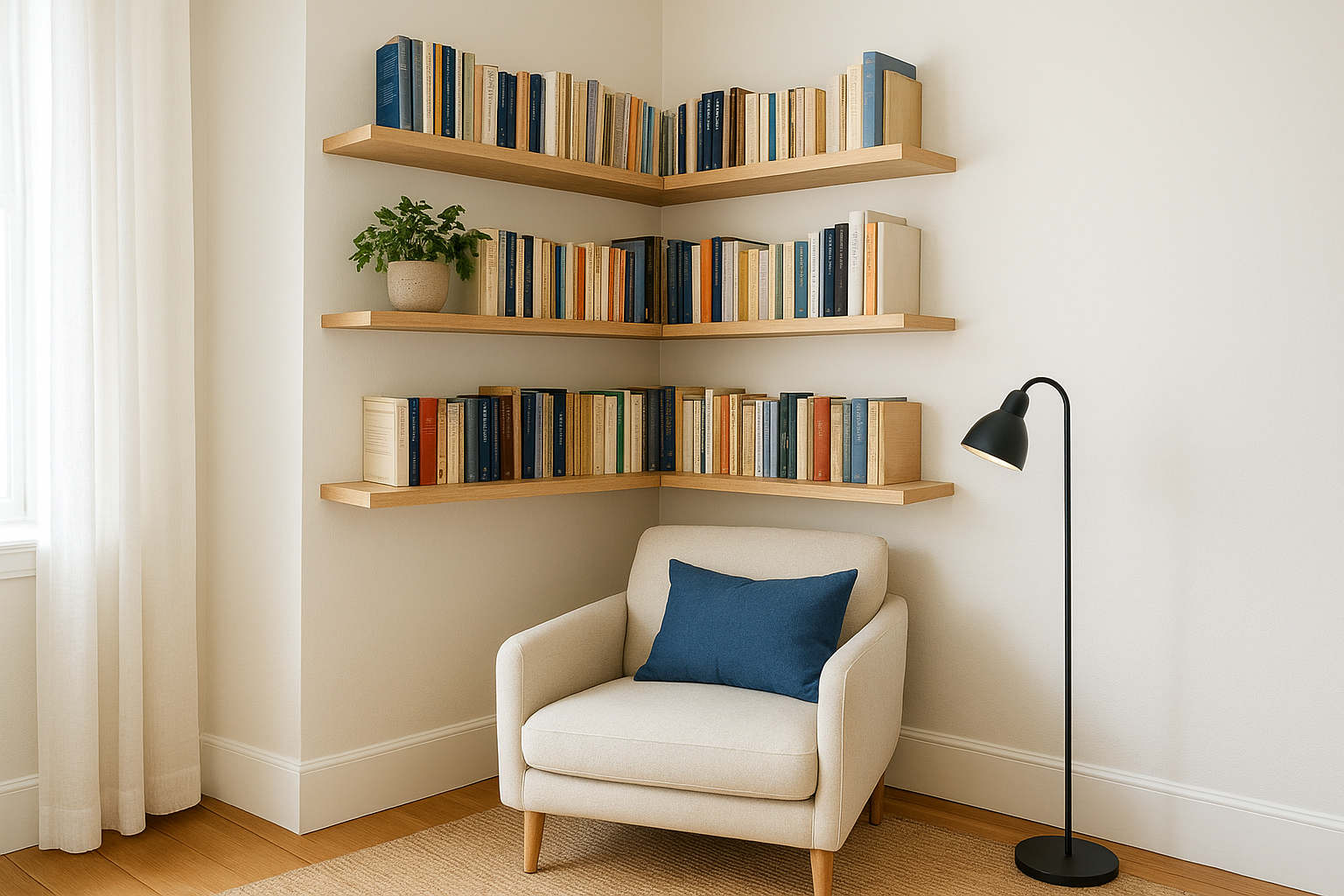
A corner is one of the most underused spaces in a living room. Wrapping floating shelves into a corner turns dead wall space into a dedicated reading area with built-in storage on both sides, making this one of the most functional floating shelves ideas for living room layouts where you want a cozy, purposeful spot without adding furniture.
The look you get
Corner shelves that meet at a 90-degree angle create an enclosed, alcove-like feel even without walls or a ceiling closing things in. When you pair the shelving with a small chair or floor cushion below, the nook reads as its own room within the room. The effect is warm and intentional, particularly in Cape Cod homes where layered textures and natural light already set a relaxed, inviting tone.
A corner reading nook turns the least-used part of your living room into the spot everyone actually wants to sit.
What to put on it
Books are the obvious choice here, and they work well because stacking them in both directions across the two shelf runs reinforces the wraparound shape. Add a small plant on one shelf and a reading lamp tucked into the corner below to complete the setup. Keep the lower shelves accessible for books you’re currently reading and use the higher shelves for display objects.
Build and install notes
Corner shelves need precise miter cuts where the two runs meet so the joint looks clean rather than patched. Internal cleat systems on both walls distribute weight evenly, and confirming stud locations on each wall independently before installation prevents misaligned mounting points.
9. Frame a fireplace with floating shelves on both sides
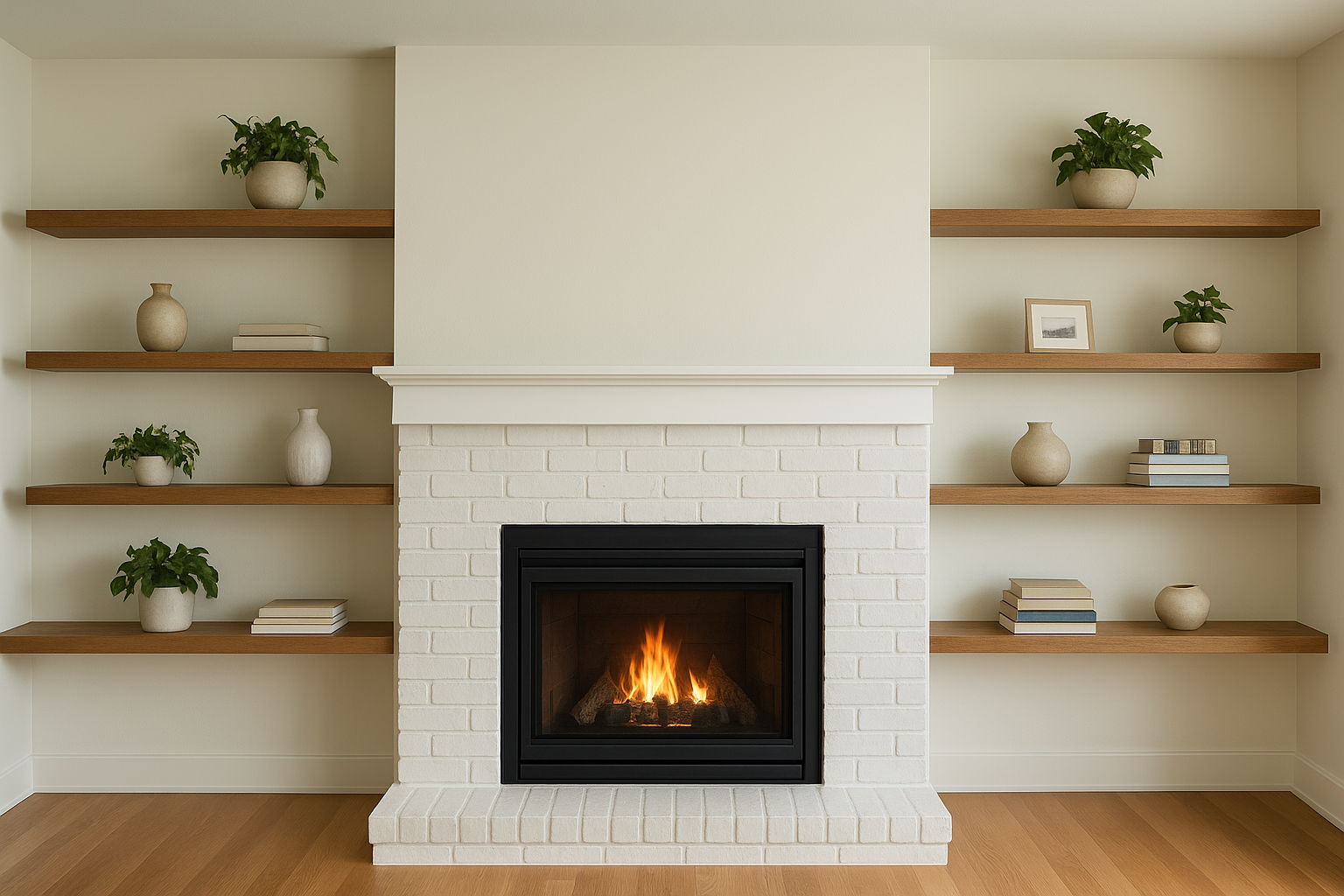
A fireplace is already the natural focal point of most living rooms, but the wall around it often goes underused. Adding floating shelves on both sides turns that surrounding wall into a purposeful display area that reinforces the fireplace as the room’s centerpiece rather than leaving it isolated.
The look you get
Flanking shelves create a symmetrical frame around the firebox that reads like a custom built-in without the cost of full floor-to-ceiling cabinetry. The composition anchors the entire wall and gives the fireplace a more finished, architectural presence. This is one of the most classic floating shelves ideas for living room walls where a fireplace already dominates but the surrounding space feels incomplete.
Framing a fireplace with shelves on both sides transforms a functional feature into a designed focal point.
What to put on it
Books and plants split evenly between the two sides give you the visual balance the layout needs. Aim for roughly equal mass on each shelf run, even if the individual objects vary. Framed photos, small sculptures, or a collection of similar objects grouped together also work well. Avoid anything that competes too directly with the mantel display below.
Build and install notes
Heat and moisture from the firebox affect the materials you choose, so keep shelves at least 12 inches from the firebox opening and use solid wood rather than MDF. Confirm stud locations on both sides of the fireplace independently, since framing around a firebox rarely follows standard stud spacing.
10. Use picture ledges to layer art and photos
Picture ledges are a specific type of floating shelf with a shallow lip along the front edge that keeps framed pieces from sliding off. Unlike standard shelves, they’re designed for leaning artwork, photos, and prints rather than freestanding objects. This makes them one of the most flexible floating shelves ideas for living room walls where your art collection changes often and you don’t want to commit every frame to its own hole in the wall.
The look you get
Picture ledges create a gallery wall effect without dedicating a single nail hole to each individual frame. You lean prints and photos against the wall at varying heights and layers, which gives the arrangement depth and an effortlessly casual, curated quality. Swapping pieces in and out takes seconds, so the display can evolve as your taste does without any patching or repainting.
Picture ledges give you a gallery wall you can rearrange on a Tuesday afternoon without touching a drill.
What to put on it
Frames of different sizes layered in front of each other work best here. Mix a large print at the back with a smaller framed photo leaning in front, then add a small object like a ceramic or a plant at one end to break up the frames. Varying the frame finishes across wood, black metal, and white adds texture without making the arrangement look chaotic.
Build and install notes
The front lip on a picture ledge needs to be at least 1 inch tall to hold frames securely, especially in a busier household. Keep the ledge depth between 3 and 4 inches so frames lean at a natural angle without tipping forward. Solid wood handles the shallow profile better than MDF, which can chip along the lip edge with regular use.
11. Add a shelf rail to keep decor in place
A shelf rail is a small rod or bar mounted along the front edge of a floating shelf that keeps objects from sliding or tipping forward. It’s one of the most practical floating shelves ideas for living room spaces where you want to display lighter items without worrying about them shifting every time someone walks past or a door closes nearby.
The look you get
The rail adds a refined, furniture-like quality to an otherwise plain shelf. Depending on the material you choose, a brass, matte black, or brushed nickel rail can read as a subtle design detail that ties into your other hardware finishes. The overall effect is a shelf that looks considered rather than purely functional, with a slight nod to classic library or apothecary shelving.
A shelf rail turns a flat board into a finished piece that holds its arrangement without constant adjustment.
What to put on it
Rails work best with smaller, lighter objects that benefit from a little containment. Small framed prints leaned against the wall, short ceramic vessels, candles grouped together, or a row of paperbacks all sit securely behind the rail without looking penned in. Avoid oversized or very heavy objects since the rail is a stabilizer, not a structural support.
Build and install notes
Mount the rail into the solid wood of the shelf body rather than into the finish surface to prevent pull-out over time. A rail height of 1.5 to 2 inches keeps most small objects in place without obscuring them visually. Matching the rail finish to existing door or window hardware in the room keeps the detail cohesive.
12. Mix open shelves with closed storage below
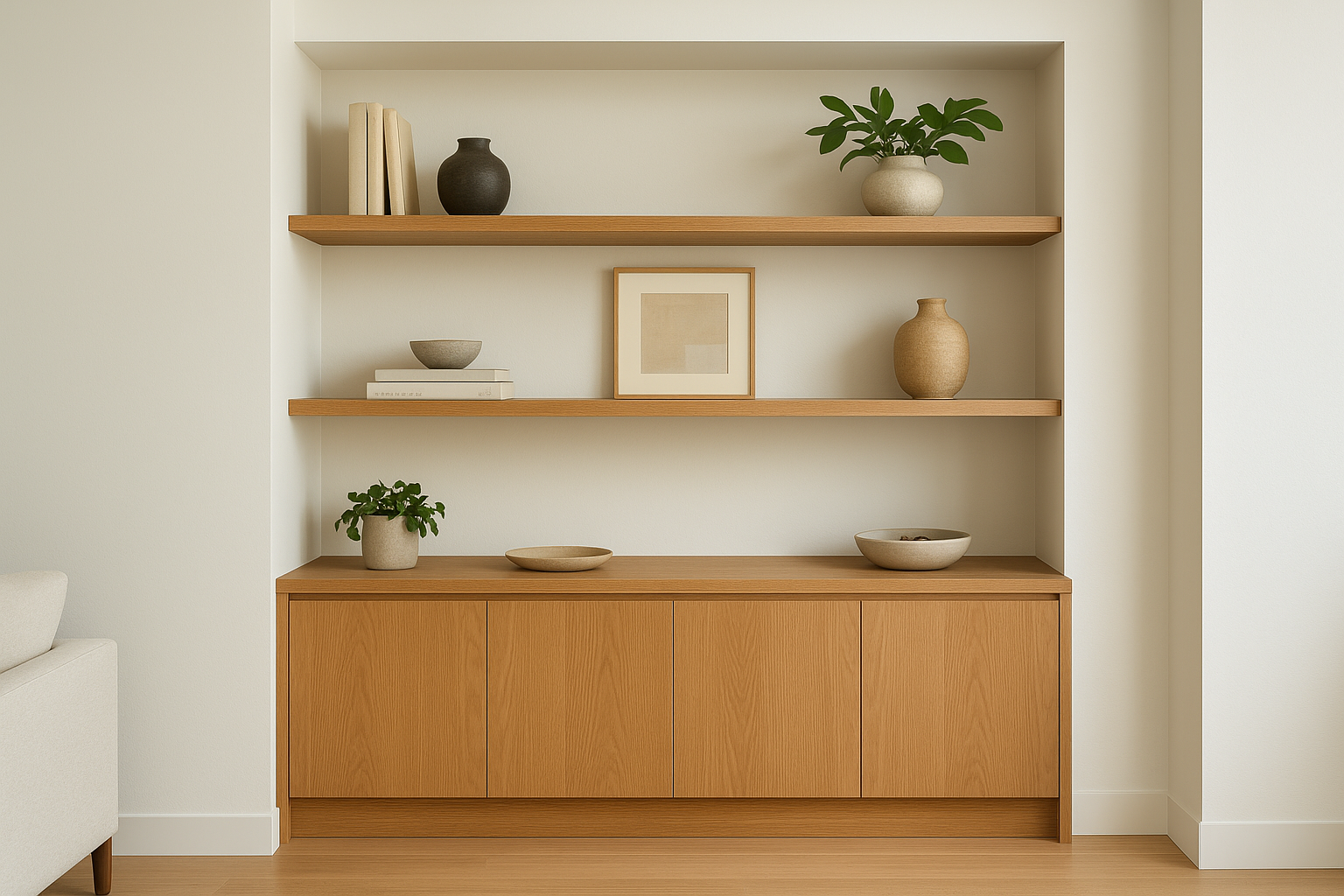
Open floating shelves display what you want to show. Closed storage hides what you don’t. Combining both in the same wall unit gives you the visual appeal of floating shelves ideas for living room walls while keeping the everyday clutter out of sight. This pairing works in rooms where storage needs are real but the aesthetic still matters.
The look you get
The combination reads as a built-in wall unit without requiring full floor-to-ceiling cabinetry. The upper open shelves keep the wall feeling light and open while the lower cabinets or drawers ground the whole arrangement. The visual split between the two zones gives the wall a clear structure that feels designed rather than assembled from separate pieces.
Open above and closed below is one of the most practical storage configurations you can put in a living room.
What to put on it
Use the open shelves for your best-looking objects: books, plants, art, ceramics. Reserve the closed section below for remotes, charging cables, board games, extra blankets, or anything else you reach for regularly but prefer not to display. Keeping a clear boundary between the show layer and the storage layer makes both sections look more intentional.
Build and install notes
The lower cabinet depth typically runs deeper than the shelf above, so the two sections need to be sized and aligned carefully to avoid an awkward step in the profile. Use matching wood species and finish throughout so the open and closed sections read as one continuous piece rather than two separate units pushed together.
13. Choose glass or acrylic shelves for a lighter feel
Most floating shelves ideas for living room walls assume you’re working with wood, but glass and acrylic shelves take the "floating" concept further by making the shelf itself nearly invisible. When you want storage and display without adding visual weight to the room, a transparent shelf does more with less.
The look you get
Glass and acrylic shelves disappear against the wall in a way that wood never can. The shelf becomes a platform that seems to suspend objects in midair, which draws full attention to whatever sits on it rather than the shelf itself. This works especially well in smaller living rooms or spaces with bold wallpaper or textured walls where a solid shelf would cover up something worth seeing.
Transparent shelves are one of the few cases where the shelf works hardest by staying out of the way.
What to put on it
Objects with color, texture, or interesting silhouettes perform best on a transparent surface because nothing competes with them visually. Colored glass vessels, small sculptures, trailing plants, and groupings of candles all read clearly without the shelf drawing attention away. Avoid stacking books horizontally since the weight and visual bulk tend to work against the airy quality you’re going for.
Build and install notes
Tempered glass is the right choice for structural shelves since standard glass can crack under uneven loads. Acrylic scratches more easily than glass but weighs significantly less, which reduces the load on your wall anchors. Either material requires brackets rated for the specific shelf weight, so confirm the load rating before installation rather than after.
14. Build a floating bar shelf for easy entertaining
A floating bar shelf gives you a dedicated spot for bottles, glassware, and bar tools without committing floor space to a bar cart or sideboard. This is one of the most practical floating shelves ideas for living room walls where hosting matters and you want everything within easy reach when guests arrive.
The look you get
A well-built bar shelf reads as an intentional design feature rather than a utilitarian afterthought. A single wide shelf with a row of bottles displayed at the back and glassware hanging from an integrated rack below gives the wall a sophisticated, hospitality-inspired quality that feels relaxed and deliberate at the same time. Natural wood finishes work particularly well here, especially in Cape Cod interiors where warm textures already set the tone.
A floating bar shelf turns an empty wall into the most social corner of your living room.
What to put on it
Keep the shelf organized by category: spirits at the back, mixers or decanters toward the front, and stemware hanging from a mounted glass rack below the shelf. Add a small tray for tools like a jigger and bar spoon, and one or two short plants to soften the arrangement without cluttering the surface.
Build and install notes
Bar shelves carry real weight from bottles and glassware, so anchoring into studs with a hidden cleat or steel rod system is non-negotiable. Build the shelf deep enough, at least 10 to 12 inches, to hold standard bottles upright without tipping. A lip along the front edge prevents bottles from sliding forward when someone reaches past them.
Next steps
You now have 14 floating shelves ideas for living room walls that cover everything from simple styling tweaks to full built-in configurations. Some of these you can tackle yourself. Others, like framing a fireplace, wrapping a corner nook, or building a bar shelf that carries real weight, require proper planning, the right materials, and a mounting system that won’t fail six months in.
If you’re on Cape Cod and want shelves built to your exact wall rather than adjusted to fit, Suman Custom Carpentry hand-builds every shelf at our Hyannis shop and backs the work with a lifetime guarantee on craftsmanship. You get shelves sized for your space, finished to match your millwork, and installed to stay put. Reach out to Suman Custom Carpentry to start a conversation about your project. Bring your wall dimensions and any photos that caught your eye in this list, and we’ll take it from there.