
Custom Bath Cabinets: What to Know Before You Buy
Searching for custom bath cabinets near me usually means one thing: you’re tired of stock vanities that don’t fit your bathroom, your storage needs, or your style. Big box stores sell the same handful of sizes to everyone on Cape Cod, and half the time the finish looks cheap within a year. If you want something built for your actual space, you need a shop that designs and builds locally, not a warehouse shipping pre-made boxes.
This guide answers the practical questions that come up before you sign a contract: what “custom” really means versus semi-custom, how local shops price projects, what a realistic build timeline looks like, and which materials hold up in a humid coastal bathroom. You’ll also learn what questions to ask any carpenter before hiring them.
We wrote this from the perspective of a Hyannis-based shop that hand-builds cabinetry in-house, so the advice reflects what actually happens during a real bathroom vanity project, not generic showroom talk. By the end, you’ll know exactly what to look for and what to avoid when choosing a custom cabinet builder near you.
Why custom bath cabinets are worth the investment
Most bathrooms on Cape Cod were not built with modern storage needs in mind. Older homes have odd wall angles, low ceilings near dormers, plumbing stacks in inconvenient spots, and window placements that make a standard 30-inch or 36-inch vanity a poor fit. When you search for custom bath cabinets near me, you’re really looking for someone who can measure your actual space and build a cabinet that uses every inch of it, instead of forcing your bathroom to accommodate a factory-made box.
Built to fit, not to compromise
Stock vanities come in fixed widths, usually in 3-inch increments, and they rarely account for things like a recessed alcove, a sloped ceiling, or a narrow half-bath where six extra inches of counter space would make a real difference. A custom-built vanity closes that gap. You get drawers where you actually want them, a sink bowl positioned to match your plumbing rather than the other way around, and cabinet depth that clears a swinging door or a radiator without anyone noticing the workaround. This is the single biggest reason homeowners upgrade from stock to custom.
A cabinet built for your exact bathroom will always outperform one built for an average bathroom that doesn’t exist.
Durability that outlasts stock cabinetry
Humidity is the enemy of bathroom cabinetry, and it’s a bigger problem on the coast than almost anywhere else. Salt air and moisture swell particleboard, peel laminate edges, and warp cheap MDF within a few years. A shop that hand-builds cabinets in-house can choose moisture-resistant materials and construction methods suited to your specific bathroom, whether that means solid maple face frames, marine-grade plywood boxes, or a finish schedule with extra sealing coats around the sink cutout. Stock manufacturers build for the lowest common denominator climate, not for a house three blocks from Nantucket Sound.
A comparison worth seeing
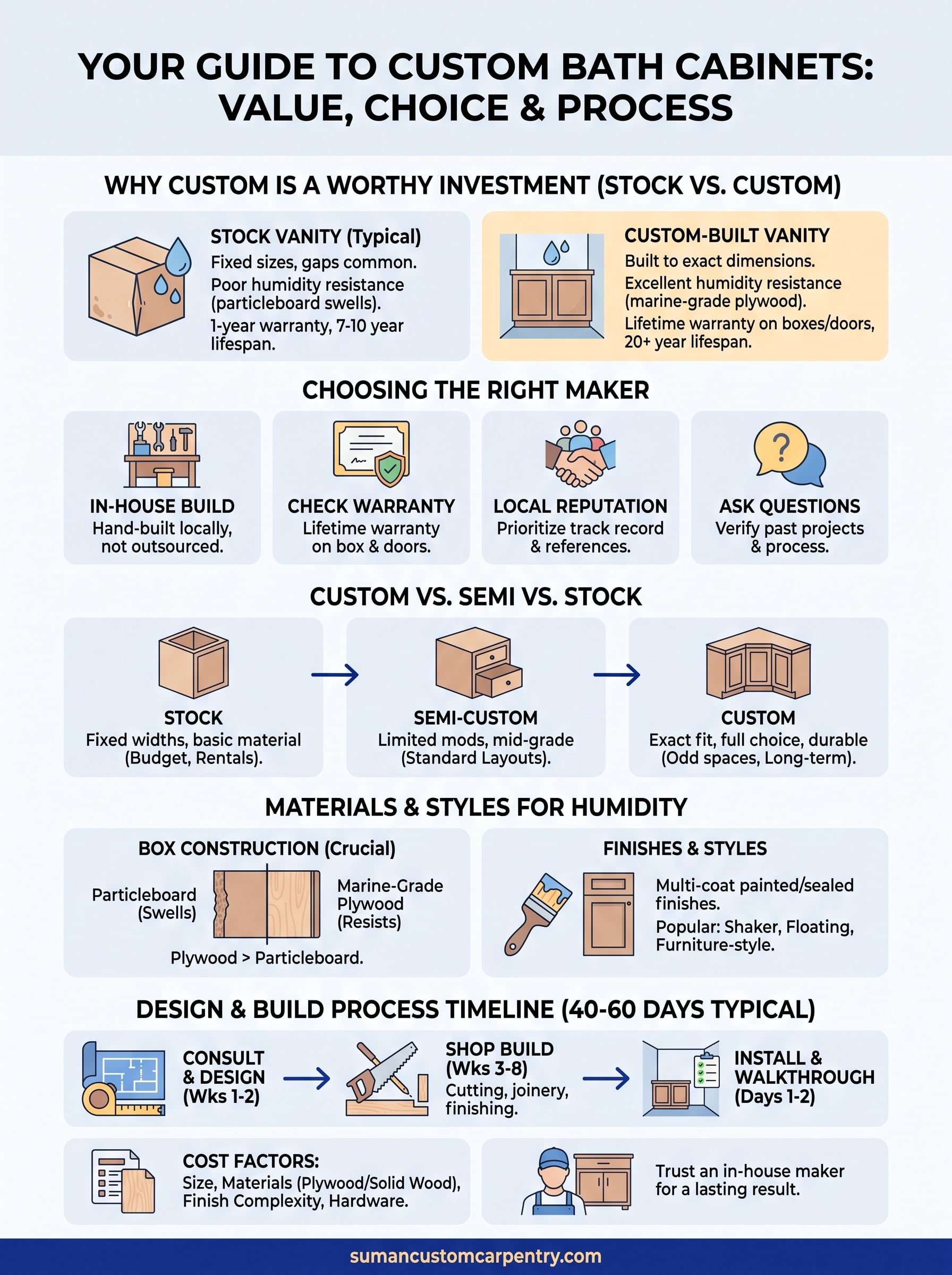
Here’s how the two approaches typically stack up over a 15-year ownership period:
| Factor | Stock Vanity | Custom-Built Vanity |
|---|---|---|
| Fit to space | Fixed sizes, gaps common | Built to exact measurements |
| Material quality | Often particleboard/laminate | Solid wood, marine-grade plywood options |
| Moisture resistance | Limited, prone to swelling | Built for coastal humidity |
| Storage layout | Generic drawer/shelf configuration | Designed around your actual habits |
| Warranty | Typically 1 year or less | Lifetime warranty on boxes and doors (varies by builder) |
| Expected lifespan | 7-10 years | 20+ years with proper care |
Numbers like these are why homeowners who plan to stay in their house long-term rarely regret paying more upfront for custom work.
Resale value and long-term cost
Owners often assume custom cabinetry is a luxury expense, but the math tells a different story once you factor in replacement cycles. A stock vanity that swells and needs replacing twice in fifteen years can cost more in total than one custom piece that lasts the life of the house. Real estate agents on Cape Cod consistently point to updated, well-built bathrooms as one of the features buyers notice first during a showing, and hand-built cabinetry photographs and shows better than a big-box unit with visible seams. Investing here pays back both in daily use and at resale.
Design flexibility you won’t get off the shelf
Quality also shows up in the details that stock manufacturers skip entirely. Full-extension drawer slides rated for heavy use, soft-close hinges, dovetail joinery instead of staples, and finish colors matched to your exact trim rather than a preset palette, these are the small choices that separate a cabinet you’ll still like in ten years from one you’ll want to replace in five. Roomier layouts can also include built-in hampers, pull-out trash bins, or outlets tucked inside a drawer for hair tools, none of which come standard on a warehouse product. Working with a local carpenter means every one of these details gets discussed before anything is built, not discovered after installation when it’s too late to change.
How to choose the right custom cabinet maker near you
Finding a name that shows up under custom bath cabinets near me is the easy part. Vetting that name before you hand over a deposit is where most homeowners fall short. A quick search tells you who exists nearby, not who actually builds quality work or shows up on schedule. Spend an extra week checking credentials and you’ll avoid the horror stories about half-finished vanities sitting in a garage for months.
Start with in-house work, not outsourced labor
Ask directly whether the shop builds cabinets on-site or subcontracts the work to a third-party manufacturer and just handles installation. Plenty of “custom” companies are really just sales fronts for a factory somewhere else, which means less control over materials, timelines, and fixing mistakes. A shop that hand-builds everything in its own workshop can adjust a design mid-project without waiting on a supplier three states away. That flexibility matters when your bathroom turns out to have a plumbing surprise behind the wall, which happens more often than anyone likes on older Cape homes.
If the builder doesn’t control the build, they can’t control the outcome.
Check the warranty terms carefully
Warranty length tells you how confident a builder is in their own materials and joinery. A one-year warranty on a cabinet box is a red flag, since most manufacturing defects and moisture issues take longer than a year to show up. Look for a lifetime warranty on cabinet boxes and doors, with a separate multi-year warranty specifically covering paint or finish work, since painted surfaces wear differently than raw wood or stained cabinetry.
Questions to ask before you hire
Bring this list to your first consultation:
- How many bathroom cabinet projects have you completed in the last two years?
- Do you build in-house, and can I visit the shop?
- What’s your standard warranty on boxes, doors, and finish?
- Can I see references or photos from projects in homes similar to mine?
- Who will be my main point of contact during the build?
- What happens if we find an issue after installation?
A builder who answers these without hesitation, and who can point to a real body of local work, is worth taking seriously.
Local reputation matters more than online ads
Anyone can run ads for “custom cabinets near me,” but reputation on the ground is harder to fake. Talk to neighbors, check recent reviews for specific mentions of communication and timeline accuracy, and ask to see a finished project in person if the builder allows it. A shop that’s been operating on Cape Cod for years, fully insured and with a track record of finished projects rather than half-built ones, is a safer bet than a newer outfit with a flashy website and no local history behind it. Direct access to the owner or lead carpenter throughout the project, rather than a rotating cast of sales reps, is another sign you’re dealing with a shop built around craftsmanship instead of volume.
Custom vs. stock vs. semi-custom: what’s the difference
Walk into any bathroom showroom and you’ll hear three terms tossed around like they mean the same thing: custom, semi-custom, and stock. They don’t, and the differences affect price, fit, and how long the cabinet lasts in a humid bathroom. Knowing which category you’re actually buying keeps you from paying custom prices for a semi-custom product, which happens more often than most homeowners realize.
Stock cabinets: fast and cheap, but rigid
Stock vanities come pre-built in fixed sizes, usually 24, 30, 36, or 48 inches wide, with a limited set of finishes and door styles chosen by the manufacturer. You buy what’s on the shelf or in the catalog, and installation means fitting your bathroom to the cabinet rather than the other way around. Stock cabinetry works fine for a rental property or a quick flip where budget matters more than fit, but it rarely holds up long-term in a coastal bathroom, and you’re stuck with whatever storage layout the factory decided works for everyone.
Semi-custom: some flexibility, still limited
Semi-custom sits in the middle. You pick from a set of standard cabinet boxes but get some choice in finish, hardware, and a handful of size modifications, usually in small increments. It’s a reasonable compromise if your bathroom is close to a standard layout and you just want better materials or a nicer door style than what stock offers. The catch is that semi-custom cabinetry still comes from a factory production line, so if your space has an odd angle, a low ceiling, or plumbing in an unusual spot, you’ll likely still end up with wasted space or an awkward workaround.
True custom: built around your bathroom, not a catalog
Custom cabinetry starts with a carpenter measuring your actual bathroom and designing around it, not selecting from a preset list. Every dimension, drawer configuration, and material choice gets decided based on your space and how you use it. This is what separates a genuine local search for custom bath cabinets near me from someone who just wants a nicer stock vanity.
The word “custom” only means something when the design starts with your bathroom, not a factory’s size chart.
Here’s a quick side-by-side to keep the categories straight:
| Category | Sizing | Materials | Lead Time | Best For |
|---|---|---|---|---|
| Stock | Fixed widths only | Basic, often particleboard | In stock or 1-2 weeks | Tight budgets, rentals |
| Semi-custom | Limited modifications | Mid-grade options | 4-8 weeks | Standard layouts, better finish |
| Custom | Built to exact measurements | Full range, including solid wood | 6-10 weeks typical | Odd layouts, long-term homes |
Once you know which category actually fits your project, the next decision is material, since that choice affects both durability and price just as much as the build method does.
Materials and styles for custom bathroom cabinets
Once you’ve settled on custom over stock or semi-custom, material choice becomes the decision that determines how your cabinet holds up in five, ten, and twenty years. Bathrooms generate more moisture than any other room in the house, and coastal air only makes that worse. A local custom cabinet shop should walk you through material options based on your specific bathroom, not just hand you a color swatch book and call it a design consultation.
Solid wood options that handle humidity
Maple, oak, and birch are the workhorses of custom bathroom cabinetry because they machine cleanly, take stain and paint evenly, and resist warping better than softer woods. Maple in particular is a favorite for painted vanities since it has a tight, even grain that doesn’t telegraph through the finish. For a shop building in-house, solid wood face frames paired with marine-grade plywood boxes give you the best combination of strength and moisture resistance, especially around the sink cutout where water exposure is constant.
The cabinet box matters more than the door style, because that’s the part fighting moisture every single day.
Plywood versus particleboard construction
This is the detail most homeowners never think to ask about, and it’s the one that determines whether a cabinet lasts two decades or needs replacing after five years near a humid shower.
| Construction Type | Moisture Resistance | Typical Lifespan | Common Use |
|---|---|---|---|
| Particleboard | Poor, swells when wet | 5-10 years | Budget stock cabinets |
| Standard plywood | Moderate | 10-15 years | Semi-custom cabinetry |
| Marine-grade plywood | Excellent | 20+ years | Custom coastal bathrooms |
Asking a builder which material they use for the box, not just the door, tells you more about long-term quality than anything in a showroom brochure.
Finishes suited to Cape Cod bathrooms
Painted finishes remain the most popular choice for coastal bathroom vanities, with soft whites, muted blues, and warm grays fitting the beach house aesthetic that dominates Cape Cod interiors. Stained wood finishes are making a comeback too, especially white oak with a clear or lightly tinted stain that shows off the natural grain. Whatever finish you choose, ask about the number of sealing coats applied around the sink cutout and countertop edge, since that’s where water sits longest and finishes fail first.
Popular styles homeowners are requesting
Style preferences shift, but a few requests come up consistently in custom bathroom projects:
- Shaker-style doors with recessed panels, still the most requested look for both traditional and modern coastal homes
- Furniture-style vanities with tapered legs, giving a bathroom a less “builder grade” feel
- Floating vanities with wall-mounted cabinets, popular in smaller bathrooms where floor space is tight
- Two-tone cabinetry, often a painted vanity base paired with a stained or contrasting upper medicine cabinet
- Beadboard or paneled cabinet sides for an authentic Cape Cod cottage look
Material and style choices work together, and a good carpenter will steer you away from combinations that look great on a mood board but fail in a real, humid bathroom within a few years.
What to expect during the design and build process
Once you’ve picked a builder, the process itself follows a fairly predictable path, even though every bathroom is different. Knowing the stages ahead of time helps you spot delays early and keeps you from feeling blindsided when a step takes longer than you assumed. A shop that handles custom bath cabinets near me searches well should walk you through this timeline before you sign anything, not after the deposit clears.
The initial consultation and measurement visit
First, a carpenter visits your home to measure the bathroom, check plumbing locations, and talk through how you actually use the space. This isn’t a five-minute tape-measure job. Expect questions about storage habits, who uses the bathroom daily, and whether you want features like a built-in hamper or outlets inside a drawer. This visit is also when material and style options get discussed in the context of your actual room, not a generic showroom display.
Design proofs and material selection
Next comes the design phase, where the shop produces drawings or 3D renderings showing cabinet dimensions, door style, and finish. You’ll typically get a chance to request changes before anything moves to the shop floor. This is the stage to finalize hardware, drawer configuration, and finish coats, since changes get harder and pricier once construction starts.
The design phase is the cheapest place to fix a mistake. After the build starts, every change costs time and money.
Building in the shop
Hand-built cabinetry takes real shop time, and a rushed build shows up later as sticking drawers or uneven doors. A realistic build timeline for a bathroom vanity runs 40 to 60 days from signed design to delivery, similar to what you’d expect on a full kitchen project, though smaller vanities sometimes move faster. Here’s roughly how that time breaks down:
- Design finalization and material ordering: 1-2 weeks
- Cutting, assembly, and joinery: 2-4 weeks
- Sanding, staining, or painting: 1-2 weeks
- Hardware installation and quality check: several days
- Scheduling and delivery: 1 week
Installation day and final walkthrough
Finally, installation typically takes one to two days for a single bathroom vanity, depending on plumbing and countertop coordination. A good crew protects your existing floors and walls, levels the cabinet precisely, and checks every drawer and door before calling the job finished. Expect a final walkthrough where the carpenter points out care instructions, especially around sealed edges near the sink, and confirms warranty paperwork is in hand. If anything feels off during that walkthrough, a trustworthy builder fixes it on the spot rather than asking you to schedule a separate follow-up visit weeks later.
How much do custom bath cabinets cost
Price is usually the first question homeowners ask and the last thing anyone gives a straight answer to. Costs vary based on size, material, and complexity, but you should walk into any consultation with realistic numbers in mind so you can tell whether a quote is fair or padded. Anyone searching for custom bath cabinets near me deserves a clear breakdown, not a vague “it depends” from a salesperson trying to get a signature before discussing dollars.
What actually drives the price
Several factors push a custom vanity price up or down, and understanding them helps you spot where you can save without sacrificing durability. Size and drawer count matter most, since more joinery and material means more shop hours. Material choice comes next: solid maple runs higher than paint-grade poplar, and marine-grade plywood boxes cost more than standard plywood but pay for themselves in lifespan. Finish complexity, including multi-coat paint or hand-applied stain, adds labor time. Hardware upgrades like soft-close hinges and full-extension slides add a modest amount per drawer but make a noticeable difference in daily use.
Typical price ranges by project size
Here’s a general range you can expect from a local shop building in-house, not a big-box installer marking up a factory product:
| Project Type | Typical Price Range | What’s Included |
|---|---|---|
| Single sink vanity (24-36 in) | $2,500 – $5,500 | Box, doors, drawers, standard hardware |
| Double sink vanity (60-72 in) | $5,000 – $10,000 | Larger box, more drawers, upgraded hardware options |
| Vanity with matching medicine cabinet | $6,000 – $12,000 | Coordinated finish, additional storage |
| Full bathroom built-ins (linen tower, storage wall) | $8,000 – $18,000+ | Multiple units, custom configuration |
These figures reflect labor, materials, and finish work but usually exclude countertops, plumbing, and installation labor unless the shop bundles those into a single project quote.
Why the cheapest quote is rarely the best one
A quote that comes in far below everyone else usually means a shortcut somewhere, whether that’s particleboard instead of plywood, a shorter warranty, or subcontracted labor the company doesn’t fully control. Custom cabinet pricing should reflect real shop time and real materials, and a builder who can’t explain why their number is lower than a competitor’s is worth a second look before you sign.
A low price on a custom cabinet almost always means a shortcut you won’t see until it fails.
Getting an accurate quote
The only way to get a number you can trust is an in-home measurement and a real conversation about materials, not a phone estimate. Insist on a written quote that itemizes materials, hardware, finish, and warranty terms separately, so you know exactly what you’re paying for and can compare it apples-to-apples against any other estimate you get.
Choosing a cabinet maker you can trust
Everything in this guide comes down to one decision: who you trust to measure, design, and build the cabinet that sits in your bathroom for the next twenty years. Skip the flashy ads and focus on the fundamentals instead: in-house construction, a warranty that actually covers years of use, materials suited to a humid coastal climate, and a builder who answers your questions without hedging. Custom bath cabinets near me should never mean settling for whoever ranks first in a search result. It should mean finding a shop with a real track record on Cape Cod, one that treats your bathroom like it’s the only project on the schedule that week.
If you’re ready to talk through a real design for your space, reach out to Suman Custom Carpentry and get a straight answer on timeline, materials, and price before you commit to anything.