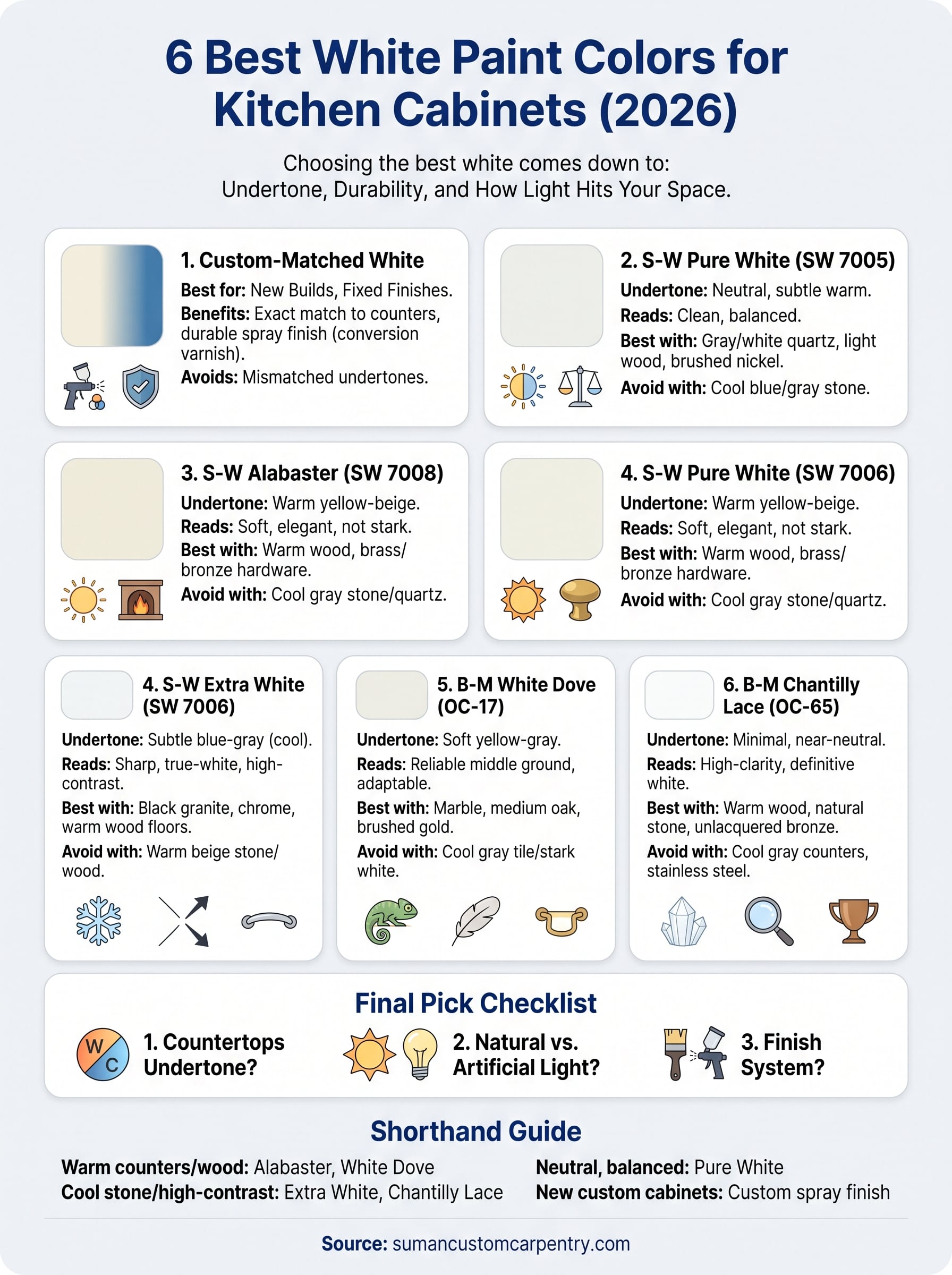
White cabinets never go out of style, but picking the wrong shade of white can make a kitchen feel cold, yellow, or just plain off. After building and finishing hundreds of custom kitchens at our Hyannis shop, we’ve learned that choosing the best white paint for kitchen cabinets comes down to three things: undertone, durability, and how light hits your space.
Not all whites are created equal. Some lean warm with creamy or yellow undertones. Others pull cool with blue or gray. The right choice depends on your countertops, flooring, lighting, and the overall feel you’re going for. Get it wrong, and even beautifully built cabinetry won’t look the way you imagined. Get it right, and the whole kitchen clicks together.
Below, we break down six white paint colors we consistently recommend to our Cape Cod clients, with specific product names, undertone details, and the finish types that actually hold up on cabinet surfaces over time.
1. Custom-matched white for your cabinets
Before jumping to stock colors, consider whether a custom-matched finish makes more sense for your project. If you’re building new cabinetry from scratch with a shop like ours, you have the option to dial in an exact white that works with your specific countertop slab, tile, and hardware rather than reverse-engineering a match after the fact.
When a custom match beats a stock white
A custom match wins when your kitchen has fixed finishes with strong undertones that a stock color won’t complement cleanly. For example, if your countertop has warm beige veining, a true-white stock paint can look stark by comparison. A tinted spray finish blended specifically for your space avoids that disconnect from the start.
If you’re building cabinets from scratch, locking in the finish color before installation is always easier than trying to match it afterward.
How a cabinet shop matches white to your finishes
Your cabinet maker will typically ask you to bring in physical samples of your countertop, tile backsplash, and flooring. At our Hyannis shop, we test tinted whites under the same lighting conditions as your kitchen before committing to a final formula. This process takes the guesswork out of choosing the best white paint for kitchen cabinets in your specific space.
What to specify for a spray-grade cabinet finish
Ask your shop to use a conversion varnish or catalyzed lacquer rather than a standard latex paint. These spray-applied finishes cure harder, resist moisture better, and hold up to daily cleaning far longer than brush-on products. Specify a satin or semi-gloss sheen for cabinet surfaces so fingerprints wipe off without dulling the finish.
Durability notes for kitchens near the coast
Cape Cod kitchens deal with higher humidity and salt air year-round, which accelerates paint degradation on improperly prepared or sealed surfaces. A catalyzed finish on properly primed, sanded MDF or solid wood holds up significantly better than water-based latex in these conditions.
Typical cost factors for a custom spray finish
Material and labor costs for a spray-applied custom finish run higher than a stock paint job, typically adding 15 to 25 percent to your finishing budget. That said, longer finish life and fewer touch-ups over time often make it the more cost-effective choice across a 10-to-15-year horizon.
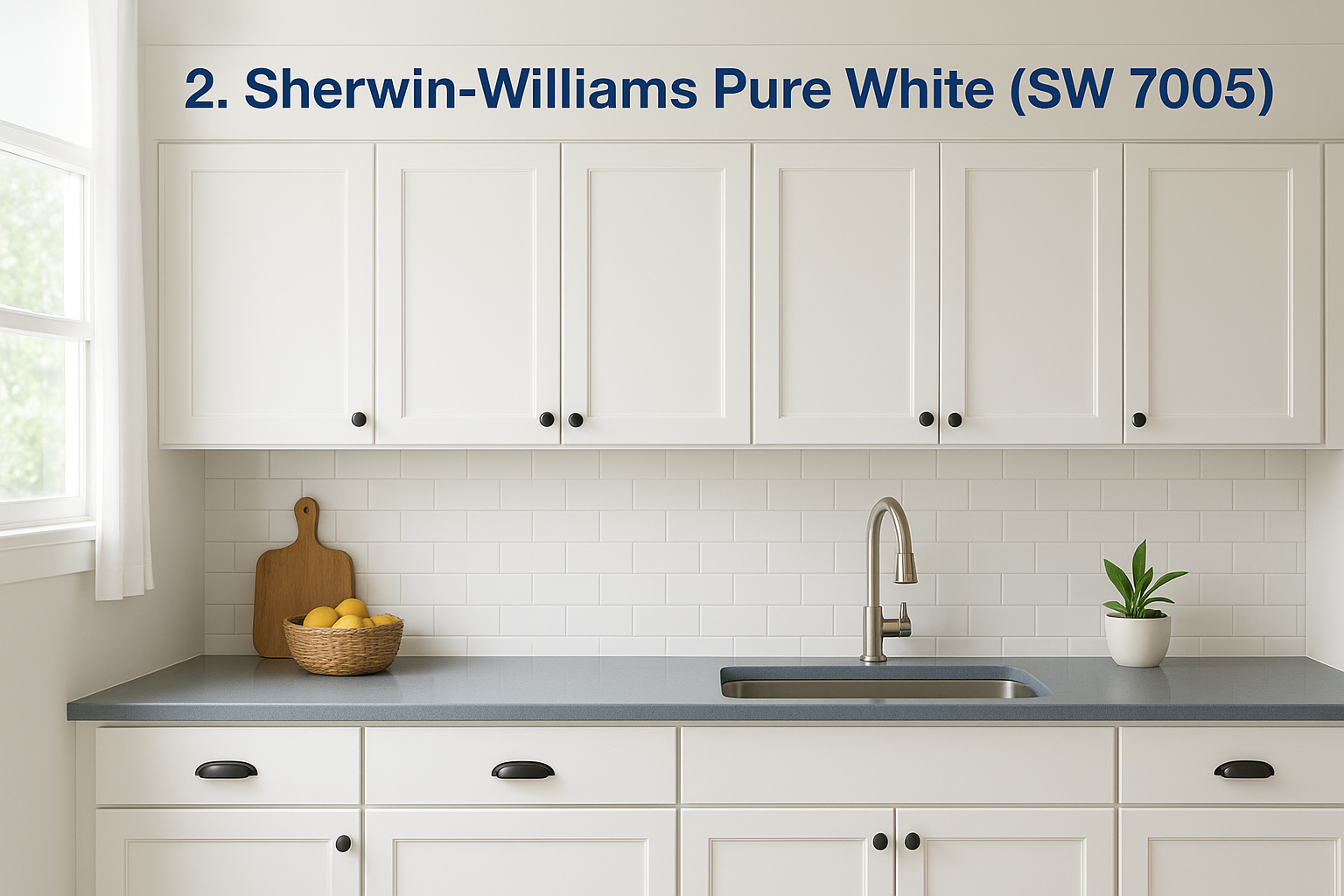
2. Sherwin-Williams Pure White (SW 7005)
Pure White is one of the most reliable options when choosing the best white paint for kitchen cabinets. It sits in a neutral middle ground that works across many kitchen styles without pulling too warm or too cool.
How it reads on cabinet doors and trim
On flat and shaker-style doors, Pure White reads as a clean, balanced white with good depth. It matches well to trim, so you can use the same color on both cabinets and surrounding millwork without noticeable contrast between surfaces.
Undertones and what they do in different light
Pure White carries subtle warm undertones that stay balanced under cool LED lighting. In north-facing kitchens with limited natural light, those undertones prevent your cabinets from reading stark or cold.
This balance makes Pure White one of the few stock whites that holds up consistently across both warm and cool lighting conditions.
Best pairings with counters, floors, and hardware
Pure White pairs well with a wide range of kitchen finishes. Strong combinations include:
- Gray or white quartz countertops
- Light hardwood or natural oak floors
- Brushed nickel or matte black hardware
Avoid heavily warm-toned stone slabs, where the slight warmth in Pure White can amplify yellow undertones in your countertop.
Sheen and paint system that keeps it cleanable
Apply Pure White in a satin or semi-gloss finish for easy daily cleaning. Use a bonding primer first for strong adhesion on bare wood or previously painted cabinet doors.
When to skip it
Skip it if your kitchen has blue-toned tile or cool gray stone countertops. The warm undertones will compete with those cool finishes and make your cabinets look off-color by comparison.
3. Sherwin-Williams Alabaster (SW 7008)
Alabaster sits on the warmer end of the white spectrum, making it a strong choice for kitchens where you want softness over contrast. It’s one of the most-used cabinet whites in coastal and traditional-style homes, and it earns that reputation consistently.
Why it works for warmer, softer kitchens
Alabaster brings a quiet warmth to cabinet surfaces that reads elegant rather than stark. If your kitchen has warm wood floors, cream-toned walls, or substantial natural light, Alabaster ties those elements together without competing with them.
Undertones to watch with tile and stone
This color carries noticeable warm undertones with a yellow-beige lean. If your backsplash tile or countertop stone has cool gray or blue tones, Alabaster can read muddy or yellowish rather than clean white next to those surfaces.
Sample Alabaster against your actual tile and stone under your kitchen’s lighting before committing to it.
Best pairings with wood tones and metals
Alabaster pairs naturally with warm wood tones like walnut, oak, and cherry. On the hardware side, brass and warm bronze finishes complement it far better than cool chrome or brushed nickel.
Sheen and paint system that avoids a "creamy" cast
Use a satin sheen in a cabinet-grade formula to keep Alabaster from reading overly creamy on flat door surfaces. A bonding primer with a white base maintains color accuracy during topcoat application.
When to skip it
Skip Alabaster if your kitchen has cool gray or white quartz countertops. The warm undertones pull yellow next to those surfaces, making your cabinets look off compared to the best white paint for kitchen cabinets result you’re after.
4. Sherwin-Williams Extra White (SW 7006)
Extra White is the right pick when you want maximum contrast on your cabinet doors. It sits at the bright end of the Sherwin-Williams white lineup and reads clean and decisive against dark countertops, bold tile, and striking hardware.
How it delivers a crisp, clean cabinet look
This color delivers a sharp, true-white appearance on cabinet doors that reads consistently across different rooms and lighting conditions. Unlike softer whites, Extra White makes your cabinet doors the visual anchor of the kitchen rather than a background element.
Undertones and why it can lean cool
SW 7006 carries subtle blue-gray undertones that become more noticeable under warm incandescent lighting. In kitchens with warm yellow overhead lighting, those undertones can push your cabinets toward a slightly cold, clinical feel.
Sample Extra White under your actual kitchen lighting before finalizing it as the best white paint for kitchen cabinets in your space.
Best pairings for high-contrast kitchens
Extra White thrives in high-contrast kitchen designs. Strong pairings include:
- Black granite or charcoal quartz countertops
- Matte black or polished chrome hardware
- Warm wood floors to offset its cool lean
Sheen and paint system that resists scuffs
Apply Extra White in a semi-gloss or satin cabinet-grade formula for scuff resistance and easy cleaning. Use a high-adhesion bonding primer first on previously painted or factory-finished cabinet surfaces.
When to skip it
Skip Extra White if your kitchen has warm beige stone countertops or yellow-toned wood floors. The cool undertones will clash with those warm finishes and make your cabinets look out of place next to them.
5. Benjamin Moore White Dove (OC-17)
Benjamin Moore White Dove is one of the most consistently recommended cabinet whites in the industry. Interior designers reach for it repeatedly because it sits in a reliable middle ground between warm and cool, making it adaptable across many kitchen styles without leaning too far in either direction.
Why designers use it as a "safe" cabinet white
Designers call White Dove "safe" because it reads as a true white in most lighting conditions without swinging too warm or too cold. Its broad adaptability makes it a dependable pick whether your kitchen has modern fixtures or a more traditional layout.
White Dove holds its character under both LED and incandescent lighting without shifting dramatically in either direction.
Undertones and how to prevent a muddy look
This color carries soft yellow-gray undertones that stay subtle in well-lit kitchens. In darker rooms with limited windows, those undertones can drift toward muddy, so always test a large painted sample in your actual space before committing.
Best pairings with marble, quartz, and wood
White Dove works well across a range of natural stone and wood finishes. Strong pairings include:
- Calacatta or Carrara marble countertops
- Medium-toned oak or walnut floors
- Brushed gold or warm brass hardware
Sheen and paint system for a smooth sprayed finish
Use a satin or semi-gloss cabinet-grade formula for the best result on doors and drawer fronts. A high-adhesion primer underneath ensures the finish bonds correctly and delivers the smooth, sprayed appearance White Dove is known for.
When to skip it
Skip White Dove if your kitchen has cool gray tile or stark white stone countertops. The warm undertones make it the wrong choice as the best white paint for kitchen cabinets in those cooler, higher-contrast spaces.
6. Benjamin Moore Chantilly Lace (OC-65)
Chantilly Lace is Benjamin Moore’s most popular bright white for cabinetry, and it earns that reputation by delivering a clean, high-clarity look that photographs well and holds its character under most lighting conditions.
How it compares to "true white" cabinets
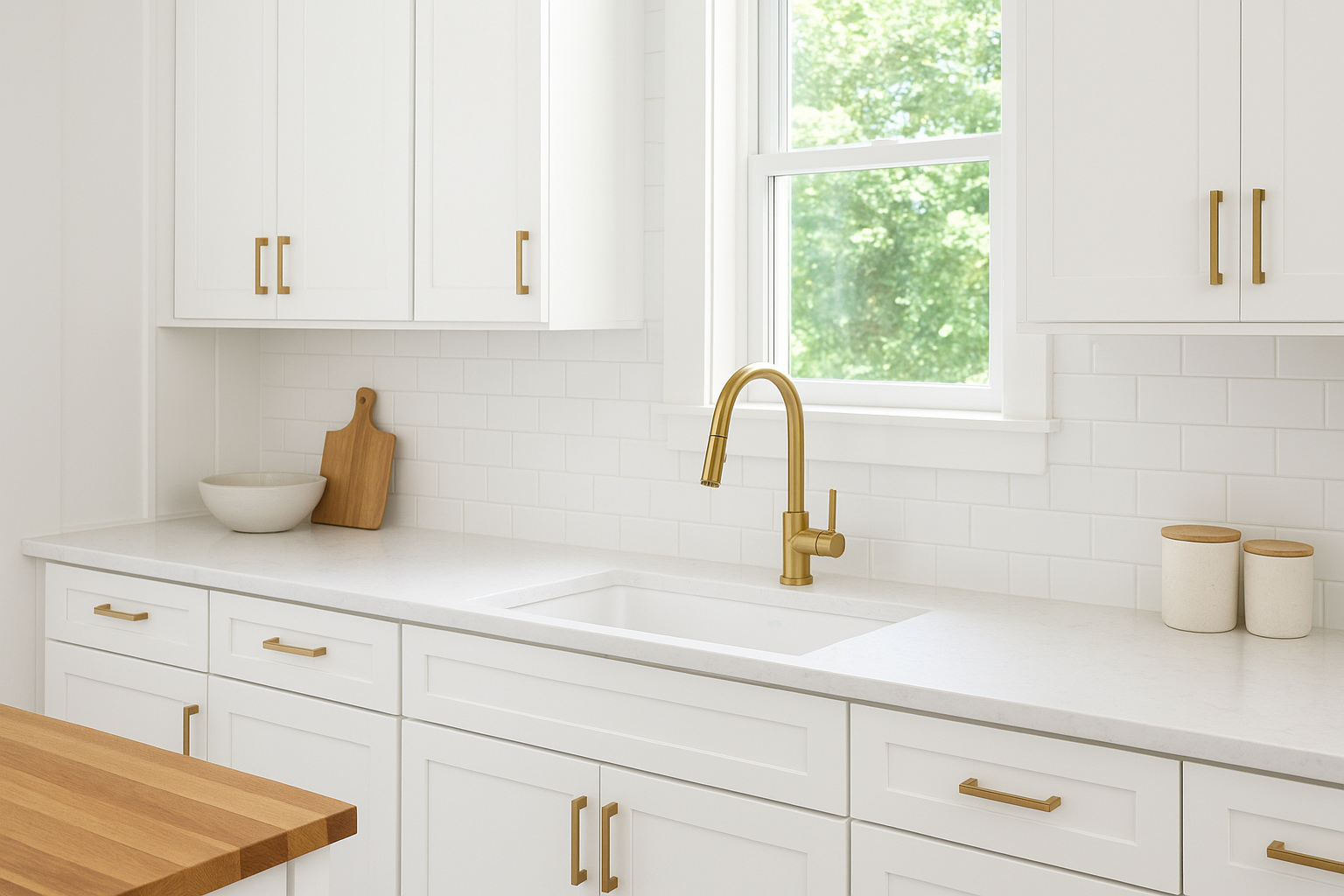
Chantilly Lace sits closer to a true neutral white than White Dove, with almost no discernible undertone shift under standard kitchen lighting. If you want your cabinets to read definitively white rather than soft or creamy, this color delivers that result consistently.
Undertones and why it can look stark
This color carries minimal undertones, which is precisely what makes it both appealing and risky. In kitchens with limited natural light or warm-toned finishes, that near-neutral white reads cold and flat rather than crisp and intentional.
Sample Chantilly Lace in your actual kitchen before committing, especially if your space has fewer windows or warm wood floors.
Best pairings to keep it from feeling sterile
Pair Chantilly Lace with warmer surrounding finishes to balance its brightness:
- Warm wood or butcher block countertops
- Natural stone with warm veining like gold or amber
- Brass or unlacquered bronze cabinet hardware
Sheen and paint system that highlights prep quality
Chantilly Lace is an unforgiving color because its high brightness amplifies surface imperfections. Use a cabinet-grade satin formula over a well-sanded, primed surface for the smoothest possible result.
When to skip it
Skip it if your kitchen has cool gray countertops or stainless steel appliances. In those settings, other options work better as the best white paint for kitchen cabinets without pushing the space toward a sterile, clinical feel.
Final pick checklist
The right white paint for your kitchen comes down to three quick questions: What undertones does your countertop carry? Does your kitchen get strong natural light, or does it rely on artificial fixtures? And what finish system will your painter or cabinet shop apply? Answer those three, and the field narrows fast.
Use this shorthand to land on your choice:
- Warm countertops or wood floors: Alabaster or White Dove
- Cool gray stone or high-contrast design: Extra White or Chantilly Lace
- Neutral, balanced kitchens: Pure White
- New custom cabinets built from scratch: custom spray finish matched to your finishes
If you’re building new cabinetry and want the best white paint for kitchen cabinets dialed in before installation, talk to our team at Suman Custom Carpentry. We handle everything from color selection through final installation on Cape Cod.