
If you’re planning a kitchen renovation on Cape Cod, one of the first numbers you’ll want to nail down is your kitchen cabinet installation cost per linear foot. It’s the most practical way to compare quotes, set a realistic budget, and avoid sticker shock halfway through your project. But the range is wide, and what you’re actually paying for changes dramatically depending on whether you go stock, semi-custom, or fully custom.
At Suman Custom Carpentry, we design and hand-build custom kitchen cabinetry right here in our Hyannis shop. We’ve worked with homeowners across Cape Cod through every stage of the cabinet process, from initial design meetings to final installation, so we see exactly where costs come from and where they don’t. That perspective matters when you’re trying to make sense of pricing that can swing from $100 to $1,200+ per linear foot depending on the route you take.
This article breaks down current 2026 pricing for stock, semi-custom, and custom cabinet installation. We’ll cover material costs, labor estimates, and the variables that push your total up or down. Whether you’re weighing big-box options against a local cabinet shop or just trying to figure out what’s reasonable for a 20-linear-foot kitchen, you’ll leave here with the numbers you need to budget with confidence.
Why installers price cabinets by linear foot
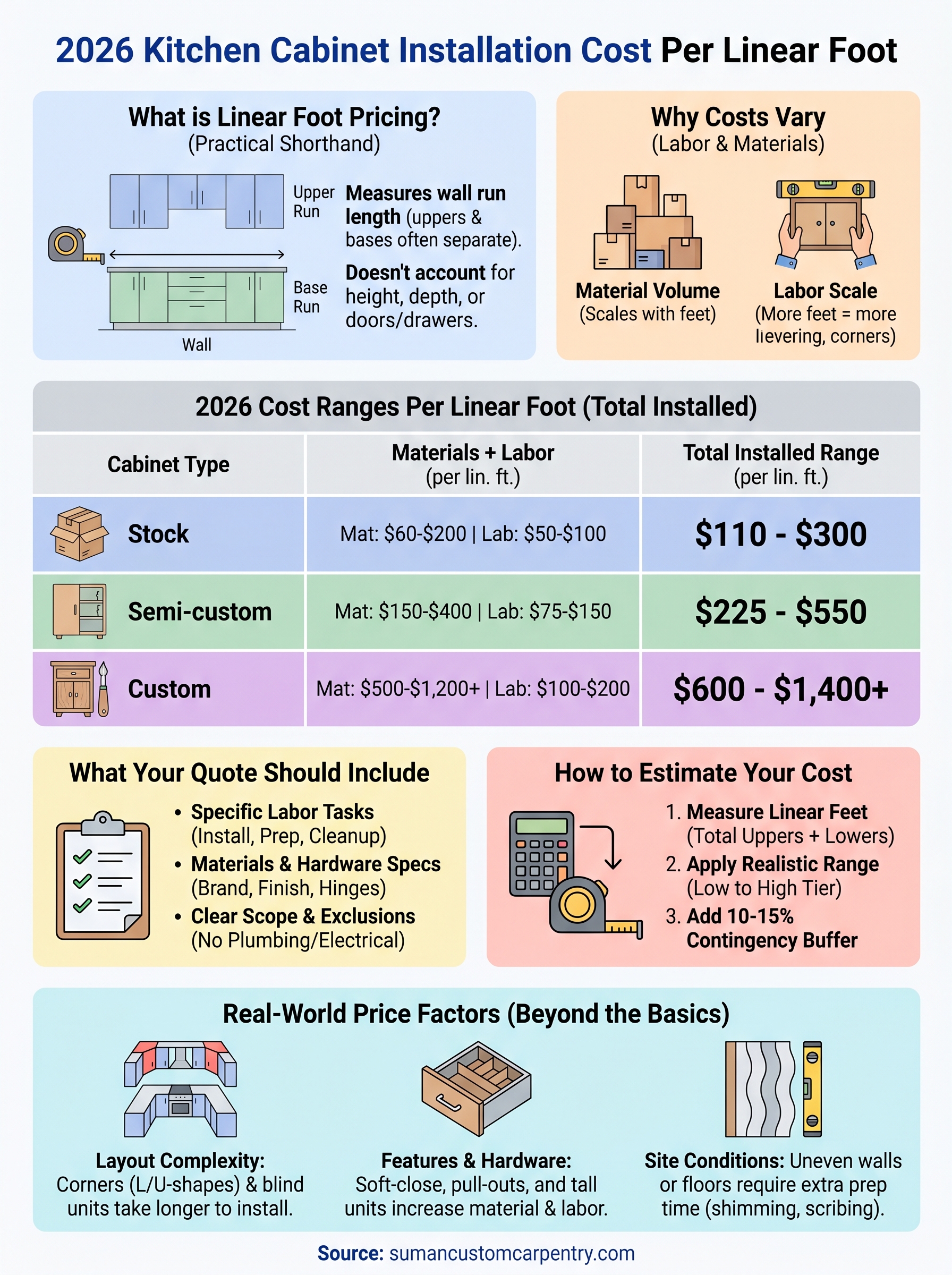
Linear foot pricing is a practical shorthand that lets contractors, cabinet shops, and homeowners speak the same language early in a project. When you ask for an estimate before final plans are drawn, a contractor can look at your kitchen layout and give you a workable number based on how many feet of cabinetry you’re planning to install. That single measurement captures both the wall-by-wall scope of the work and the material volume in one figure, which makes it straightforward to compare multiple quotes against each other before you’ve committed to anything.
What a linear foot actually measures in your kitchen
A linear foot of cabinetry is simply one foot of cabinet run measured along the wall. If your base cabinets stretch across 12 feet of one wall and 8 feet of another, you have 20 linear feet of base cabinetry. Upper cabinets, base cabinets, and islands are each measured separately, and most contractors add them together to reach a total when calculating the kitchen cabinet installation cost per linear foot for the whole project.
This measurement does not account for height, depth, or the number of doors and drawers packed into that run. A 12-inch-deep pantry cabinet and a 24-inch-deep base cabinet both count as one linear foot each. That’s why the specific cabinet configuration matters a lot when someone quotes you a per-linear-foot figure. Make sure you know whether a quote covers upper cabinets, base cabinets, or both before you stack it against any other number you receive, because that distinction alone can cut a quote in half or double it.
A linear foot quote that doesn’t specify what’s included (uppers, lowers, or both) is not an apples-to-apples comparison with any other quote you receive.
How labor scales with cabinet runs
Labor is the biggest variable in a per-linear-foot estimate, and it scales with the length of the run for a clear reason: more linear feet means more cabinets to level, secure, and align. A longer run also means more wall anchoring points, more filler strips, more toe kicks, and more time spent checking that each box is plumb before the next one goes in.
Installers also factor in corners, which are the most time-consuming parts of any cabinet installation. A kitchen with two inside corners and an L-shaped layout takes noticeably longer to install than a single straight run of the same total linear footage. Most experienced contractors build this complexity into their per-linear-foot rate, while others add a separate line item for corners. Either way, the linear foot is still the base unit they start from, and understanding that helps you read a quote more critically.
Why material cost fits the same pricing model
Cabinet manufacturers and suppliers sell their products in standard widths: 9-inch, 12-inch, 15-inch, 18-inch, and so on up to 36 or 48 inches for wider base units. When you buy cabinetry, you’re essentially filling linear feet of wall space with a combination of these standard widths. That makes linear footage a natural fit for pricing materials, because the number of boxes you need scales directly with how many feet of run you’re covering.
Custom cabinets built to exact dimensions add a layer of complexity here. When a cabinet shop builds face-frame or frameless boxes to fit a specific wall, the material cost per linear foot reflects not just the raw lumber or plywood but the shop time, joinery, and finishing built into each piece. That’s a fundamentally different calculation from stacking stock boxes side by side, which is one of the main reasons custom cabinetry costs more per linear foot than stock alternatives covering the same wall measurement.
2026 cost ranges per linear foot in the US
Cabinet pricing in 2026 falls across a wide spectrum, and where you land depends on the cabinet type you choose. Stock, semi-custom, and custom cabinets each carry distinct cost ranges per linear foot, covering both materials and labor unless a quote explicitly separates them. Understanding the typical kitchen cabinet installation cost per linear foot for each tier helps you set a realistic ceiling before you talk to a single contractor.
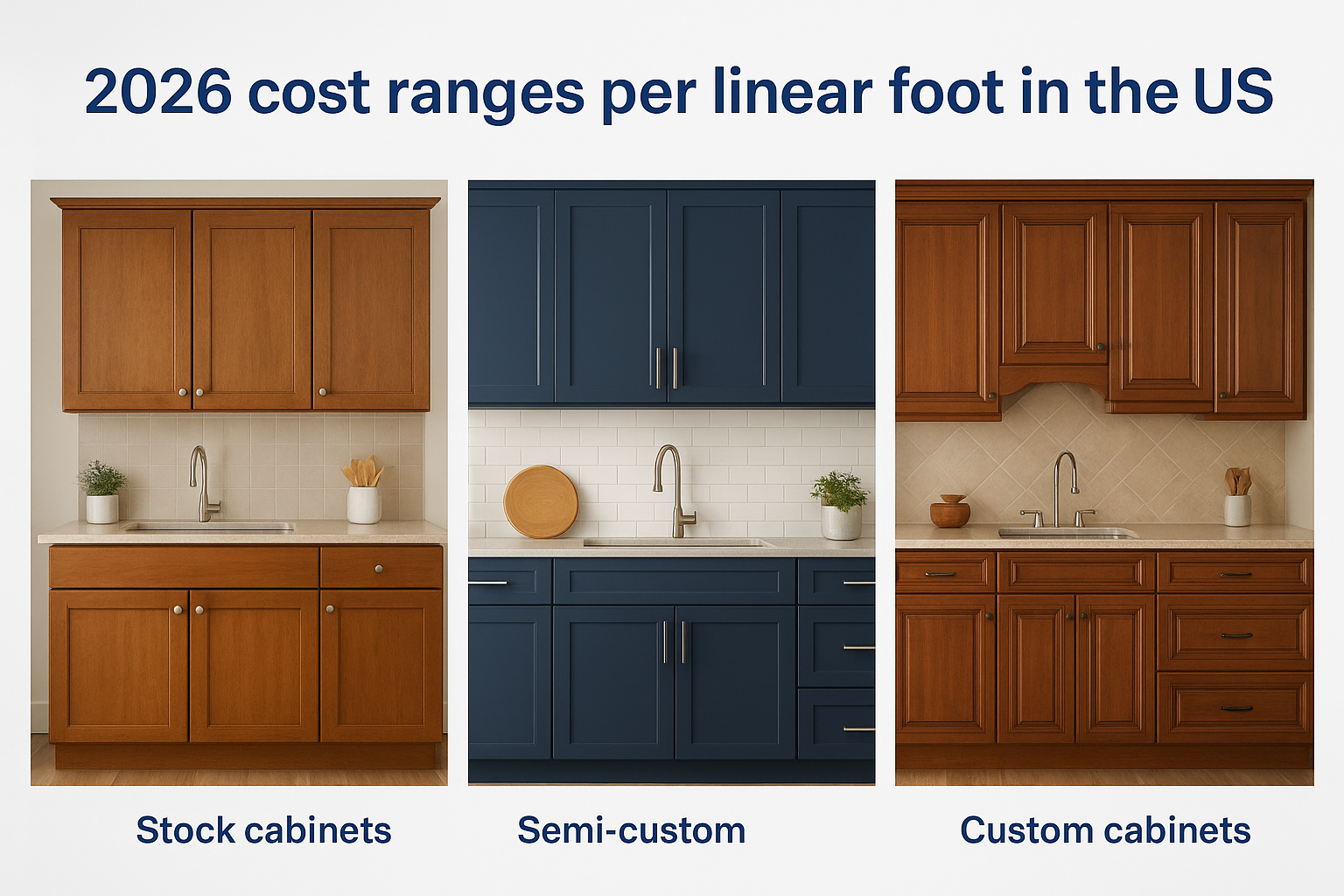
| Cabinet Type | Materials (per linear foot) | Labor (per linear foot) | Total Installed Range |
|---|---|---|---|
| Stock | $60 – $200 | $50 – $100 | $110 – $300 |
| Semi-custom | $150 – $400 | $75 – $150 | $225 – $550 |
| Custom | $500 – $1,200+ | $100 – $200 | $600 – $1,400+ |
Stock cabinets
Stock cabinets are the most affordable entry point, with total installed costs typically running between $110 and $300 per linear foot in 2026. These are pre-built boxes sold in fixed sizes at home improvement stores. You’re paying for speed and availability, not customization, which keeps costs low but limits your layout options significantly.
Because stock sizes come in fixed increments, installers often need filler strips to close gaps between boxes and walls. Those fillers add small amounts of labor time that can push your total toward the higher end of the stock range, especially in kitchens with irregular walls or multiple corners.
Semi-custom cabinets
Semi-custom cabinets give you more flexibility in sizing, finish, and interior storage features. Total installed costs generally fall between $225 and $550 per linear foot, depending on the manufacturer, the modifications you request, and your regional labor market. These cabinets are a common middle-ground choice for homeowners who want more than stock but aren’t committing to a full custom build.
Semi-custom pricing varies more than any other tier because the range of available modifications is so wide, so always get a detailed quote listing exactly what’s included before you compare it against another bid.
Custom cabinets
Custom cabinets, hand-built to your exact specifications by a local cabinet shop, carry total installed costs that typically start around $600 per linear foot and can climb well past $1,200 for complex kitchens with specialty features or premium materials. On Cape Cod specifically, high-end residential projects regularly land in the $800 to $1,200+ range, because homeowners are investing in craftsmanship, durable materials suited for coastal environments, and long-term warranties that stock products simply don’t offer.
What your install quote should include
A quote that only lists a total number tells you almost nothing useful. Before you sign anything or use a contractor’s figure to anchor your kitchen cabinet installation cost per linear foot estimate, you need to confirm that the quote breaks down exactly what’s covered. A detailed quote protects you from unexpected charges mid-project and gives you a real basis for comparison when you’re weighing bids against each other.
Labor line items
The labor portion of your quote should be specific about what tasks are included, not just a lump sum. A well-structured quote will separate the cost of cabinet installation from any related work like removing old cabinets, prepping walls, or patching surfaces after the old units come out.
If demolition and disposal aren’t listed separately, ask directly whether they’re included, because some contractors price them as add-ons that can run $200 to $500 or more depending on kitchen size.
You should also see whether the quote covers hardware installation, meaning hinges, drawer slides, and pulls. These take real time to install correctly, and if a contractor leaves them out, you’ll either do it yourself or pay a separate trip charge to have them come back.
Materials and hardware
Some installers supply cabinets directly and some work only with what you provide. Your quote should make this distinction clear so you know whether the material cost is built in or sits entirely on your side of the budget. If the installer is supplying the cabinets, the quote should list the brand, product line, and finish so you can verify what you’re actually getting.
Hardware costs are easy to underestimate. Hinges, soft-close drawer slides, and pulls add up quickly across a full kitchen, and quality hardware on custom cabinetry costs more than the basic options included with stock boxes. Ask whether hardware is itemized separately or bundled into the per-linear-foot rate.
Scope and exclusions
Every quote should state clearly what the installer will not do. Common exclusions include countertop installation, plumbing rough-in adjustments, electrical work, and finish painting. If your kitchen requires any of those trades, you’ll need separate quotes for each one.
The scope section should also confirm the total linear footage the quote covers and whether it includes uppers, lowers, or both. A quote that doesn’t specify this creates room for disagreement once the job starts, and that’s a situation worth avoiding entirely.
How to estimate your total install cost
Getting to a realistic number before you talk to contractors gives you leverage and helps you spot quotes that are out of line with the market. You don’t need a contractor on-site to run a working estimate, and the process takes less time than most homeowners expect once you understand how the kitchen cabinet installation cost per linear foot framework actually applies to your specific kitchen.
Measure your linear footage first
Start by measuring every wall run where cabinets will go, separating upper cabinet runs from base cabinet runs. Write down each measurement in feet, then add them up for a total. If your kitchen includes an island, measure its perimeter and add that separately. Don’t round aggressively; measure to the nearest half foot and use that number as your baseline for the estimate.
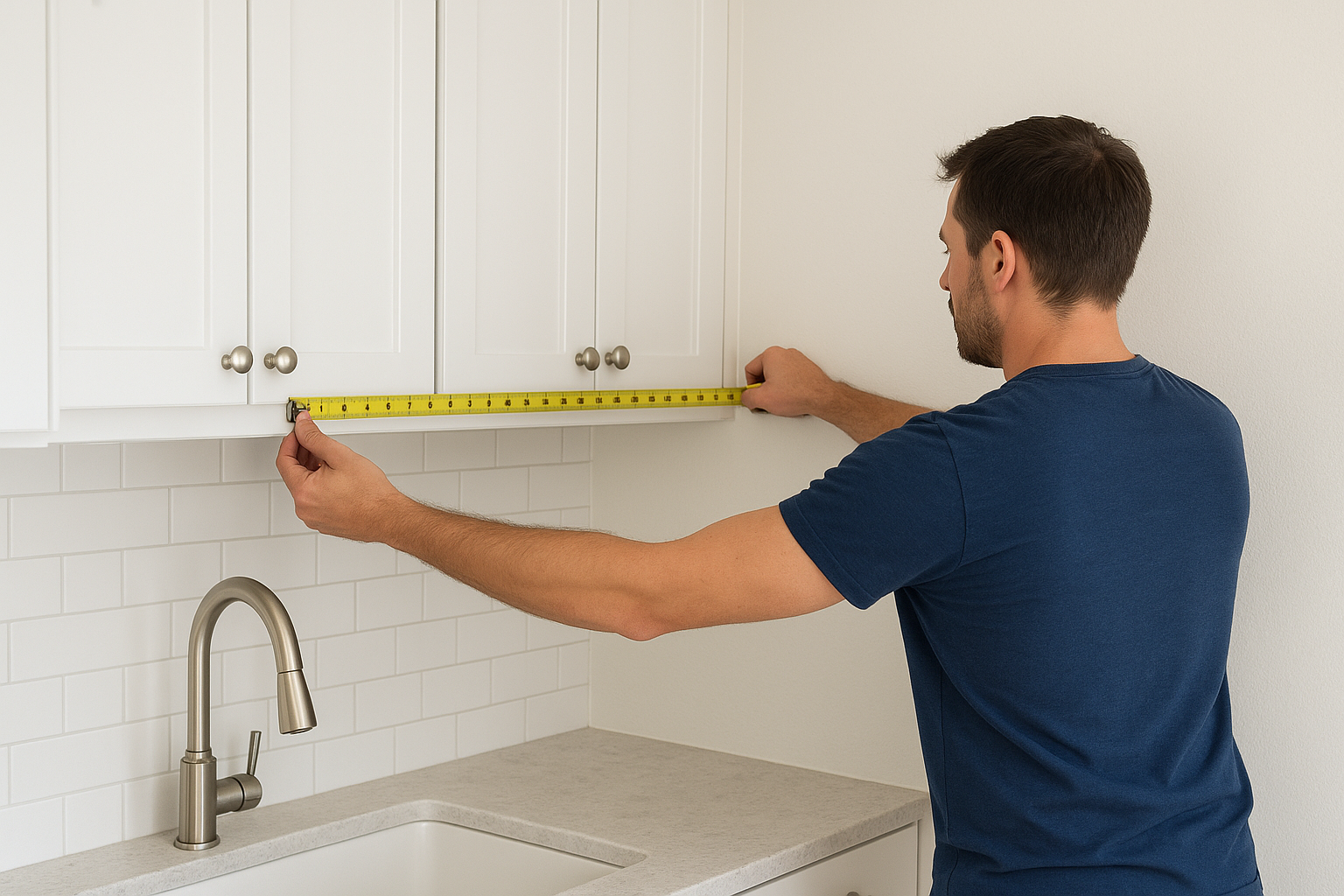
Once you have your upper total and your lower total, you can apply per-linear-foot pricing to each independently or combine them based on how your quotes are structured. Most contractors quote uppers and lowers together, but some break them apart, particularly when upper cabinet counts are low or the layout is unusual.
Apply a realistic cost range to each run
Take your linear footage totals and multiply them against the cost ranges for the cabinet tier you’re considering. Use the low end of the range to establish a floor and the high end to set a ceiling for your budget.
Here’s a simple calculation for a 20-linear-foot kitchen at each tier:
| Cabinet Tier | Low Estimate | High Estimate |
|---|---|---|
| Stock | $2,200 | $6,000 |
| Semi-custom | $4,500 | $11,000 |
| Custom | $12,000 | $28,000+ |
These figures cover both materials and installed labor. They do not include countertops, plumbing adjustments, or electrical work, which are separate budget items.
Add a contingency buffer
No kitchen renovation runs exactly on estimate. Plan for a 10 to 15 percent contingency on top of your baseline figure to cover wall repairs after old cabinets come down, filler strips, unexpected structural issues, and hardware costs that are easy to underestimate early in the planning process.
If you’re working with a custom cabinet shop, ask about the typical variance between their initial per-linear-foot estimate and final invoice on completed projects. A reputable shop will give you an honest answer, and that number tells you a lot about how precise their quoting process is before you commit.
Factors that change the price on real jobs
Published cost ranges give you a useful starting point, but real kitchen projects rarely land exactly at the midpoint of any published benchmark. Several specific variables push the final kitchen cabinet installation cost per linear foot higher or lower on actual jobs, and knowing them in advance helps you anticipate where your project is likely to fall within any given range.
Kitchen layout complexity
Your kitchen’s shape has a direct effect on how long installation takes and how much it costs. A single straight run of cabinets along one wall is the fastest layout to install. Add a corner, an L-shape, or a U-shape, and installation time increases because each corner requires careful fitting, custom corner boxes, and more precise leveling to keep the entire run aligned.
Blind corner cabinets and diagonal corner units are among the most time-consuming pieces to install correctly. If your layout includes two or more corners, expect your per-linear-foot labor cost to run toward the higher end of any quoted range rather than the middle.
A kitchen with three corners can take twice as long to install as a straight run of the same total linear footage, so factor that directly into your labor estimate.
Cabinet features and interior hardware
The cabinets themselves drive cost differences that go beyond the box. Soft-close hinges, pull-out drawer inserts, built-in organizers, and specialty storage features all add time during installation and cost during manufacturing. Each of these upgrades is worth having if it suits your lifestyle, but you should account for them explicitly in your budget rather than assuming they’re folded into a basic per-linear-foot quote.
Tall cabinets, such as full-height pantries or appliance garages, also affect the installed cost. These units weigh more, require more precise wall anchoring, and take longer to level than standard 30-inch uppers or 34.5-inch base units.
Site conditions and wall prep
The condition of your walls before installation starts is something many homeowners overlook when budgeting. Out-of-plumb walls, uneven floors, or surfaces left rough after old cabinet removal all require additional time to address before new cabinets can go in correctly. On older Cape Cod homes especially, walls are rarely perfectly flat, and installers need to shim, scribe, or add filler strips to compensate.
If your kitchen requires any electrical or plumbing adjustments to accommodate a new layout, those trades add separate costs that sit outside any cabinet installation quote you receive.
Next steps for a realistic cabinet budget
Now that you understand how the kitchen cabinet installation cost per linear foot breaks down across stock, semi-custom, and custom tiers, you have what you need to start a real conversation with a cabinet shop. Measure your kitchen, identify your layout complexity, and build in a 10 to 15 percent contingency before you talk to anyone. That preparation alone puts you ahead of most homeowners who walk into a consultation without a clear baseline number in hand.
Custom cabinetry on Cape Cod is a significant investment, and the right shop will walk you through every cost driver before you commit to anything. Suman Custom Carpentry hand-builds every cabinet in our Hyannis shop and backs the work with a lifetime warranty on cabinet boxes and doors. If you’re ready to get a detailed estimate for your kitchen project, contact us for a custom cabinet consultation and we’ll work through the numbers with you directly.