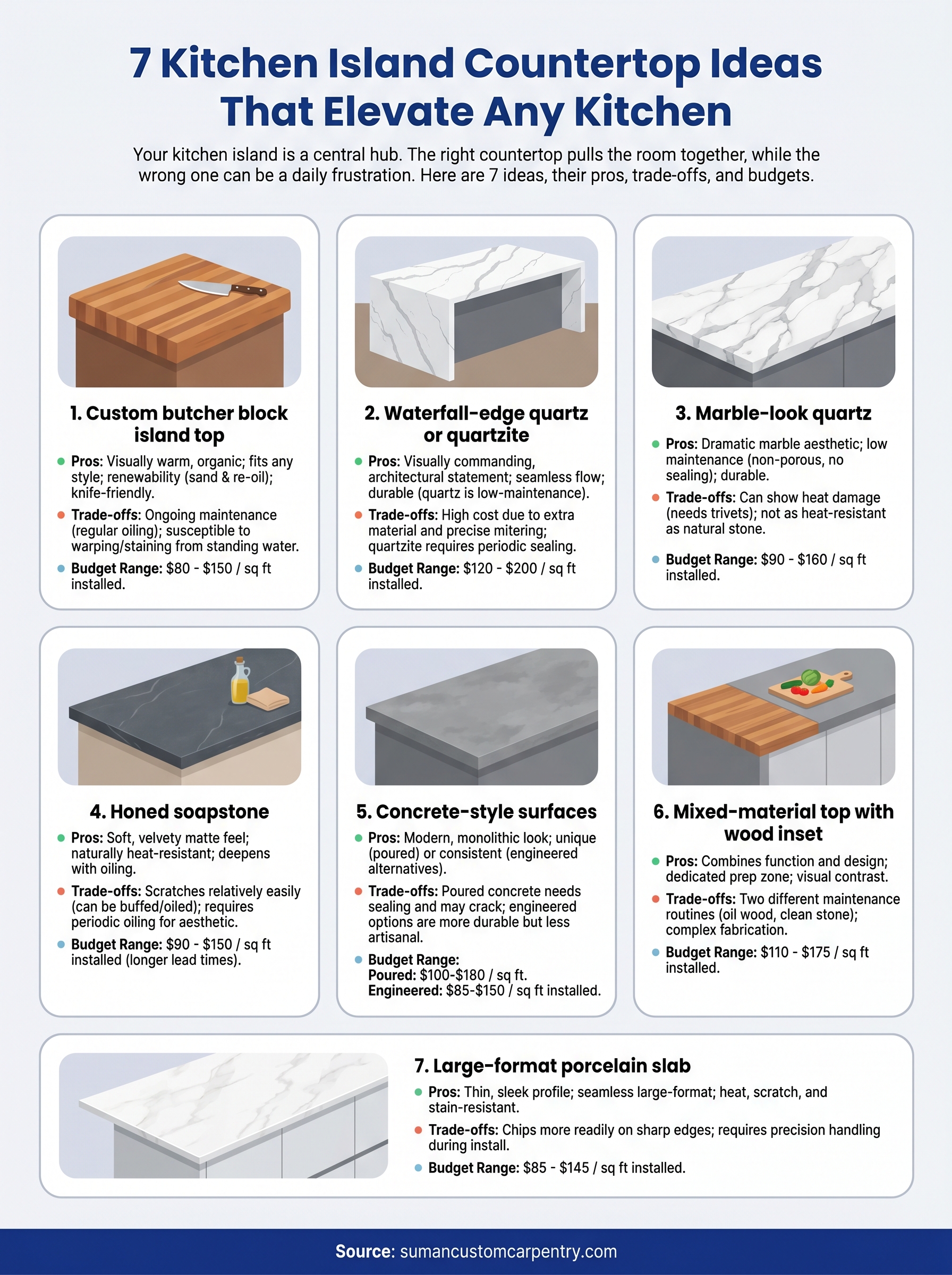
Your kitchen island is probably the hardest-working surface in your home. It’s where you prep dinner, where the kids do homework, and where guests gather during every party. So when it comes to choosing kitchen island countertop ideas, the material and style you pick matters more than most people realize. The right countertop pulls the whole room together. The wrong one? It becomes a daily frustration you can’t ignore.
The good news is you have more options now than ever, from natural stone and butcher block to engineered surfaces and mixed-material designs that make a real statement. Each comes with its own look, feel, durability, and maintenance demands. Sorting through those tradeoffs is exactly what this guide is built to help you do.
At Suman Custom Carpentry, we design and hand-build custom kitchens at our shop in Hyannis, Cape Cod. We’ve installed islands in every island configuration you can imagine, and we’ve seen firsthand how the countertop choice shapes the entire kitchen. Below, we’re sharing seven countertop ideas worth considering, with honest notes on what works, what doesn’t, and what to think about before you commit.
1. Custom butcher block island top built to your layout
Butcher block is one of the most versatile and visually warm kitchen island countertop ideas you can choose. It brings a natural, organic quality to any kitchen style, whether you’re going for a farmhouse look or something more contemporary. When it’s custom-built to your exact island dimensions and layout, it fits like nothing off the shelf ever could.
What it looks like
A custom butcher block top features tight, end-grain or edge-grain wood strips laminated together to form a thick, solid surface. The look is warm and tactile, with visible wood grain running across the entire top. You can keep it natural with an oil finish, or go with a harder varnish for a slightly more polished appearance.
Best material options
The wood species you choose shapes both the look and the performance of your island top. Hard maple is the standard choice for butcher block because of its tight grain and exceptional durability under daily use. Walnut is a strong second option if you want richer, darker tones. White oak has become increasingly popular for its subtle grain pattern and relaxed coastal aesthetic that fits light Cape Cod kitchen design particularly well.
Pros and trade-offs
This material gives you a naturally renewable surface you can sand and re-oil when it starts to show wear. Scratches and knife marks don’t ruin it; they become part of the character over time. The real trade-off is ongoing maintenance. You’ll need to oil it several times a year, and you should keep standing water off it to avoid warping or deep staining.
A custom-built butcher block top, sized and finished specifically for your island, will outlast a pre-made version by years because it’s built to the actual demands of your space.
Budget range and install notes
Custom butcher block island tops typically run $80 to $150 per square foot installed, depending on wood species and thickness. Edge-grain maple sits at the lower end of that range; wide walnut slabs push toward the higher end. Installation is less complex than stone because the material is lighter, but it still needs proper underlayment support and careful leveling to sit flat and stay stable. Annual oiling adds a small recurring cost, but it’s straightforward work you can do yourself.
2. Waterfall-edge quartz or quartzite statement slab
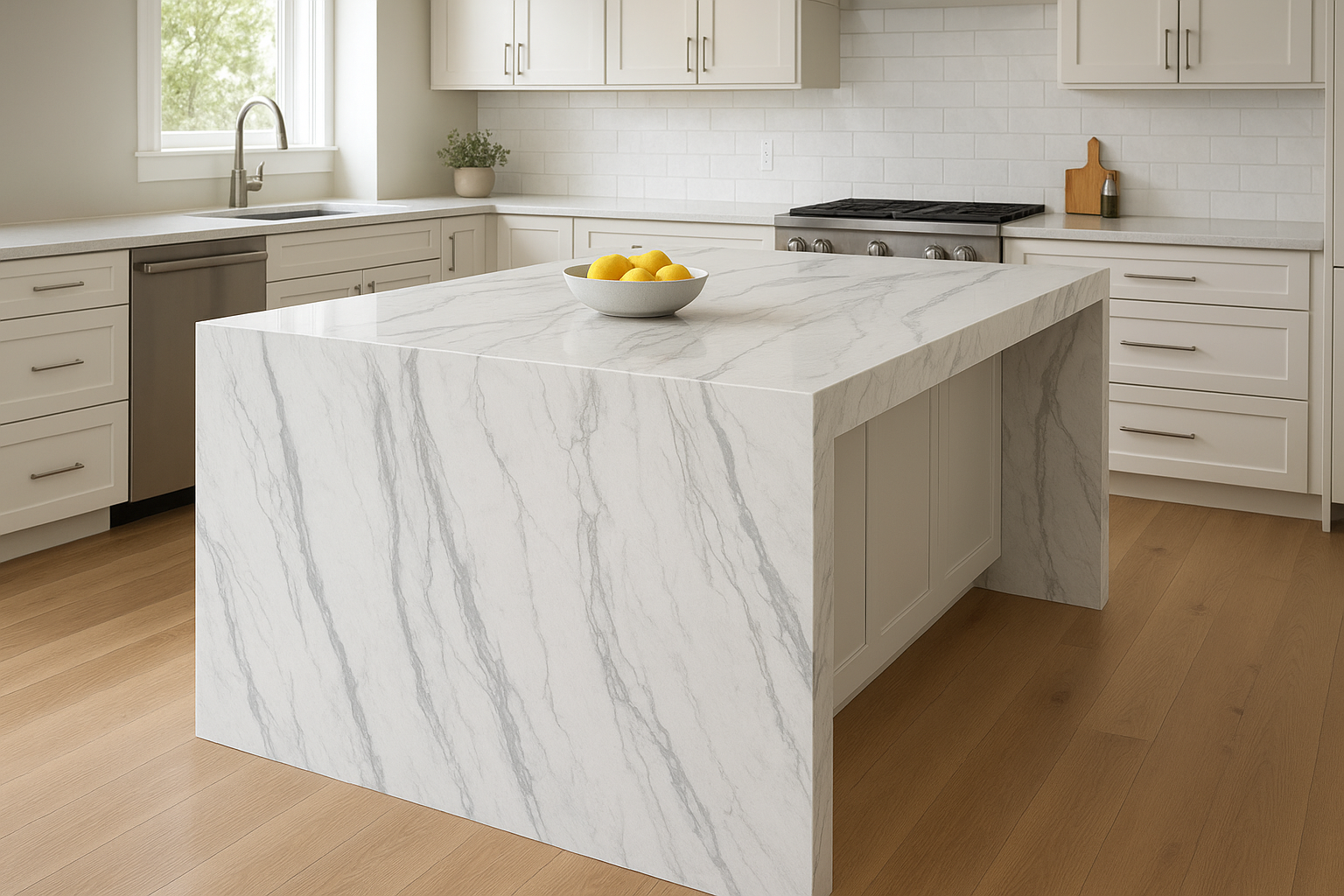
A waterfall-edge island top is one of the most visually commanding kitchen island countertop ideas you can put in a kitchen. The countertop surface continues vertically down both ends of the island, creating a seamless flow of material from top to floor. The result is bold and architectural.
What it looks like
The waterfall edge creates a continuous slab effect where the stone or engineered surface wraps the island like a solid block. When the material has strong veining, that pattern flows down the sides, making the whole island feel like a single sculptural object. It works especially well in open-concept kitchens where the island is visible from multiple angles.
Best material options
Quartz is the most practical choice for this application because it comes in consistent slabs that match across cuts. Quartzite, which is a natural stone, offers more variation and depth than quartz but requires more careful sealing. Both materials are available in large-format slabs that make the waterfall mitering cleaner and more seamless.
The mitered joint on a waterfall edge needs to be precise. A custom island fabricator near you who works with stone regularly will get that seam far tighter than a general contractor will.
Pros and trade-offs
Quartz resists staining and scratching better than most natural stones and needs no sealing. Quartzite is harder and denser but does require periodic sealing to maintain its surface. The main trade-off for both is cost, driven largely by the extra material needed to wrap the sides.
Budget range and install notes
Expect to pay $120 to $200 per square foot installed for a waterfall-edge quartz or quartzite top. The added material for the vertical drops and the precision mitering push the cost above a standard flat-top installation. Structural support inside the island base needs to be solid before installation begins, so it pays to settle the island layout and size rules early.
3. Marble-look quartz for high drama, low maintenance
Marble has been a top kitchen island countertop idea for decades, but the upkeep stops a lot of homeowners from committing. Marble-look quartz gives you the same dramatic aesthetic without the etching, staining, and frequent sealing that real marble demands.
What it looks like
Marble-look quartz replicates the bold veining and soft, luminous background of natural marble through engineered stone. The veins run in sweeping, organic patterns across a white, cream, or gray base, and the surface has a polished sheen that reads as genuinely luxurious.
Best material options
Calacatta-style quartz features thick, dramatic veining on a bright white background and delivers the most visual impact. Carrara-style options tone it down with softer, finer gray veining for a more understated look. Brands like Silestone and Cambria produce large-format slabs that keep the veining consistent across your entire island surface.
Choosing a large-format slab minimizes visible seams, which matters a lot when you’re working with a veined pattern that needs to read as continuous.
Pros and trade-offs
Quartz is non-porous and requires no sealing, which makes it one of the most low-maintenance surfaces available. The trade-off is that it can show heat damage if you set hot pans directly on it, so trivets are a must.
Budget range and install notes
Marble-look quartz typically runs $90 to $160 per square foot installed. Slab size and veining complexity affect pricing, so larger islands with dramatic patterns will sit at the higher end of that range.
4. Honed soapstone for a soft, matte island top
Soapstone is one of the more underused kitchen island countertop ideas on this list, but homeowners who choose it rarely regret it. The material has a quiet, tactile quality that polished stones simply cannot replicate, and it fits naturally into kitchens that favor understated elegance over flash.
What it looks like
Honed soapstone has a smooth, velvety matte surface that typically ranges from medium gray to deep charcoal. The color shifts and deepens when you apply mineral oil, giving it a rich, almost slate-like appearance over time. Unlike polished stone, it absorbs light rather than reflecting it.
Soapstone darkens naturally with use and oiling, so the island top you have in five years will look richer and more refined than the one you install on day one.
Best material options
True geological soapstone is your only real option here since there are no engineered alternatives that match its feel. Look for slabs with consistent density and minimal surface fissures, as softer soapstone grades scratch more easily. Virginia and Brazilian soapstone are the most widely available sources in the US market.
Pros and trade-offs
Soapstone is naturally non-porous and heat-resistant, making it genuinely practical for an island surface. The main trade-off is that it scratches relatively easily compared to quartz or quartzite. Most scratches buff out or blend in with regular oiling, but it’s not the right choice if you want a surface that stays pristine without any attention.
Budget range and install notes
Expect to pay $90 to $150 per square foot installed. Slab availability varies by region, so lead times can run longer than engineered surfaces, especially on Cape Cod where specialty stone suppliers are more limited than in larger metro areas.
5. Concrete-style surfaces for a modern, monolithic look
Concrete-style countertops deliver one of the most visually distinct kitchen island countertop ideas available today. The look is raw, architectural, and quietly industrial, and it pairs well with both modern minimalist kitchens and transitional designs that mix warm and cool materials.
What it looks like
A concrete-style island top has a flat, uniform matte surface with subtle tonal variation that gives it depth without heavy patterning. The color typically stays in the gray, taupe, or warm putty range, though custom pigments let you shift toward cooler or warmer tones. The overall effect reads as one solid, deliberate mass.
Best material options
You have two main paths here: poured and hand-finished concrete or concrete-look porcelain and quartz slabs. True poured concrete is fully custom and can be formed to any shape or dimension. Engineered alternatives mimic the look with more consistent coloring and better stain resistance, which matters a lot in a working kitchen.
If you want the texture and tonal variation of real concrete without the long-term sealing demands, a high-quality concrete-look quartz slab is the more practical choice for most homeowners.
Pros and trade-offs
True concrete gives you a completely one-of-a-kind surface, but it requires regular sealing and can develop hairline cracks over time. Engineered alternatives are far more durable day to day and need minimal upkeep in exchange for a slightly less artisanal feel.
Budget range and install notes
Poured concrete runs $100 to $180 per square foot installed. Concrete-look quartz or porcelain sits in the $85 to $150 range, with shorter lead times and simpler long-term care.
6. Mixed-material top with a wood prep station inset
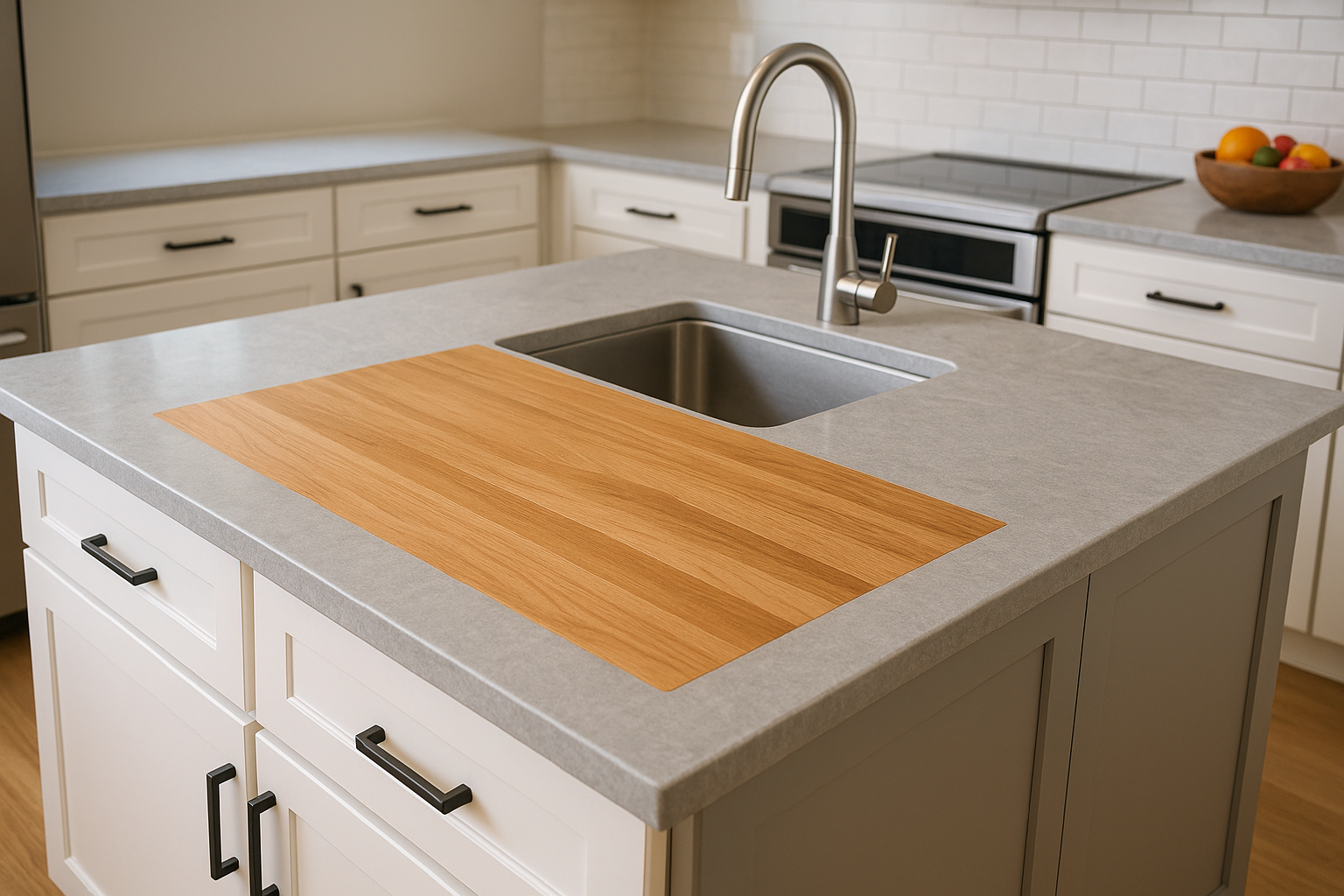
Among all the kitchen island countertop ideas in this guide, the mixed-material approach is the one that combines function and design most directly. You get a primary surface material across most of the island, with a dedicated wood prep station inset cut flush into one section, giving each zone a specific purpose.
What it looks like
The island reads as a single unified surface until you notice the wood inset sitting flush within the surrounding stone or quartz. The contrast between a matte wood grain and a polished or honed stone field is subtle but deliberate.
Best material options
Quartz paired with hard maple butcher block is the most popular combination because both materials are durable and relatively easy to maintain alongside each other. Quartzite with walnut works well for kitchens leaning into a warmer, more natural palette. The key is choosing materials that complement rather than compete in tone and texture, the same principle behind most island design ideas for layout, seating, and storage.
The inset wood section works best when it sits over a drawer bank rather than an open cabinet run, so the support structure keeps the wood from flexing under heavy use.
Pros and trade-offs
You get a purpose-built prep zone that’s far gentler on knife edges than stone, alongside a main surface that handles everything else. The trade-off is that two different materials require two different maintenance routines, so you’ll need to oil the wood section regularly while the stone largely takes care of itself.
Budget range and install notes
Mixed-material island tops typically run $110 to $175 per square foot installed, reflecting the added fabrication work needed to fit both materials flush. Precise seam fitting between the two surfaces is the most labor-intensive part of the job.
7. Large-format porcelain slab for a thin, sleek profile
Large-format porcelain is one of the most underestimated kitchen island countertop ideas available right now. It delivers a refined, architectural finish at a competitive price point, and the thin profile, often just 12 to 20 millimeters thick, gives it a distinctly contemporary edge that thicker stone slabs cannot match.
What it looks like
Porcelain slabs are produced in oversized formats, often 120 by 60 inches or larger, which means your island top can be a single continuous sheet with no seams at all. The surface texture varies from a polished gloss to a matte linen finish, and the printed patterns convincingly replicate marble, concrete, and even wood grain at a very close distance.
A seamless single-slab top is one of the cleanest design moves you can make on an island, and large-format porcelain makes it achievable without the cost of a premium quartzite slab.
Best material options
Italian-produced porcelain from manufacturers like Dekton or Neolith leads the category in surface density and color consistency. These brands produce slabs in ultra-compact sintered formats that perform better under heat and impact than standard ceramic tile-based alternatives.
Pros and trade-offs
Porcelain is heat-resistant, scratch-resistant, and fully non-porous, making it one of the most practical surfaces for a working island. The trade-off is that it chips on sharp edges more readily than quartz, so edge profiles need to stay simple and slightly eased.
Budget range and install notes
Large-format porcelain typically runs $85 to $145 per square foot installed. The slabs are lightweight compared to stone, but precision cutting and careful handling during installation are non-negotiable to avoid cracking.
Next steps
Picking the right surface from all these kitchen island countertop ideas comes down to how your island actually gets used every day. If you prep and cook heavily, butcher block or soapstone will serve you better than a polished quartz that shows every water ring. If the island is more about entertaining and display, a waterfall-edge slab or large-format porcelain makes a stronger visual statement with minimal upkeep.
Before you commit to any material, think about your island’s dimensions and base support, and how the top will integrate with the rest of your kitchen finishes. Getting those details right from the start saves you from expensive corrections later. The fabricator and installer you choose matters just as much as the material itself. If you’re building a custom island on Cape Cod and want a countertop that fits your layout exactly, talk through your project with our Hyannis shop from the ground up.