
Most walk-in closets waste half their square footage on one hanging rod and an empty shelf up top. If yours looks like a laundry pile with good intentions, you’re not alone, and the fix usually has nothing to do with buying more bins. Good walk in closet organization ideas start with rethinking how the space is divided, not how much stuff you can cram into it. In Cape Cod homes especially, closets tend to be tucked into odd corners under rooflines, so a generic system rarely fits right.
The goal here is simple: give every category of clothing and gear its own dedicated zone, sized to how you actually dress. That means double-hang sections for shirts and folded pants, full-length space for dresses and coats, and built-in drawer units instead of stackable plastic totes that never quite close. Small closets benefit even more from this kind of planning, since every wasted inch shows up immediately.
Below are ten layouts and storage strategies that hold up in real daily use, from budget-friendly shelving swaps to full custom builds. Some you can tackle over a weekend. Others are worth calling in a carpenter for, especially if your closet has awkward angles or a slanted ceiling to design around.
1. Custom-built closet systems designed for your space
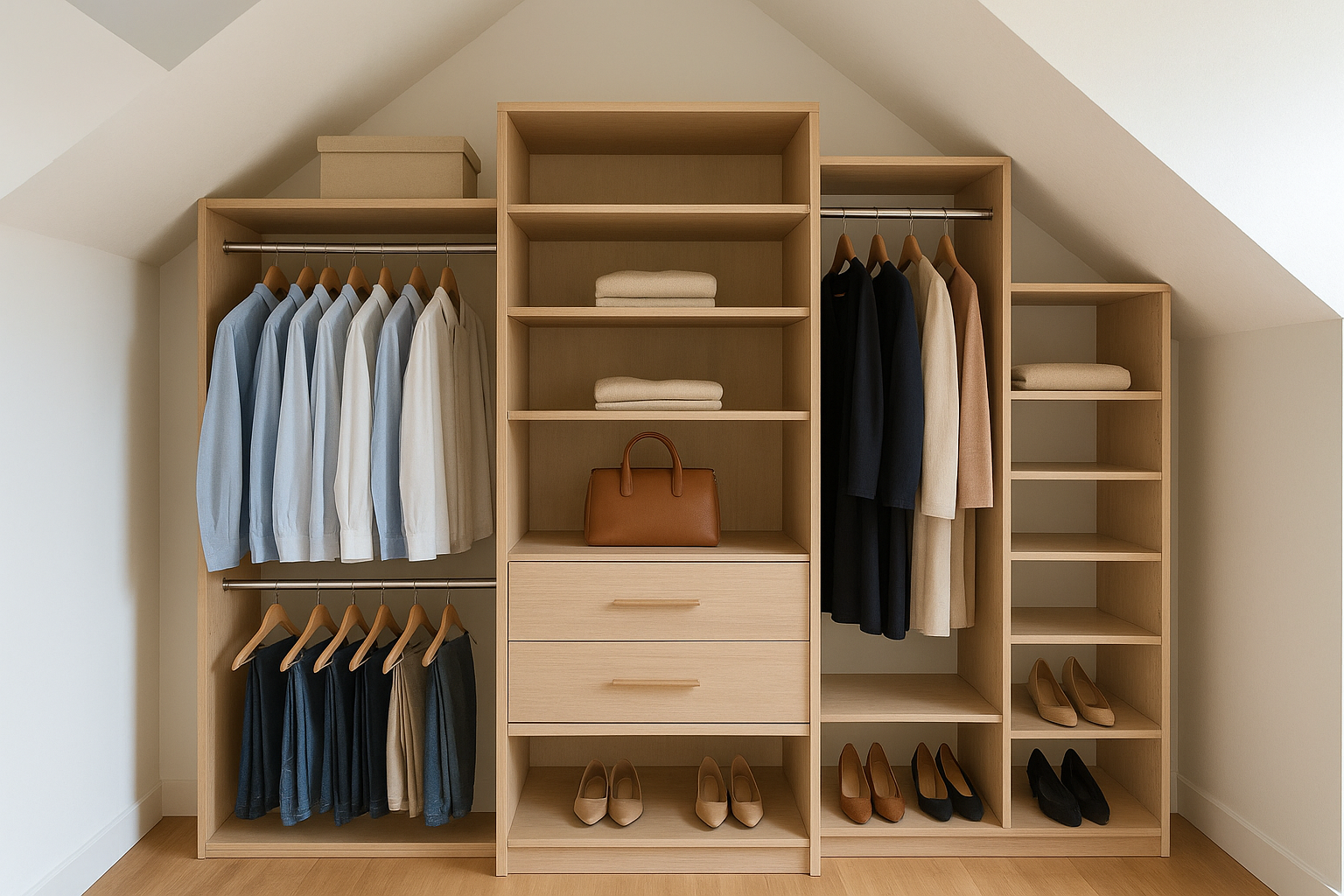
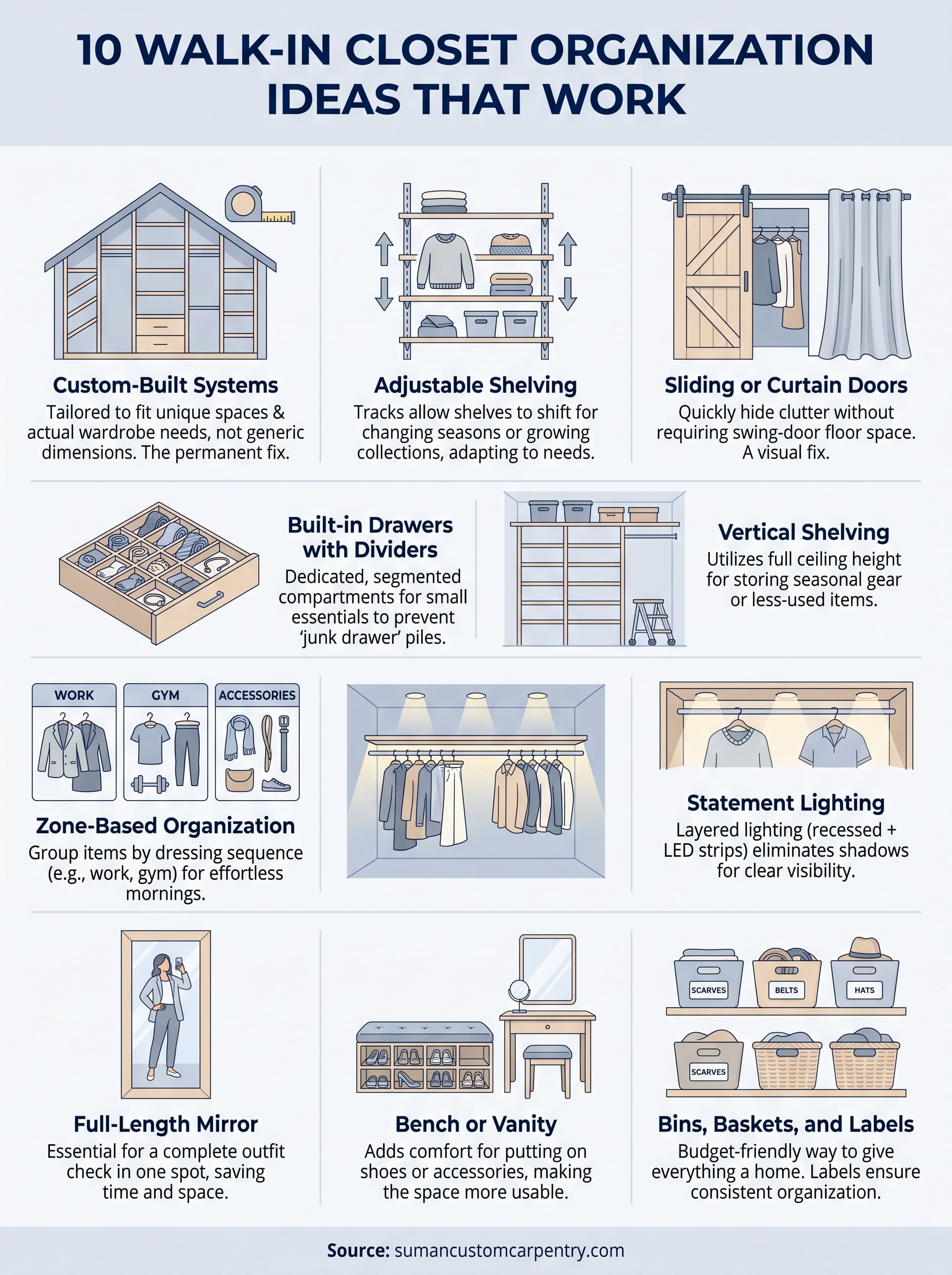
A custom-built system is the closest thing to a permanent fix for a walk-in closet that never quite works. Instead of buying a prefab kit and forcing your clothes to fit its dimensions, a carpenter measures your actual space, including the sloped ceiling or awkward jog in the wall that most stock systems ignore, and builds shelving, rods, and drawers to match. This is where most of the best walk in closet organization ideas actually start, because every other tip on this list works better once the bones of the closet are right.
How it works
Design begins with a walkthrough of your wardrobe, not just the room. A good carpenter asks how many long dresses you own, whether you fold or hang your sweaters, and how many pairs of shoes need a home before drawing anything. From there, the layout gets broken into sections built to those numbers: double-hang rods for shirts, a single tall section for coats and gowns, drawer banks sized for folded items, and open shelving for shoes or bags. In-house construction means every panel is cut and finished to fit your actual wall dimensions, not a generic 12-inch increment.
A closet built around your actual wardrobe outperforms any off-the-shelf system, no matter how many add-ons it comes with.
Best for
This approach suits homeowners planning to stay in their house long enough to want the investment, and anyone dealing with an irregular closet shape that stock shelving units can’t handle. It’s also the right call if you’ve already tried wire shelving or a big-box kit and found yourself back at square one within a year. Coastal Cape Cod homes often have closets built into odd rooflines or dormer spaces, and that’s exactly the situation where custom work earns its cost.
Estimated cost
Pricing depends heavily on size, materials, and how many features you add, but here’s a general range based on typical residential projects:
| Closet size | Basic system | Full custom build with drawers and lighting |
|---|---|---|
| Small (4-6 ft) | $1,500-$3,000 | $3,500-$6,000 |
| Medium (walk-in, 6-10 ft) | $3,000-$6,000 | $6,000-$12,000 |
| Large walk-in or dual-owner closet | $6,000-$10,000+ | $12,000-$20,000+ |
Because the work is hand-built rather than assembled from pre-manufactured parts, expect a longer lead time than a weekend DIY kit, usually a few weeks from design approval to installation. Given the lifetime guarantee that reputable local shops offer on cabinet boxes and doors, it’s worth treating this as a one-time expense rather than something you’ll revisit in five years.
2. Adjustable shelving that adapts as your needs change
Wardrobes shift with the seasons, kids grow, and shoe collections have a habit of expanding. Adjustable shelving solves a problem fixed shelves can’t: it lets you reconfigure the closet without tearing anything out. Instead of committing to one layout forever, you install a track or pin system that lets shelves move up, down, or out entirely as your storage needs change.
How it works
Most adjustable systems use a vertical track mounted to the wall or closet panel, with shelf brackets or pins that slide into pre-drilled holes at regular intervals. Want a taller gap for boots this winter and shorter shelves for folded sweaters next fall? You just unclip the shelf and move it. Better systems pair this with modular shelf inserts, so you can swap a flat shelf for a shoe cubby or a slanted shelf for handbags without any new carpentry. This flexibility is part of why adjustable shelving shows up so often in lists of practical walk in closet organization ideas: it adapts instead of forcing you to adapt to it.
The best closet system isn’t the one that looks perfect on day one. It’s the one that still works in year five.
Best for
Adjustable shelving fits households where storage needs genuinely change, growing kids, seasonal wardrobe swings, or anyone who isn’t ready to commit to a single fixed layout. It also works well as a middle step between wire shelving and a full custom build, giving you real flexibility without the higher price tag of built-in drawer banks.
Estimated cost
Expect $150 to $500 for a mid-size closet if you’re installing a quality track system with solid shelving, versus $50 to $150 for basic wire shelf kits that won’t hold up as long under heavier loads.
3. Sliding or curtain doors that hide the clutter
Even a beautifully organized closet can look messy the moment life gets busy, and that’s where a door makes all the difference. A sliding barn door or a simple curtain panel gives you a way to close off the whole space in seconds, hiding half-folded laundry or shoes waiting to be put away without pretending the closet doesn’t exist. This is one of the simplest walk in closet organization ideas on this list, because it solves a visual problem rather than a storage one, and it does that job well.
How it works
Sliding doors run on an overhead track, either a barn-door style rail mounted above the opening or a bypass track built into the closet frame itself. Curtain doors work even simpler: mount a rod or wire above the entry and hang a fabric panel that pulls closed on rings. Both options skip the swing radius a hinged door needs, which matters in tight bedrooms where floor space near the closet is already tight.
A door doesn’t organize your closet, but it buys you five extra minutes before anyone sees the mess.
Best for
This works best for closets located in shared or high-traffic rooms, guest bedrooms, or anyone who wants a quick visual fix without a full renovation. It’s also a smart choice for renters, since curtain rods and track kits install without permanent changes to the wall.
Estimated cost
Curtain panels and a tension rod run $30 to $80. A quality sliding barn door setup, hardware included, typically lands between $150 and $400 depending on the door material and track length.
4. Built-in drawers with dividers for small essentials
Socks, belts, jewelry, and folded t-shirts are the items that turn a tidy closet into a junk drawer with better lighting. Built-in drawers with dividers solve that by giving every small category its own compartment, so nothing gets tossed into a pile the moment you’re running late. This is one of the walk in closet organization ideas that pays off daily, not just when guests walk through.
How it works
A drawer bank gets installed below your hanging rods, usually at hip height so you’re not bending to the floor for socks. Inside, removable dividers split each drawer into smaller sections, some shops offer felt-lined inserts for jewelry, others use simple wood grids sized to fit folded shirts or rolled ties. Because the drawers are built into the system rather than bought separately, they match the depth and width of the closet exactly, which means no wasted gap on either side.
A drawer without dividers is just a bin with a fancy front.
Best for
This suits anyone with a lot of small accessories, watches, cufflinks, scarves, or folded basics, that don’t have a natural home on a shelf or rod. It’s also a smart addition for shared closets, since dividers let two people keep their small items separated without a system of shoeboxes stacked on the floor.
Estimated cost
A single custom drawer with dividers typically runs $150 to $350 depending on size and insert material, while a full bank of four to six drawers as part of a larger build adds roughly $800 to $2,000 to the project. Standalone furniture-grade dresser inserts cost less upfront but rarely match the fit of a built-in unit.
5. Vertical shelving to use every inch of height
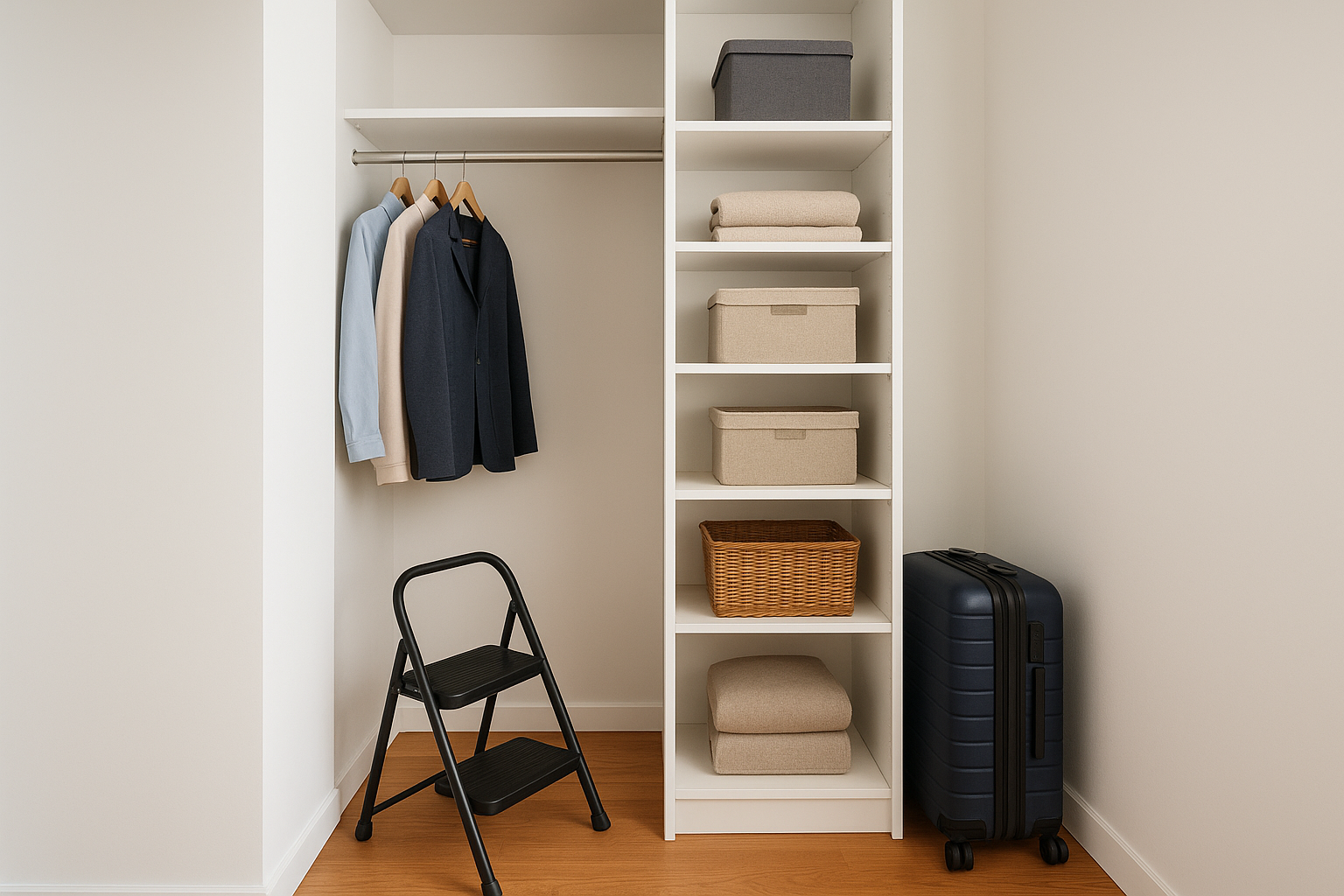
Most walk-in closets stop storing anything useful about five feet up, leaving a dead zone of empty air above your hanging rods. Vertical shelving fixes that by running shelves all the way to the ceiling, turning wasted height into space for bins, off-season clothes, or luggage you only touch twice a year. It’s one of the easiest walk in closet organization ideas to justify, because you’re not adding square footage, you’re just finally using what’s already there.
How it works
Shelving gets stacked in full-height columns, usually along one or both side walls, with closer spacing near the bottom for everyday items and wider gaps up top for bins or boxes. A rolling step stool or a short ladder makes the top shelves practical instead of decorative, since anything you can’t reach becomes clutter you ignore. Some setups also include a slim pull-down rod near the ceiling for rarely worn formal wear, so even the top few feet earn their keep.
If you can see empty wall above your closet rod, you’re storing air instead of clothes.
Best for
This approach suits smaller walk-ins where floor space is tight but ceilings run 8 feet or higher, plus anyone storing seasonal items like ski gear, holiday decorations, or extra bedding. It’s also a smart fit for households that need to store luggage without dedicating a hallway closet to it.
Estimated cost
A basic set of upper shelves added to an existing layout runs $200 to $500 for a mid-size closet. Building full-height shelving as part of a larger custom system typically adds $600 to $1,500, depending on materials and whether you include a pull-down rod.
6. Zone-based organization for effortless mornings
Morning routines fall apart when your closet forces you to hunt for pieces instead of grabbing them in order. Zone-based organization fixes this by grouping items the way you actually get dressed, not by category alone. Work clothes cluster together, weekend gear sits in its own section, and accessories land near the mirror instead of scattered across three shelves. This is one of the walk in closet organization ideas that changes how a closet feels to use, even if nothing about its size or structure changes.
How it works
You start by mapping your daily routine, not your wardrobe. Dressing sequence matters more than clothing type: shirts near pants, belts near the shelf where you grab shoes, jewelry near the mirror or exit. Some homeowners split zones by person in a shared closet, others split by season or activity, like a dedicated corner for gym clothes near a hamper. A carpenter can build labeled sub-sections into an existing shelving layout, or you can simply rearrange what’s already there using consistent bins and hooks to mark each zone.
Organize by how you get dressed, not by what a closet designer thinks looks tidy.
Best for
Zoning works well for busy households, shared closets, and anyone who’s tired of standing in front of a full closet with nothing quick to grab. It’s especially useful for two people sharing one walk-in, since clear zones prevent the daily creep of one person’s clothes taking over the other’s space.
Estimated cost
Rearranging an existing closet into zones costs nothing beyond your time. Adding labeled bins, hooks, or small dividers to support the system runs $30 to $100. Building zoning into a new custom layout adds little to no extra cost, since it’s mostly a planning decision made before construction starts.
7. Statement lighting that brightens every corner
A closet with no real light source turns every outfit decision into guesswork, and a single ceiling bulb rarely reaches the corners where you actually need it. Good lighting is one of the walk in closet organization ideas people skip until they’re squinting at two navy sweaters trying to tell them apart. Once you add proper fixtures, the whole space feels bigger, cleaner, and easier to keep organized, because you can actually see what’s out of place.
How it works
Most closets benefit from layering two types of light rather than relying on one fixture. Recessed ceiling lights spread even brightness across the whole room, while LED strip lighting tucked under shelves or inside drawers eliminates the shadows that a center light can’t reach. Motion sensors are worth adding too, since they turn lights on the moment you walk in and off when you leave, which matters if your hands are already full of hangers. A carpenter can wire lighting directly into a custom build so cords never show, giving the closet a finished look instead of a clipped-on fixture.
A closet you can’t see clearly is a closet you can’t keep organized.
Best for
This upgrade suits any closet without a window, plus larger walk-ins where corners and back walls sit far from the doorway. It’s especially worth it for closets with dark cabinetry or deep drawer banks, where shadows hide small items like jewelry or folded accessories.
Estimated cost
Basic battery-powered LED strips or puck lights run $20 to $60 and install without an electrician. Hardwired recessed lighting with a dedicated switch typically costs $200 to $600 depending on the number of fixtures and whether new wiring needs to be run.
8. A full-length mirror for a complete outfit check
A walk-in closet without a mirror forces you to finish dressing somewhere else, usually in a bedroom with worse lighting and less room to turn around. A full-length mirror keeps the whole process in one spot, letting you check an outfit from shoes to shoulders before you ever leave the room. It’s a small addition, but it’s one of the walk in closet organization ideas that changes daily use more than its size suggests.
How it works
Most setups fall into two categories: a mirror mounted flat on a wall or door, or a freestanding floor mirror that leans against a clear stretch of wall. Door-mounted versions save floor space and work well in tighter closets, while a swing mirror built into a custom system lets you angle the reflection without repositioning your whole body. Placement matters more than size here. A mirror crammed into a corner with a shelf overhead never shows a full outfit, so it needs a clear sightline and enough open floor in front of it to actually stand back.
A closet without a mirror isn’t finished, no matter how organized the shelves look.
Best for
This fits any closet with at least a few feet of open floor space, and it’s especially useful for anyone who dresses for work or events directly from the closet rather than a separate bathroom. Shared closets benefit too, since one shared mirror often works better than two people fighting over bathroom counter space.
Estimated cost
A simple door-mounted mirror runs $30 to $80. A quality freestanding floor mirror typically costs $80 to $250, while a mirror built into a custom closet door or panel adds roughly $150 to $400 depending on frame material and installation.
9. A bench or vanity for comfort and function
Standing closets work fine until you’re pulling on boots or sitting to pick the right pair of earrings. A built-in bench or small vanity gives you a place to sit down, which sounds minor until you’ve tried tying shoelaces while balanced on one foot in a doorway. It’s one of the walk in closet organization ideas that turns a storage room into a space you actually enjoy spending five extra minutes in each morning.
How it works
A bench typically gets built along one wall, often below a window or between two shelving towers, with upholstered seating or a simple wood top depending on the look you want. Many designs hide storage underneath, cubbies for shoes, a drawer for accessories, so the seat earns its footprint twice over. A vanity setup adds a small counter and stool, usually paired with the mirror and lighting already in the closet, so hair and makeup touch-ups don’t require a trip to the bathroom. Carpenters can build either option directly into a custom system, matching the wood tone and hardware to the rest of the closet instead of dropping in a mismatched piece of furniture.
A place to sit turns a closet from a storage room into a room you actually use.
Best for
This addition suits larger walk-ins with a few extra feet of floor space, plus anyone who dresses with accessories, jewelry, ties, watches, that benefit from a flat surface at sitting height. It’s a strong fit for primary bedroom closets shared by two people, where a bench gives both a place to sit without crowding the hanging sections.
Estimated cost
A simple standalone bench runs $100 to $300. A built-in bench with under-seat storage, matched to a custom closet system, typically adds $500 to $1,200, while a full vanity setup with counter and lighting can run $800 to $2,000 depending on materials.
10. Budget-friendly bins, baskets, and labels
Not every closet needs a carpenter, and this last entry proves it. Bins, baskets, and labels are the cheapest of all the walk in closet organization ideas here, and they work in any closet, rented or owned, custom-built or stock wire shelving. If you’re testing whether a zone-based layout or vertical shelving is worth the investment, start here first.
How it works
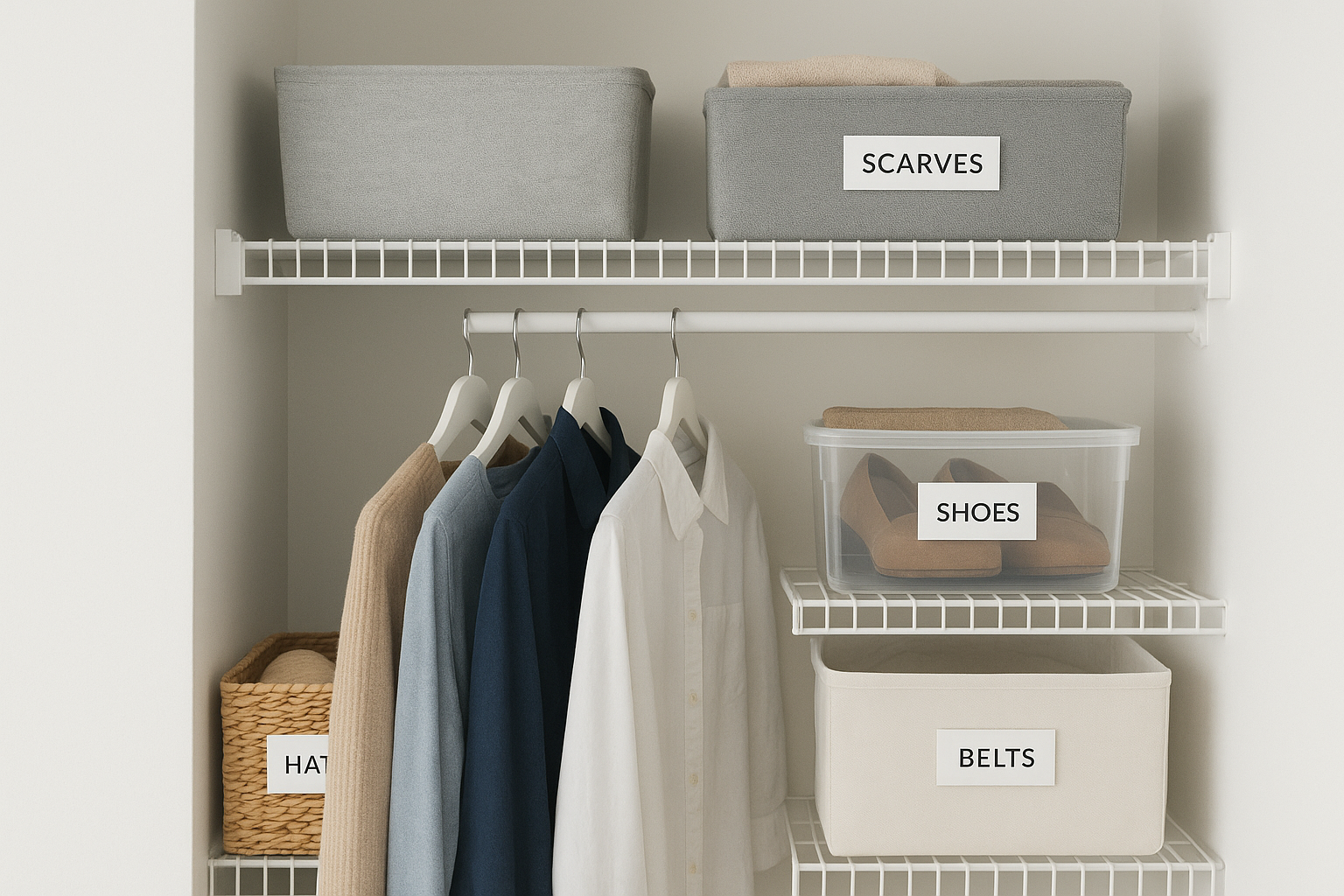
Grab open-top bins for items you grab daily, scarves, gym socks, workout gear, and reserve lidded baskets for things you touch once a season. Labels do the real work: a simple tag on each bin means anyone in the house puts things back where they belong, not just wherever there’s room. Common picks include:
- Woven baskets for shelves, good for folded sweaters or handbags
- Clear stackable bins for shoes, so you can see the pair without opening every box
- Small labeled trays for jewelry or belts inside a drawer
- Fabric cubes for a closet with open cube shelving instead of solid shelves
A labeled bin turns "I’ll deal with it later" into "it already has a home."
Best for
Renters, anyone on a tight budget, and closets that already have decent shelving but no system for what goes where all benefit here. It’s also the fastest fix if you’re short on time before guests arrive or a move-in deadline.
Estimated cost
Basic bins and baskets run $5 to $20 each, so a full closet refresh typically costs $50 to $150 total. A label maker adds another $20 to $40 if you want a more polished, consistent look across every shelf.
Choosing the right approach for your space
Not every closet needs all ten of these fixes. A rented apartment might only call for bins and a curtain door, while a primary suite closet with awkward rooflines is exactly where a custom-built system earns its cost. Start small if you’re unsure: rearrange into zones, add lighting, see how the space feels before committing to drawer banks or a bench. The pattern across every idea here is the same, though. Storage that matches your actual wardrobe always outperforms storage that just looks organized in a photo.
If you’ve tried the budget fixes and you’re still fighting a closet that doesn’t work for your space, that’s usually a sign the layout itself needs rethinking, not another bin. That’s a project worth doing once and doing right. Get in touch with Suman Custom Carpentry to talk through a design built around your closet, your wardrobe, and your Cape Cod home.